Showing posts with label Pomorany. Show all posts

Monday, September 21, 2015

Paul Niznik and Anastasia Justina Romanowicz:Family Genealogy


Paul Niznik married Anastasia Justina Romanowicz in June 1864.  They are my paternal great-grandparents.


Marriage record for Paulus  Niznik and (Anastasia) Justina Romanowicz, June 1864. Their rrecord is the second one on the page. Source: Metrical Books 1837-1882, Greek Catholic Church, Pomorzany (Zborow).  Original manuscripts of the Central State Historical Archives of Ukraine in Lviv. Filmed by the Church of Jesus Christ of Latter Day Saints. Vol. 201-4A/4642.


Paul was 29 years old when he married, and is listed with two occupations: pelleo (person who works with skins and hides) and artilleryman in the service of Duc Leopold of Bavaria. He may have been involved in the the Second War for Italian Independence in 1859. His parents, Ivan Niznik and Maria Gudziak were deceased at the time of the marriage.  Both the Niznik and Gudziak families were in  the skin and hide trade.


The victorious French watch the Austrian Armies retreat after being defeated in the Battle of Magenta, June 1859. The Austrians are on the bottom right of the painting by Ernest Meissonier. One group of Austrian artillery are pulling a cannon as they retreat.
.
Anastasia Justina Romanowicz was 19 when she married Paul Niznik.  Both her parents, Ivan Romanowicz and Agatha Pauluk,  had passed away.  The Romanowicz family were also pelleony.  From what I have found in the Metrical Records, marriages were common between families in the same trade.  Paul and Anastasia were also distant cousins. Permission to marry was given by Andreas Nisnik and Andreas Romanowicz.

After their marriage, Anastasia and Paul went to live in his father's family home, number 287 in Pomorazany. Although Paul's parents were deceased, his stepmother, Maria Materko Niznik was still living in the house.  This home belonged to the Niznik family since 1837, according to the earliest records in the Metrical Records, and probably longer that that. 

Village house, similar to the house in Pomorany where Paul and Anastasia lived when they married.

Since the Metrical Records include only deaths after 1865, I know only one of Paul and Anastasia's surviving children, my grandfather, John Nyznyk, born in 1878. Three of Paul and Anastasia's children died in childhood: Peter,  was born and died on July 15, 1867; Anna, born in 1871, lived for six months; and Varvara, born in 1873, lived one year.  There were most likely more children, but there are no records of their births available at this time.

When I first looked at the marriage record, I wasn't sure that Paul's bride was the same woman listed on my grandparent's marriage license, since her name was Justina, not Anastasia.  A volunteer at the Family History Center told me that when I found a birth record for a child of Anastasia and Paul, her correct first name would be listed.  After searching death records, I discovered that Anastasia used one or both of her given names.  She is listed as Justina on the marriage record; on the death record of son Peter, she is listed as Anastasia, and on the death record of daughter Anna, she is listed as Anastasia Justina.
According to the Metrical Records, the Niznik family name changed spelling three times.  In the oldest records, it is Nisnik.  In the 1850's it is spelled Niznik,  with an umlaut over the z.  In 1867, it is spelled Nyznyk.  In the Metrical Records, the first name was written in Polish, the last name in Latin.  But by the late 1860's the priests were recording names with Ukrainian spellings.

I have a few more Metrical Records for Pomorzany to study.  The records for Ozerna have arrived at the Family History Center, so soon I will begin to research the Kociuba (Koshuba) family.

Sunday, September 13, 2015

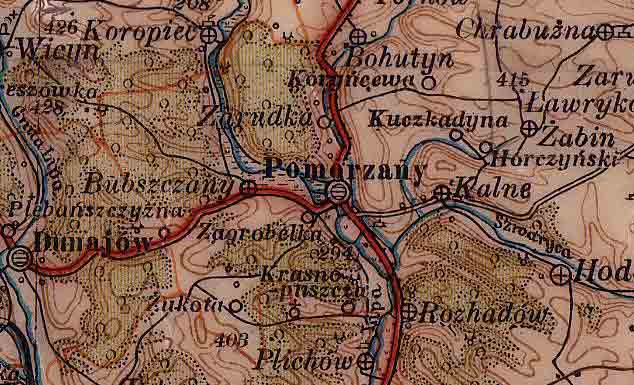
Pomorzany, Pomorany Ukraine: Looking into the Past


Source: luszpinski.net


When I was growing up, I assumed that finding my family history in Eastern Europe was impossible.  I believed that because of the wars, many records were destroyed and when Ukraine became a part of the Soviet Union in 1939, all remaining records were either destroyed or were impossible to access.  Believing this made discovering my family history impossible.

I did have some basic information, my maternal grandmother gave me the names of her grandparents and aunts and uncles, and some information about her childhood.  Her sister wrote a wonderful memoir about growing up in a  Ukrainian village.  Since I had that, I was able to piece together a basic history of the Rychly family in Ukraine.  My maternal grandmother, Pauline Rychly Koshuba Haydak gave me some information about my maternal grandfather's family, the Koshubas.
I had very little information about my father's family, the Klak and Nyznyk families but when my father had to find information in order to get a US passport, he found the names of both his paternal and maternal grandparents. Now I had something to look for.

The Nyznyk family of Pomorzany or Pomorany, is the family about which I know the least.  I have researched my grandfather,  John Nyznyk in New York, but the search information about him goes cold after 1940.  I decided to go back in time and find out about two of my grandparent's families, the Nyznyk and Romanowicz families.  I was lucky that the Family History Center has the Metrical Records from the Greek Catholic Church of Pomorzany from 1837 to 1862 on film.   I have found  have found a lot of ancestors on these films , but I still can't  fit the puzzle pieces together yet.  What I can do is tell about life in this village during the twenty five years between 1837 and 1862.

The Metrical Records are easy to read, since they are written in Latin and arranged in columns.   In 1793, after the First Partition of Poland, the Austrian government required that vital statistics be kept in all areas acquired in the partition. Local Roman and Greek Catholic churches served as recorders of all vital statistics and that two copies of every record be made, one to stay in the church, the other to be kept in another place, in this instance in the city of Lviv.  All birth, death and marriage records were kept by the Greek Catholic and Roman Catholic Churches at first, eventually Jewish synagogues and other Christian denominations were also able to  record and kept vital statistics.  The LDS Church has filmed vital records in many Ukrainian villages and towns  which are kept in Salt Lake City and  are accessible  at  Family History Centers all over the world.
The birth record in Latin and English

Every record includes names, dates and places where the life event occurred.  Sometimes parent's names are included and occupations are noted as well.  Since local clergymen wrote all the information with pen and ink,  they give a look into the past when beautiful penmanship was necessary and appreciated.  First names were recorded in Latin and surnames were listed in Polish.  "Conditio" which means occupation in Latin is noted on all records.  Agricola was the Latin word for farmer, and the most common occupation.  Nyznyk and Romanowicz family members were listed as pelleo, or persons who worked with skins and hides.  Other common occupations were sutor or sudor, shoemaker, and fabrile, a person who works with metal.  In the 1850's laborers began to appear, and mendicane, or beggar was also listed.

Marriage records contained the most information; the names of the persons to be married were listed along with their ages and occupation for the groom. His  parent's names and occupations followed, sometimes the grandparents were also listed with their occupations.  The bride's information was listed in a separate column. The information was similar, but women did not have occupations.     Both the bride's and groom's house numbers were listed.

A example of a marriage record. Source Stumbleblock.wordpress
When a birth was recorded,  the name of the father was listed first, the mother's first name was listed, followed by "daughter of" and her father's first and last name and occupation. The date of birth was listed, followed by the dates of baptism and confirmation. The house number listed where the birth occurred, which was not always in the home of the parents.  Married couples went to live with the husband's parents, so the first child was usually born in their house. A different house number might be listed for the birth of a second child, because the couple now had their own house. In an illegitimate birth, only the mother's name was mentioned. Second marriages were also recorded, but not as much information was included. A death record included the person's age, date of death and burial, and cause of death.

Example of a birth record from 1907, column headings are in Latin and Ukrainian.


In the 1830's, most causes of death were listed as  "ordinario" or ordinary; later,  specific diseases were listed.  In a death entry, a man's name stood alone, but a woman was listed either as "daughter of" followed by her father's name if she was not married,  or "wife or/widow of" followed by her husband's name.  The house number was always included.  From information in the Metrical Records, many more children died than adults.   Very few people lived to a great age, most died in their fifties or sixties.  Common causes of death were convulsions, epilepsy, consumption (tuberculosis), pleurisy, fibrio gastris and cholera. In 1850, eleven people died of fibrio gastris between  the beginning of September and the end of October, mostly adults.  1855 saw a cholera epidemic between July and September.  59 villagers died, mostly children at first, adults later.  In the Gudziak (cousin of the Nyznyk and Romanowicz families) home, four family members died within days of each other, first two daughters, then the father and grandmother.

Death record from 1838.  Source: Kowalfamily.wordpress


Pomorzany grew; in 1837, there were a little over 300 houses, by 1859 there were over 700 houses in the town. Most people stayed in the town, and I saw the same surnames repeated over the 25 years. Cousins often married cousins. Sons followed their father's occupation. Most people married people with the same occupation. The Nyznik  and Romanowicz families worked with leather, and their sons and daughters married children of other leather workers.  When a young married couple could afford their own house, they often moved, and this shows up in a new house number. One change in the records during the 25 years I studied was in 1855 when the column headings were in both Latin and Ukrainian.  The next year, the Ukrainian heading disappeared. In the birth record example above  from 1907, the heading were in both languages.  In  the earliest records, the family surname was spelled Nisnik. In 1856, the spelling changed and it was spelled Niznik.  There were trends in first names: John was always popular for boys, Maria for girls.  Anastasia and Tecla were also popular for girls.  Rarer first names were Erasmus and Procopious and Parascevia and Michalina.
There is more to be learned about Pomorzany, and there are still hundreds of records to be reviewed.

Wooden Church in Pomorzany. Source: Wikimedia.org

Sunday, June 21, 2015

John Nyznyk: My Grandfather, an Enigma


My paternal grandfather John Nyznyk, is an enigma, a mysterious or inscrutable person.  I never met him and have see only two pictures of him, both from his wedding to my grandmother Mary(Maria) Klak in 1914.  There are a few family stories about him, but I have no way of verifying any of them.  In this post, I am using material that has a source--no tales, no hearsay, only the facts.  There are only a few sources that I am sure about--the marriage license, the baptismal certificate of my father and his application for United States citizenship.  There are other documents, but I can't be sure that they are his. His story illustrates the problems of finding information for genealogy research. 
If you know anybody with the name of Nyznyk or Niznik or Nisnik, who has ancestors from Galicia, they may be related to John and could shed some light on his story.
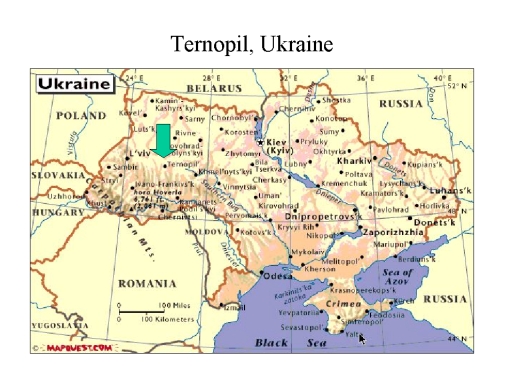
Map of Ukraine, green arrow points to Ternopil'

Pomorjany (Pomorany) is about 15 km SW of Zbirov. and 48 km west of Ternopil"

Arrival in the  United States 1910

John Nyznyk was born on July 27, 1878 in Pomorainy, Galicia, a part of the Austrian-Hungarian.   According to his Declaration of Intent for citizenship, he came to the Port of New York on March 12, 1910 on the Albany.  The Intent (First Papers) was filed on November 19, 1926.  This confirms his date of birth and birthplace. According to the ship's manifest, John arrived in New York on April 1, 1910, on the ship,  S.S. Volturno which sailed from Rotterdam on March 14,1910.  His name is listed as Jan Niznik.  His age is either 22 or 32-- the handwriting is hard to read.  He had $25 with him, he came from the village of Pomorainy in Galicia, his language and ethnicity Ruthenian (Ukrainian) and his occupation was laborer.  He could read and write, and he left his wife Parasia Niznik in Pomorainy.  The ship's manifest also states that he had been in the United States from 1901-1908.  The name and address of the person he was going to in New York is illegible. 

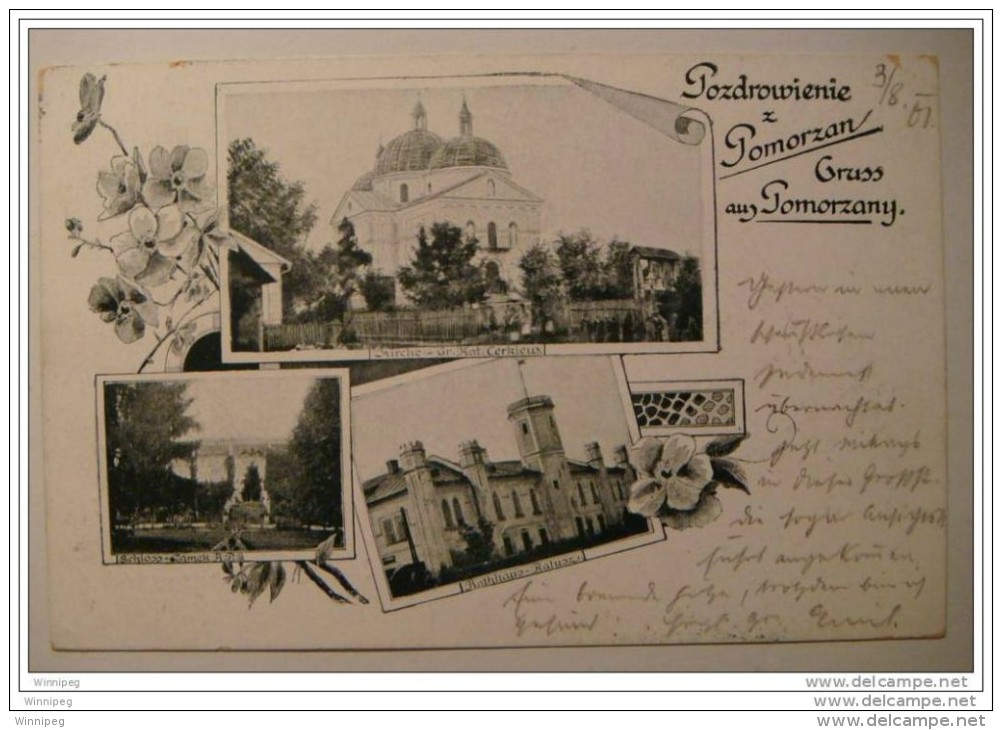
Old postcard sent from Pomorany--Pomorzany in Polish. Source: del campo.net

Marriage to Maria Klak: 1914

John Nyznyk married Mary Klak on November 21, 1914 at St George Greek Catholic Church, 22 East 7th Street, New York, New York.   On the marriage lisence he listed his occupation as a laborer and his residence at 533 East 6th Street, New York, New York.  He also stated that his parents were Paul Nyznyk and Anastasia Romanowicz.  The witnesses to the marriage were Michael Rudnicki (brother-in-law of Mary Klak) and Nicholas Malinowski.  The priest officiating at the wedding was Rev. M. Lysiak.

Birth of son Peter: 1915

Peter Noznick, son of John and Maria Nyznyk was born on August 18, 1915 in New York City at Bellview Hospital. Peter's  surname on the birth certificate was Nausneck, no first name was listed.
According to the Birth Certificate, the family was living at 403 East 92nd St , New York City.  John's occupation was listed as harness maker.  Peter was baptised at St George Church on September 12, 1915. On the Baptismal Certificate his name was listed as Peter Paul Nyzny .  His baptismal sponsors were Michael Rudnicki and Ksenia Malynowska (also a relative of Peter's mother). The officiant was Rev. Pidhorecky.

World War I Draft Registration: 1918

In 1918, all men were required to register for the draft since the United States had just entered World War One. I found a Registration Card for a John Naznak,  with a birth date of July 27, 1876.  I think that this might be my grandfather, but the birth date listed is two years earlier than the birth date on his marriage license.  His residence is 123 Avenue A, Room 12, New York City.  His occupation is listed as upholsterer, his employer is  Liberty Auto Trimming Company.  He is described at tall, slender with grey hair and brown eyes.  He also states that he has filed papers for citizenship, which is different from his Intent papers which he filed eight years later.

United States Census: 1920

According to the 1920 Census, John Noznok was living at 613 East Eleventh St in New York City.  There are several discrepancies in this Census record, so I am not sure that this man is my grandfather.  His age is 42, born in 1878, and he states that he is married and that he has filed first papers.  His occupation is listed as a trimmer in an auto factory.  His year of immigration is listed as 1913, his birthplace is listed as Galicia and his mother tongue is Ruthenian (Ukrainian.) The only information that is consistent with other sources is his age, native language and birthplace and that he is married.

Declaration of Intent to file for United States Citizenship 1926

John filed his Declaration of Intention for US citizen ship in 1926 in the Southern District of New York.  He states that his name is John Nyznyk, he was born on July 27, 1878 in Pomorainy,  Austria.  His physical description lists his complexion as dark, his height as 5 feet, seven inches, his hair gray and his eyes brown.  His occupation is upholsterer.  His says that he is married and his wife Mary, born in Austria, who lives with him at 138 East Third Street, New York City.  He also says that he came to the United States on the ship Albany, on March 12, 1910.  He does not mention that he has any children.  He signed his name "John Nyznyk" and the signature looks similar to his signature on World War I registration document. The date of filing is November 19, 1926.

Petition for United States Citizenship 1930

John Nyznyk's Petition for Citizenship was filed on April 8, 1930.  He lists his address as 533 East 6th Street, New York City, the same address as he had when he married in 1914.  He says that he  married Mary on November 21, 1914, and that her residence was unknown to him since 1915. He also states that she came to the United States in 1916 or 1917. He said that he has two children, Michalina born in 1910 and Paul, born in 1904.  He also states that his wife, Anna Kowalsky died in 1913.  He does not mention my father Peter at all.  He said that he came  to the United States on June 6, 1910 on the ship Niew Amsterdam, which left from Rotterdam, under the name Jan Niznik.  His two witnesses confirming residency were Michael Pochmarsky and Stephen Hysa, both of New York.  On November 10, 1930, he received certification of his citizenship by the US District Court at New York City, New York, petition number 167317. Again, inconsistencies are present in this document.  His date of immigration and name of ship differ from the Declaration of Intent. The information about wife Mary contradicts what he stated in the Declaration of Intent as well.

 My Conclusions--based on the information I have

There are quite a few discrepancies in John's petition. According to his Petition (1930), he arrived on June 6, 1910 on the Niew Amsterdam.  According to the ship's manifest (1910), he arrived in New York on June 1, 1910 on the S.S. Volturno.  The wife listed on the ship's manifest was Parasia, not Anna. If he had been in the United States from 1901-1908(Manifest), he probably wasn't the father of Paul, born in 1904(Petition).   In the Petition, he does not mention that he has a third child, my father, born in  New York in 1915.  He states in the Petition that his second wife's residence was unknown to him since 1915, but in his Declaration (1926) of Intent, he stated that he was living with her.

I do not think that the Jan Niznik on the ship's manifest is my grandfather.  There are three ships mentioned, the Albany, The Niew Amsterdam and the Volturno-- on which ship did he arrive?  It doesn't seem that the  authorities who determined  his citizenship cross checked the sources.
Although John could read and write, I doubt that he had the knowledge to do the research necessary to find the records he needed.  He probably had to hire somebody to find that information.  So after studying the sources, I have concluded that the only information about John that is consistent is his name, birth date and physical description, place of birth and native language.  His story did not end in 1930--I will revisit it next week.