Showing posts with label Zarvanytsia. Show all posts

Friday, September 20, 2013

ZARVANYTSIA, UKRAINE

Icon of the Mother of God
The Church of the Nativity of The Mother of God and bell tower in Zarvanytsia.
I have posted  a UTube video of the Shrine at Zarvarnytsia.  It includes the Church, the icon, the area and the spring.  It is in a separate blog post, which you can find on my blog.

Zarvanytsia was the birthplace of my grandmother, Marya Klak.  It is a small village of about 300 people,located on the Strypa River, about 30 miles southwest of Ternopil', Ukraine.  In spite of its small size, it is a very important place for Ukrainians of the Ukrainian Catholic Church.  Varvanytsia is visited by hundreds of thousands of Ukrainian Catholics every year, who come to see the Icon of the Virgin Mary and drink water from its spring, which is said to have miraculous powers.
I had heard of this town from my father, who said that there was a special spring, that was filled in when Ukraine was part of the Soviet Union.  I really didn't realize that it was famous and important until I met someone who had visited there recently.  Then I did some research, and realized how important this place is to  the Ukrainian people.  The story of the founding of  Zarvanytsia started in the 13th century.

In 1240, a monk left Kiev, because of a Mongol invasion.  He stopped near the Strypa River, since he was injured, drank the water of the spring, fell asleep and saw a vision of the Mother of God, The Virgin Mary.   When he woke up, his injuries were healed, and he found the icon nearby.  He decided to stay and build a chapel to house the icon.  As people heard about the miraculous powers of spring, and the icon, a duke came there and was healed , and in thanks, built a monastery there.  Eventually a town grew up there, and although there were invasions by the Turks, the icon survived, and another church was built.  The fourth church,  Holy Trinity, built in 1754 of stone, survives today.  My Grandmother must have been familiar with this church. I have tried to include a picture of this church, but since I can't read Ukrainian, I wasn't sure of the names of the many church photos that I found, so that will have to appear another time.

Old wooden church in Zarvanytsia


During World War I, the church and monastery was damaged, but was rebuilt in 1922.  When the Soviets took over Western Ukraine in 1939, the monastery was destroyed and the became a warehouse and the spring was filled in and used as a dump.  Like the people of Poland,  the people of Zarvanytsia kept their faith alive by going underground, holding services in private homes or in the surrounding forests.  The icon was hidden and survived World War I, World War II and the Soviet rule of Ukraine.
In 1991, when Ukraine declared its independence from the Soviet Union, the church was repaired, the chapel at the spring was rebuilt, and the spring was usable again.  A new and much larger church was built, and the monastery was reopened.   A new church, The Nativity of the Mother Of God was build as well.  
Zarvanytsia is a destination for Ukrainian pilgrims from around the world.  Most of the new buildings  were paid for by donations Ukrainians who live in countries around the world.
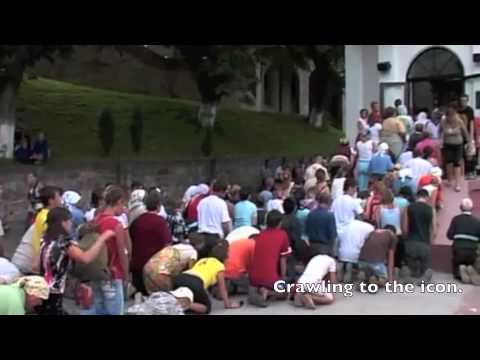

Pilgrims on their knees, approaching the Church and the icon.

The Icon of the Mother of God, notice the chains and medals on either side of the icon, which were left by pilgrim and others who were healed.


Friday, August 30, 2013

THE GENEALOGY OF MARYA KLAK


Marya Klak, my paternal grandmother, wasa born in Zarvanytsia, Ukraine in 1889, the daughter of Joseph Klak and Anna Domerecka.  She had two brothers, Ivan and Andrij, and one sister, name unknown.  According to my father, Peter Noznick,  both her parents died when she was young, leaving the children orphans.   She was twenty-two when she came to the United States, her passage paid for by her brother.  My father said that since her family was so poor, her chances of marriage were unlikely.  She left Zarvanytsia in March of 1911, and sailed from Hamburg, Germany to New York, arriving on April 9, 1911.  As the ship neared New York Harbor, the steerage passengers came on the deck and watched for the Statue of Liberty. When the Statue came into view, the passengers fell on their knees and thanked God that they were in America.

Marya Klak, between 1911-1914
Marya went to live with her sister and brother-in-law, on Houston Street, in New York City.  She worked as a live-in maid for a family who lived on Riverside Drive.  They story my father told me was that her employer was a famous actress, but I can't remember her name.

Marya Klak and John Nyznyk, November 11, 1914


She married John Nyznyk on November 11, 1914, in St. George Ukrainian Catholic Church, in New York City.  Although Marya was Polish, her husband was Ukrainian.  He was a harness maker, and according to family stories, served in the Austrian Army.  He also was a widower, and father of two children, Paul and Michelina, who were living in his home town of Pomorzany.  My father, Peter Paul, was born August 18, 1915 in Bellvue Hospital.   At the time, Marya and John were living on East 92nd Street in New York City. 

Shortly after Peter's birth, John and Marya separated. I haven't found any records of where Marya and Peter lived during this time, but I have to assume that they lived with members of her family in New York City.  My father  told me that his mother found a day nursery where working mother could leave their children, and enrolled him there. Later, she enrolled him in a school operated by the Children's Aid Society of New York, where he attended until the fourth grade. Marya worked several jobs, including a summer as a cook for a children's camp in upstate New York.  My father stayed with a family in the area and he remembers their collie dog fondly.

Peter Noznick in Central Park NYC 1920's

Peter Noznick 1917


Sometime between 1915 and 1920, Marya met and married Peter Zackowski, another Polish immigrant.  The family lived on Ave C across from the Eagle Pencil Factory. There was a fire station nearby and the horse drawn steam fire engines terrified my father.  They moved to 624 East Eleventh St, between Avenue B and C, and lived there until they moved to Connecticut. They worked several jobs and saved every penny until they had enough money to buy a farm in Windham Connecticut in 1930.  Moving to an old colonial house was a big change for Marya, she had never lived in a house that large in her life.  She wall-papered every room and furnished it with pieces from area farm sales.
Sometime during these years, she became known as Mary.


The Farm in Windham Connecticut, 1940's


Marya lived in Connecticut for the rest of her life.  She missed living in New York and having her friends and family nearby.  She did see them regularly, since they came to the farm for visits almost every summer.  They called her "Choch" which was a shorted form of auntie in Polish.  Marya and Peter ran a dairy farm until the late 1950's, when electric milking machine became the norm.  They continued to sell milk, eggs and hay into the 1960's.  Her son, Peter had three children, Pauline, Peter and Andrew, who spent many summers at the farm.  There was plenty to do there, even through there was no TV. There wan an old radio and an old Victrola record player, which required cranking to operate, as well as 100 acres of farmland and woods to explore.

Mary and her cows, Windham Center Connecticut 1960's

Mary Zackowski, Peter, Julia, Pauline and Peter Noznick 1949


Peter  Zackowski died in 1963. Shortly after his death, some friends brought Mary a puppy, who she named Skipper,  he was her companion for the last years of her life.  Mary died in 1969, a few weeks before the Astronauts landed on the moon. Peter and Mary Zackowski are buried in the Windham Center Cemetery, next to son and daughter-in-law Peter and Julia Noznick.