Friday, September 25, 2015

War Memorials on Chicago's North Shore: Highland Park Illinois

The World War One Memorial in Highland Park Illinois. Source: Waymarking.com


Located in Memorial Park in Highland Park Illinois, a suburb north of Chicago, this memorial is a combination of a bronze sculpture mounted on a granite background. It was dedicated on November 14, 1926.  The funds to build the monument were raised by residents of Highland Park.
  
The sculpture, designed by James Cady Ewell, a Highland Park  artist and resident, depicts a female figure  representing World War One.  On either side of the figure, mounted bronze tablets list the names of  278 Highland Park men and women who served in the War.  On the arch behind the figure, "Peace Victorious" is inscribed. The back of the memorial is inscribed "For your tomorrow, They gave their today ."
The list of is long, surprising since the town of Highland Park is not large today, and was even smaller during World War One.

Memorial Park is near downtown Highland Park between Laurel, Prospect and Linden Avenues.

I came across this World War I memorial on my way to a local rummage sale.  I tried to take a picture of it with my phone, but the lighting was poor, so I decided to use the snowy picture above instead.

Monday, September 21, 2015

Paul Niznik and Anastasia Justina Romanowicz:Family Genealogy


Paul Niznik married Anastasia Justina Romanowicz in June 1864.  They are my paternal great-grandparents.


Marriage record for Paulus  Niznik and (Anastasia) Justina Romanowicz, June 1864. Their rrecord is the second one on the page. Source: Metrical Books 1837-1882, Greek Catholic Church, Pomorzany (Zborow).  Original manuscripts of the Central State Historical Archives of Ukraine in Lviv. Filmed by the Church of Jesus Christ of Latter Day Saints. Vol. 201-4A/4642.


Paul was 29 years old when he married, and is listed with two occupations: pelleo (person who works with skins and hides) and artilleryman in the service of Duc Leopold of Bavaria. He may have been involved in the the Second War for Italian Independence in 1859. His parents, Ivan Niznik and Maria Gudziak were deceased at the time of the marriage.  Both the Niznik and Gudziak families were in  the skin and hide trade.


The victorious French watch the Austrian Armies retreat after being defeated in the Battle of Magenta, June 1859. The Austrians are on the bottom right of the painting by Ernest Meissonier. One group of Austrian artillery are pulling a cannon as they retreat.
.
Anastasia Justina Romanowicz was 19 when she married Paul Niznik.  Both her parents, Ivan Romanowicz and Agatha Pauluk,  had passed away.  The Romanowicz family were also pelleony.  From what I have found in the Metrical Records, marriages were common between families in the same trade.  Paul and Anastasia were also distant cousins. Permission to marry was given by Andreas Nisnik and Andreas Romanowicz.

After their marriage, Anastasia and Paul went to live in his father's family home, number 287 in Pomorazany. Although Paul's parents were deceased, his stepmother, Maria Materko Niznik was still living in the house.  This home belonged to the Niznik family since 1837, according to the earliest records in the Metrical Records, and probably longer that that. 

Village house, similar to the house in Pomorany where Paul and Anastasia lived when they married.

Since the Metrical Records include only deaths after 1865, I know only one of Paul and Anastasia's surviving children, my grandfather, John Nyznyk, born in 1878. Three of Paul and Anastasia's children died in childhood: Peter,  was born and died on July 15, 1867; Anna, born in 1871, lived for six months; and Varvara, born in 1873, lived one year.  There were most likely more children, but there are no records of their births available at this time.

When I first looked at the marriage record, I wasn't sure that Paul's bride was the same woman listed on my grandparent's marriage license, since her name was Justina, not Anastasia.  A volunteer at the Family History Center told me that when I found a birth record for a child of Anastasia and Paul, her correct first name would be listed.  After searching death records, I discovered that Anastasia used one or both of her given names.  She is listed as Justina on the marriage record; on the death record of son Peter, she is listed as Anastasia, and on the death record of daughter Anna, she is listed as Anastasia Justina.
According to the Metrical Records, the Niznik family name changed spelling three times.  In the oldest records, it is Nisnik.  In the 1850's it is spelled Niznik,  with an umlaut over the z.  In 1867, it is spelled Nyznyk.  In the Metrical Records, the first name was written in Polish, the last name in Latin.  But by the late 1860's the priests were recording names with Ukrainian spellings.

I have a few more Metrical Records for Pomorzany to study.  The records for Ozerna have arrived at the Family History Center, so soon I will begin to research the Kociuba (Koshuba) family.

Sunday, September 13, 2015

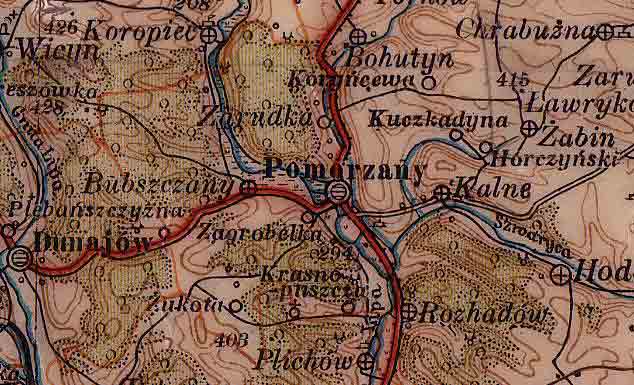
Pomorzany, Pomorany Ukraine: Looking into the Past


Source: luszpinski.net


When I was growing up, I assumed that finding my family history in Eastern Europe was impossible.  I believed that because of the wars, many records were destroyed and when Ukraine became a part of the Soviet Union in 1939, all remaining records were either destroyed or were impossible to access.  Believing this made discovering my family history impossible.

I did have some basic information, my maternal grandmother gave me the names of her grandparents and aunts and uncles, and some information about her childhood.  Her sister wrote a wonderful memoir about growing up in a  Ukrainian village.  Since I had that, I was able to piece together a basic history of the Rychly family in Ukraine.  My maternal grandmother, Pauline Rychly Koshuba Haydak gave me some information about my maternal grandfather's family, the Koshubas.
I had very little information about my father's family, the Klak and Nyznyk families but when my father had to find information in order to get a US passport, he found the names of both his paternal and maternal grandparents. Now I had something to look for.

The Nyznyk family of Pomorzany or Pomorany, is the family about which I know the least.  I have researched my grandfather,  John Nyznyk in New York, but the search information about him goes cold after 1940.  I decided to go back in time and find out about two of my grandparent's families, the Nyznyk and Romanowicz families.  I was lucky that the Family History Center has the Metrical Records from the Greek Catholic Church of Pomorzany from 1837 to 1862 on film.   I have found  have found a lot of ancestors on these films , but I still can't  fit the puzzle pieces together yet.  What I can do is tell about life in this village during the twenty five years between 1837 and 1862.

The Metrical Records are easy to read, since they are written in Latin and arranged in columns.   In 1793, after the First Partition of Poland, the Austrian government required that vital statistics be kept in all areas acquired in the partition. Local Roman and Greek Catholic churches served as recorders of all vital statistics and that two copies of every record be made, one to stay in the church, the other to be kept in another place, in this instance in the city of Lviv.  All birth, death and marriage records were kept by the Greek Catholic and Roman Catholic Churches at first, eventually Jewish synagogues and other Christian denominations were also able to  record and kept vital statistics.  The LDS Church has filmed vital records in many Ukrainian villages and towns  which are kept in Salt Lake City and  are accessible  at  Family History Centers all over the world.
The birth record in Latin and English

Every record includes names, dates and places where the life event occurred.  Sometimes parent's names are included and occupations are noted as well.  Since local clergymen wrote all the information with pen and ink,  they give a look into the past when beautiful penmanship was necessary and appreciated.  First names were recorded in Latin and surnames were listed in Polish.  "Conditio" which means occupation in Latin is noted on all records.  Agricola was the Latin word for farmer, and the most common occupation.  Nyznyk and Romanowicz family members were listed as pelleo, or persons who worked with skins and hides.  Other common occupations were sutor or sudor, shoemaker, and fabrile, a person who works with metal.  In the 1850's laborers began to appear, and mendicane, or beggar was also listed.

Marriage records contained the most information; the names of the persons to be married were listed along with their ages and occupation for the groom. His  parent's names and occupations followed, sometimes the grandparents were also listed with their occupations.  The bride's information was listed in a separate column. The information was similar, but women did not have occupations.     Both the bride's and groom's house numbers were listed.

A example of a marriage record. Source Stumbleblock.wordpress
When a birth was recorded,  the name of the father was listed first, the mother's first name was listed, followed by "daughter of" and her father's first and last name and occupation. The date of birth was listed, followed by the dates of baptism and confirmation. The house number listed where the birth occurred, which was not always in the home of the parents.  Married couples went to live with the husband's parents, so the first child was usually born in their house. A different house number might be listed for the birth of a second child, because the couple now had their own house. In an illegitimate birth, only the mother's name was mentioned. Second marriages were also recorded, but not as much information was included. A death record included the person's age, date of death and burial, and cause of death.

Example of a birth record from 1907, column headings are in Latin and Ukrainian.


In the 1830's, most causes of death were listed as  "ordinario" or ordinary; later,  specific diseases were listed.  In a death entry, a man's name stood alone, but a woman was listed either as "daughter of" followed by her father's name if she was not married,  or "wife or/widow of" followed by her husband's name.  The house number was always included.  From information in the Metrical Records, many more children died than adults.   Very few people lived to a great age, most died in their fifties or sixties.  Common causes of death were convulsions, epilepsy, consumption (tuberculosis), pleurisy, fibrio gastris and cholera. In 1850, eleven people died of fibrio gastris between  the beginning of September and the end of October, mostly adults.  1855 saw a cholera epidemic between July and September.  59 villagers died, mostly children at first, adults later.  In the Gudziak (cousin of the Nyznyk and Romanowicz families) home, four family members died within days of each other, first two daughters, then the father and grandmother.

Death record from 1838.  Source: Kowalfamily.wordpress


Pomorzany grew; in 1837, there were a little over 300 houses, by 1859 there were over 700 houses in the town. Most people stayed in the town, and I saw the same surnames repeated over the 25 years. Cousins often married cousins. Sons followed their father's occupation. Most people married people with the same occupation. The Nyznik  and Romanowicz families worked with leather, and their sons and daughters married children of other leather workers.  When a young married couple could afford their own house, they often moved, and this shows up in a new house number. One change in the records during the 25 years I studied was in 1855 when the column headings were in both Latin and Ukrainian.  The next year, the Ukrainian heading disappeared. In the birth record example above  from 1907, the heading were in both languages.  In  the earliest records, the family surname was spelled Nisnik. In 1856, the spelling changed and it was spelled Niznik.  There were trends in first names: John was always popular for boys, Maria for girls.  Anastasia and Tecla were also popular for girls.  Rarer first names were Erasmus and Procopious and Parascevia and Michalina.
There is more to be learned about Pomorzany, and there are still hundreds of records to be reviewed.

Wooden Church in Pomorzany. Source: Wikimedia.org

Saturday, August 29, 2015

Check Out FamilySearch and The Family History Center


I am very fortunate to have a Family History Center in the town where I live.
I have visited several times and found that the volunteers are helpful and knowledgeable, but I really didn't do research there until this summer.
I have always used on line search sites for genealogical research, and found them to be very useful but now I have run into several roadblocks in my search  and the commercial sites are not giving me any new information.  I decided to take the plunge and try the Family History Center to find the information I was seeking.
The Family History Centers are a part of the Church of Jesus Christ of Latter Day Saints,  also known as LDS or the Mormon Church.  The centers are open to anybody who wants to use their resources for genealogy.  There is no charge to use the materials in the Family History Center and no one will ask you anything about religion.   You do not have to be a member of the LDS church to use the materials and get help on your research. The LDS Church,  has the large repository of genealogical materials in the main library in Salt Lake City, Utah, so it was the logical place to start.


The Family Search Web Site

The Family History Search is an excellent web site which is also free.  It is a good place to start family research, and to start a family tree.  The family tree is easy to use and will give hints to help you build your tree. It is as good and easy to use as any of the commercial genealogy or family tree sites.
The site has a search option which gives access to the materials in the LDS Library in Salt Lake City.  When you click on the search option, there are four choices:

Records: 

Enter the name of a deceased ancestor and get information from records such as census forms, death records etc.  There are Tips on searching records in this section. I entered my great grandfather's name and within minutes, I had a list of information about him. You can also search by place by clicking on a map of the world.  You will find a list of information about that particular area.

Catalog: 

Search here to find information in the vast collection of the LDS library.  When you find what you want, you can order the material and it will be delivered to a local Family History center within a few weeks. You can search by place or name.  You will get a list of resources that are available.  You can order the resource and it will be shipped to the nearest Family History Center.  The resources are available for your use for several months.

Wiki:  

This is Great!  A good place to start if you are new to genealogy.  There is information on how to start the genealogy the research process. I decided to search by place and typed in "Galicia Ukraine", and got 54 results, included gazetteers, articles, and data bases.  I have not used this feature until today, but I have already printed an article about house numbers in Galician Records, which explains how every house in every town and village was numbered.


The Family History Center 

Every  LDS Church includes a Family History Center.  The centers are staffed by knowledgeable volunteers who are willing to help beginners and experienced researchers.  There are books, microfilms,  computers and microfilm and film readers in the centers.  The centers also have forms which help researchers to organize their information.  The Family History Centers are easy to locate on the FamilySearch.org web site.  This is the place where films and microfiche are sent, and the viewers to read them. Check on line for the location and hours for the Family History Center closest to you.
Volunteers catalog genealogy records.

Tuesday, August 18, 2015

"May You Live in Interesting Times"--My Father and the Last 100 Years


Today, August 18, 2015, is the 100th anniversary of my Father's birth. 
 Peter Paul Noznick 1915-2005

The Chinese have a saying--"May you Live in Interesting Times."
In his 90 years of life, my Father,  Peter P. Noznick lived in very  interesting times, and experienced life changing inventions and world changing events.  The events and inventions I have listed happened during my Father's lifetime; between 1915 and 2005.  All the inventions were either invented or put into use between 1915 and 2005.
If I missed something important that you thing should be on the list, please add it in a comment.


Events That Changed the World

World War One
The Treaty of Versailles (its consequences still affect our lives today.)
World War Two
The founding of the United Nations
The Korean War
The Viet Nam War
Iraq War I and Iraq War II.
The Bolshevik Revolution and establishment of the Soviet Union.
Peter around 1917
Womens Suffrage: 19th Amendment, 1920
World Wide Depression on 1929-1940.
The New Deal legislation
Hitler's Rise to power 1932-1945.
The Holocaust.
The first use of the Atomic Bomb 1945
The Cold War. 1945-1991
Collapse of the Soviet Union 1991
Independence of the countries of Central and Eastern Europe after 1991
Social Security
Medicare
The United States Space Program
The moon landing in 1969.
The rise of China as a economic power.
The 911 Attack on the United States in 2001
Terrorism, local and international
Peter in Junior High 1929

Inventions That Changed People's Lives

Clean drinking water
Victor Talking Machine--first commercial phonograph 
Long distance telephone service
Transcontinental telephone service
Automobiles --mass produced and affordable
Air planes
Electrical power, electric light and electric powered appliances.
The electric refrigerator
The automatic washing machine and dryer.
Radio--available and inexpensive
Movies 
Movies with sound and color
Animated feature length movies
Television and color television
Video Tapes and players
Penicillin and other antibiotics
The Polio Vaccine
Vaccines to prevent childhood illnesses
Transistors which made portable radios and personal computers possible
Jet Travel to just about anywhere
The Interstate Highway system.
Nuclear power 
Sunglasses
Frozen Food
Shopping carts
The supermarket
Peter, University of Connecticut 1938
Deodorant
The credit card
The portable defibrillator
Digital cameras
Telecommunication satellites
The United States Space program
Cell phones
Air conditioning
Computers
Personal Computers
Portable computers and tablets.

Things  We Need 

A cure for diseases such as Parkinson's Disease, Multiple Sclerosis and Lou Gehrig's Disease
A cure for cancer
Peace in our cities and communities
World Peace


Peter at work, Beatrice Foods Co, 1970's


Monday, August 10, 2015

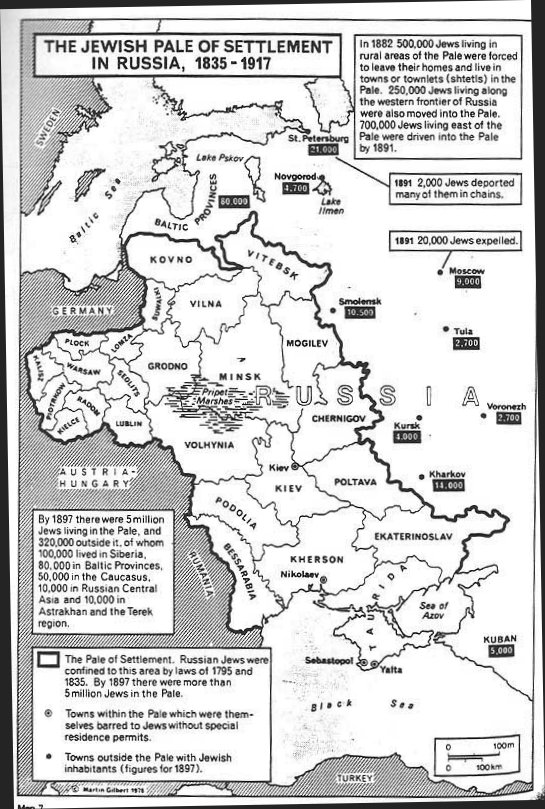
The Partitions of Poland, The Pale and The Shtetl


Catherine II of Russia, Joseph II of Austria and Frederick the Great of Prussia decide how to cut up Poland.
This story starts with secret pacts which change the map of Europe and ends with the First World War.  The Polish-Lithuanian Commonwealth, was a huge state of over one million km in Central and Eastern Europe established in 1569 by the Union of Lublin.  It was ruled by an hereditary nobility, which elected its King. By the middle of the 18th century, it was weakened by  many years of war and  controlled by Russia. In 1730, the rulers of Austria, Prussia and Russia signed a secret pact to maintain Polaand's status, keeping it weak.  They also decided how to divide the Commonwealth up at some future time.

 The Partitions of Poland

In August 1772, Austrian, Prussian and Russian armies invaded Poland and took over 30% of its land, according the the agreement of 1730.  Although the Poles fought back, they lost, and a treaty was signed on September 22, 1792.  Prussia took parts of Northern Poland, enlarging its eastern territories.  Austria gained all of Galicia and other sections of "lesser Poland."  Russia, the strongest power, took over Belarus and a part of northeast Poland known as Livonia. Poland still existed, but was significantly weakened by the First Partition.
The Second Partition, in 1773, Russia and Prussia took more Polish land, leaving only one third of the Polish-Lithuanian Commonwealth. Austria did not participate in this partition. 
In 1795,  the  Third Partition, Poland disappeared from the map of Europe.  In total, Russia now controlled 66% of Poland, Prussia 19% and Austria 14.5%.  Russia was the dominant power in Central and Eastern Europe, a quest started by Peter the Great and completed by Catherine II, also called The Great. 

The effects of the Partitions were enormous.  Poland disappeared as a country for 123 years.  Prussia was on its way to becoming a major European power.  Austria, the weakest power of the three, was now the ruler of many  competing ethnic groups, one of many factors that would lead to its end in the First World War.  Russia was now the ruler of many non-Russian people, including one million Jews.  Many Polish Jews  found themselves living in Russia which was not as tolerant or understanding of their religion or culture as Poland. 

The Pale of Jewish Settlement

"Pale" is and English term which originally referred to the lands of the "Wild Irish", which were considered to be "Beyond the Pale" during the time when the English were settling Northern Ireland with English and Scottish people in the 17th century during the rule of James I. 


In Russia,  The Pale was the area where the Jewish population was required to live. The Pale was over one million square km, and included  all of Lithuania Belarus, and Moldava  and parts of  Poland and Ukraine. 
Before the First Partition of Poland, there was a very small Jewish population in Russia.  The Russian way of dealing with Jews was to force them to convert to the Russian Orthodox religion or leave.  The Russian Tsars were fearful of incorporating the large Jewish population into their society and stated the official reason for the Pale was to protect the "Russian people from economic enslavement that might be imposed on them by the Jews." 

In Russia, Jews had only the rights specifically given to them by the government.  Jews were required to live in the Pale, had limited educational opportunities,  were forbidden to own land, and were restricted to  certain occupations.  They could not live in the capital cities of St Petersburg, Moscow, Kiev, or Nikoleav, Sevastopol and Yalta in the Crimea.They could not live in peasant villages.   Most Jews lived in small towns and cities, and worked in  commerce and crafts.   The Jewish population of the Pale grew from one million to five million between 1800 and 1900, resulting in an over concentration of Jews in small number of occupations. The competition between shopkeepers, merchants and semi-skilled craftsmen was intense and led to poverty.  Although many left for Western Europe and the United States, it not enough to counter balance the growing population.

In the 1860's certain educated and skilled Jews were allowed to live inside the Pale, but the numbers were limited.  Many others lived there illegally.  There were government crackdowns and those who were caught were brought back to the Pale in chains with a military escort.  The rules for residency in the Pale were always changing.  After the assassination of of Tsar Alexander II in 1881, thousands of Jews were forced to leave the capital cities.  Pogroms followed and the May Laws put more restrictions on the Jewish people. The pogroms and anti-Jewish laws resulted in immigration to the Western Europe and the United States

Although life in the Pale was difficult, people managed to adapt and adjust. Charity and helping other was an important part of life. Since there were few opportunities for education, Jews started chedars,  schools to give children religious education, and Yeshivas to train rabbis.  They had their own system of rabbinical courts to sort out conflicts. ORT , The Society for the Spread of Productive Work, was founded  to provide job training which would enable men to learn new skills and find different occupations.  Many Jews joined Hasidic  groups, others joined the reform movement, Haskala. Political groups formed including the Bund and socialist parties.  Zionism became important in many towns. A strong framework for the Jewish community was built, which transferred to new Jewish communities in  Western Europe, the United States, South America and other parts of the world.
World War One and the Bolshevik Revolution ended the government  policies that made the Pale possible.

The Shtetl


Shtetl mean small town in Yiddish. Most Jews in the Pale lived in small towns and cities because they  were not allowed to live in the major cities of Russia or in the countryside.  Many of them were merchants, shop keepers and tradesmen such as tailors and shoemakers.  Jews were not the only people in the towns,  but there was little mixing of Jews and Russians. Most of the other people in the area were peasant farmers, who lived outside outside the town in the countryside.  Every town had Russian Orthodox churches and several synagogues. 


Berdichiv on the Gnilopyat River. Source:  Yad Vashem

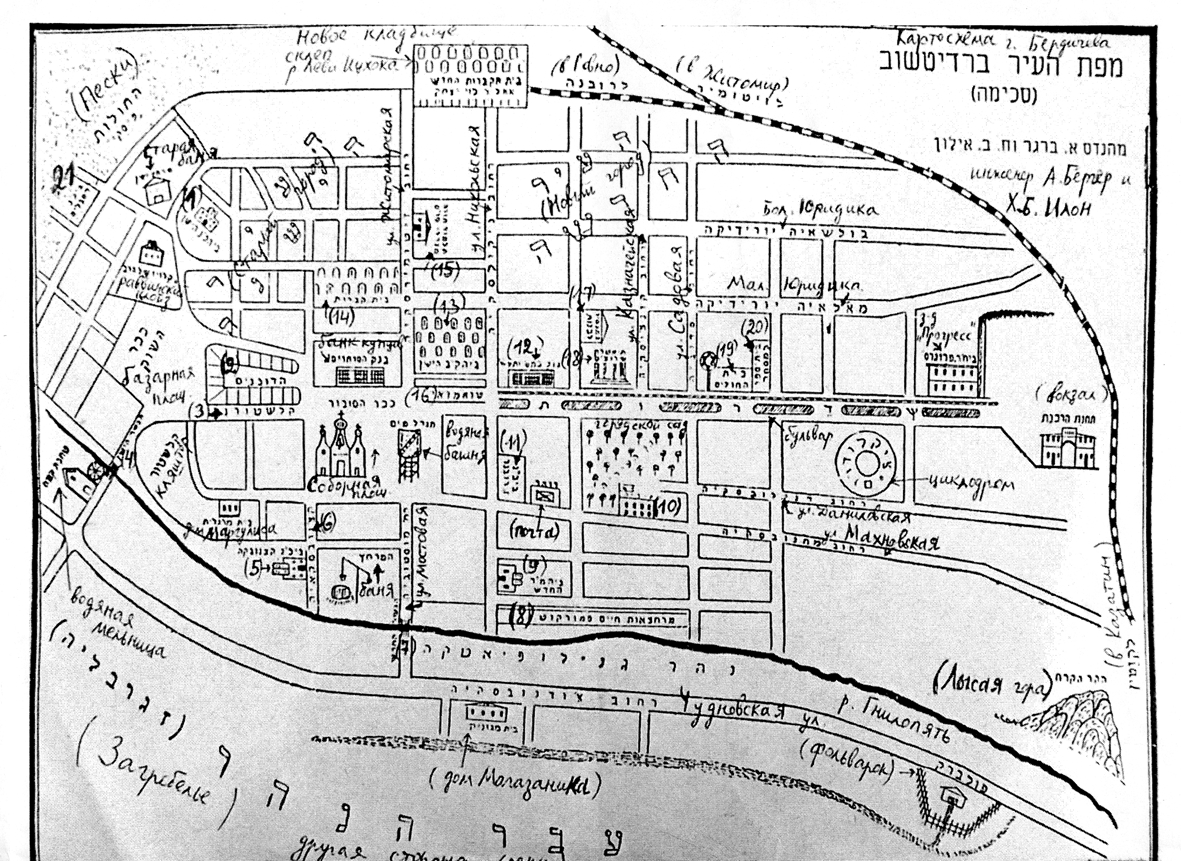
Berdichev, a town 93.1 miles SW of Kiev, was the model for the towns described by Shalom Aleichem in his stories. It was considered to be the typical shtetl. By 1861 it was the largest Jewish community in Russia. It was one of the most important trading and banking centers of the Polish-Lithuanian Commonwealth and by 1765 it was the largest commercial enter in eastern Poland, as a result had a large Jewish population.  In 1789, four years after the Third Partition of Poland, Jews made up 75% of the town's population and were a major force in its economy. The main street was known as "Gold Street,"  and many of its banking houses were owned by Jews. Many of the estates surrounding the town were owned by Polish noblemen and employed Jews as their agents.  There were over 80 synagogues in town and several Yeshivas.  One of its synagogues was known as the musical synagogue, famous for training cantors.    It was the center for Jewish book publishing in Russia.  Because of this, Berdichiv was known as "The Jerusalem of Volhynia"  (Volhynia is the name of the area where Berdichiv is located).


The musical synagogue of Berdichiv. source: Kehilalinks.jewishgen.org
 In the 1800's the Russian government opened areas in southern Russia for settlement.  Many of the people of Berdichiv decided to move to Odessa where they have more opportunity.  Others decided to leave Russia altogether and move to the United States or to Palestine. 

Map of Berdichev, labels are in Yiddish. 


Sources: Lukin, Benjamin, Berdichiv, YIVO, Enclycopedia of Jews in Eastern Europe.
Rosenthal, Herman, Pale of Settlement, Jewish Encyclopedia.com
Berdichiv, Jewish Virtual Library.org.

Saturday, August 1, 2015

Wooden Churches and Synagogues in Poland and Ukraine


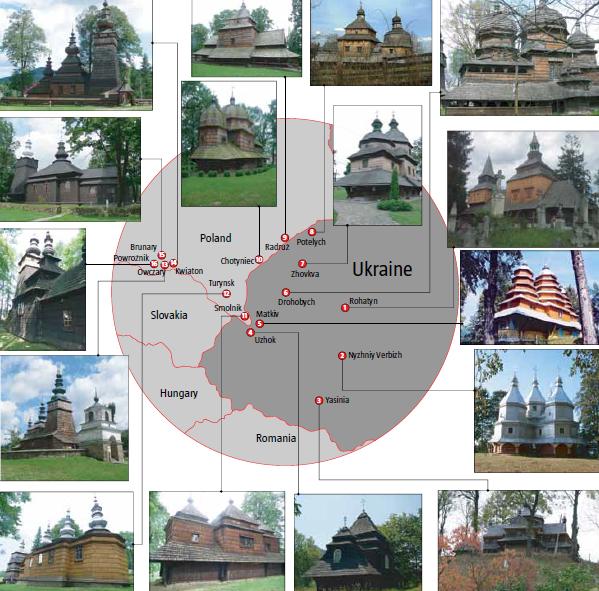
Locations of Wooden Churches in Ukraine and Poland: Source: Ukrainian Weekly


St George Church, Drohobych, woodcut by Olena Kulchytska

St George, Drohobych, painting by Olena Kulchytska


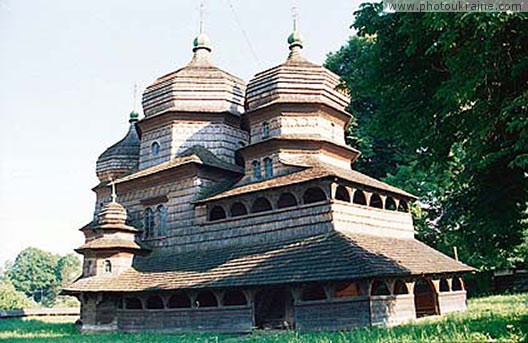
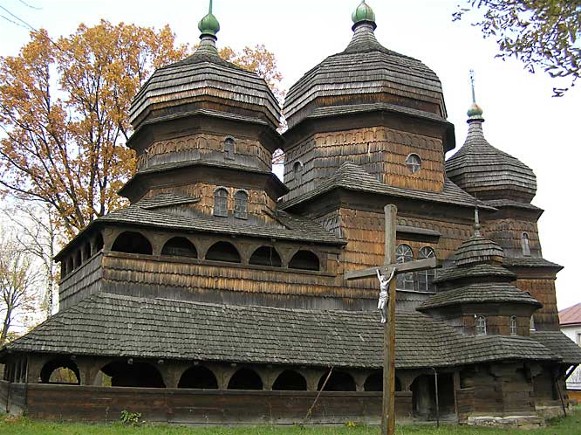
St George Church, Drohobych, Ukraine built c. 1500


Three versions of the St George Church, Drobobych, Ukraine.  

The picture above,  in black and white hung in my grandmother's living room for as long as I can remember.  I knew that it was a church in Ukraine, but that's about all the thought I gave it.  Later, when my mother had it in her house, and later in her apartment,  I became more interested.  I asked a person who could speak Ukrainian, who told me the name of the church and of the artist who made the woodcut.  Then I decided to do a little research and found the photo (above left) and the painting (above right).  The painting is by the same artist as the woodcut, who I discovered was a well known Ukrainian artist.  This led me to learn more about the wooden churches in Ukraine.  As I looked for information and purchased a book about wooden churches, I discovered that there were also wooden synagogues in Ukraine and Poland, built around the some time. I also found that many are UNESCO World Heritage sites.
The map at the top of the page shows the location of some of the churches in Ukraine and Poland.  There are no synagogues, because most of them were burned by the Nazis during World War II.

Gwozdziec Synagogue,  originally in Hvizdets, Ukraine.

 
Gwozdziec Synagogue

Most wooden synagogues were built in the mid 16th through the mid 17th century. Many were located in Eastern Galicia, part of Poland, then Austria-Hungary and now Poland and Ukraine,  They were also found in Lithuania and Bela Rus.  Many were located near the Carpathian Mountains a source of building material.   Only a few of the wooden synagogues are left, since over 200 were burned by the Nazis, those that survived are in poor condition.  The Gwozdziec Synagogue was  destroyed in World War I.  It was rebuilt in Sanok, Poland, as part of the Museum of Polish Jews.
The synagogue was the center of the local Jewish community.  It was used for religious services, teaching, and as a place to discuss religious law.
Bimah; Interior of the rebuilt Gwozdziec Synagogue.

Synagogue buildings were usually square or rectangular.  The main room was large, with a high ceiling. The synagogue was ofter the tallest building in the small towns and villages of Galicia. Most faced east and were located on or near a river.  The entrance was on the west side of the building, and led into a vestibule.  The women's section was often located above the entrance,  but in the synagogue, it was located on the side.  The main room was large, with the Bimah, a raised platform covered with a wooden canopy was in the center. Both were decorated with elaborate designs. The Bimah was one of the most important parts of the synagogue, because it was where the Torah and other scriptures were read. The Torah Scrolls were kept on the eastern wall in a Aron-Hakodesh, an elaborate carved altar. Synagogues in Galicia were known for beautiful wall paintings.  Other rooms in the building were used for children's education and for mens' Torah study.
Click in the link to read about the reconstruction of the Gwozdziec Synagogue.
A 300 Year-old Synagogue Comes Back to Life in Poland

Drawing of the Gwozdiec Synagogue by Karol Maszkowski, 1893.

Wooden Churches

St George, Drohobych. Source: Encyclopedia of Ukraine.


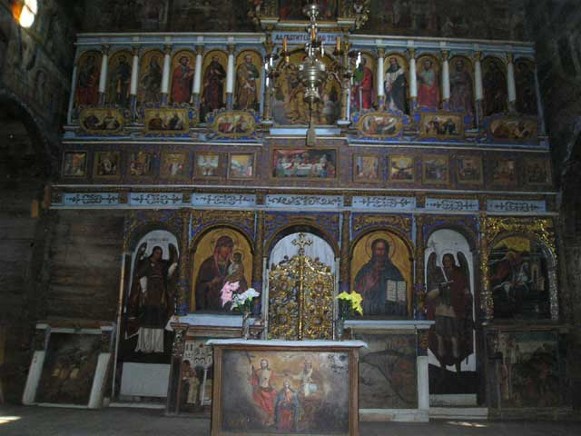
The oldest wooden church in Ukraine was built in Hacczow in 1388.  The  most common building material used in the churches was wood, because it was plentiful and inexpensive.  The methods of building were similar to those used in the synagogues, but the style was different.  The churches had bell towers which were topped with a cross.    St George Church in Drohobych, c.1500,  is one of the oldest and best preserved wooden churches in Ukraine.  It was build in the Boyko style, with three bell towers and three rooms.  (The Boykos lived in the Carpathian mountains and spoke a distinct dialect of the Ukrainian language).  Originally the churches had two bell towers, but in time, as new churches were built, more towers were added.  There are churches with three, four, five, six or seven individual towers. Builders strive to build churches of great height, but 50 meters was about as high as wooden buildings could be built.  To make the building appear taller, each tier was narrower than the one below it, giving the  ceiling the appearance of great height. The buildings were elaborately decorated inside, often with beautiful wall paintings and an iconostasis--a wall separating the high altar from the rest of the sanctuary, covered with icons and featuring an elaborate gate in the center.

Interior of St George Drohobych. Source: Encyclopedia of Ukraine

Sources:  

Encyclopedia of Ukraine.
Hewryk, Titus, Masterpieces in Wood: Houses of Worship in Ukraine., The Ukrainian Museum, New York, 1987.
"A 300 Year-old Synagogue Comes Back to Life in Poland" New York Times, June 15, 2011.

For more information: 

Carpathian Wooden Churches.blogspot.com
Unesco.org: "Wooden Tserkvas of the Carpathian Region of Poland and Ukraine"
Rail, Evan. "In Ukraine, Churches with a Distinctive Allure", New York Times, July 15, 2011.