|
| Jewish Waldheim Cemetery |
Last Sunday, we made a trip to the cemetery to visit my
husband’s grandparents. I had
never been there, and he hadn’t been there for years. It was an interesting trip.
 |
| Gate at a section of Jewish Waldheim |
Jewish Waldheim is a collection of cemeteries, developed by
Jewish organizations beginning in the 1870’s. It is located in Forest Park,
Illinois, nine miles west of Chicago. Various groups organized, purchased a
group of cemetery lots and sold them to members. These groups included synagogues, landsmanshaften, which
were groups of people from the same European town or village, and fraternal
organizations. Many sections were
fenced, some had elaborate gateposts or arched gateways. Many had their own caretakers. As time passed, interest in these
groups dwindled and members died. Eventually most of the cemetery was consolidated
under one owner. Today some of the
cemetery is in disrepair, and other sections are well maintained.
My husband’s paternal grandparents, Sarah and Morris
Gerstein are buried in the Odessa section. They immigrated from Odessa to Chicago in the early
1900’s.

 |
| Morris Gerstein |
Most of the gravestones in Jewish Waldheim include pictures of the persons buried there. Many have bronze covers, similar to those on the Gerstein gravestone. Sarah died in 1929, but her picture was taken many years earlier. Morris's picture appears to be taken later in his life.
 |
| Sarah Gerstein |
 |
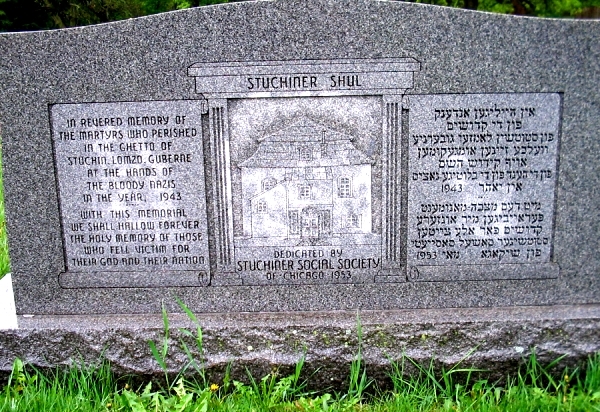
| Stuchin Monument in Jewish Waldheim Cemetery |
The maternal grandparents, Abraham and Rose Krause, are
buried in the Stuchiner section, which was organized by the Stuchin Social
Society. In
this section, there is a monument to the Jews of Stuchin, killed by the Nazis
in World War 2, erected by the Stuchiner Society. There is also a Lomzer
section in Waldhiem, organized by Jews from the town of Lomza, near Stuchin.
Unfortunately the picture of my husband's maternal grandfather is gone, and the cover was taken from his grandmother's picture.
Unfortunately the picture of my husband's maternal grandfather is gone, and the cover was taken from his grandmother's picture.


 |
| Rose Krause's sister, Fannie Center and her husband, Abraham are buried nearby. |
In Chicago, a law forbid any cemeteries to be built within
the city limits. Since there are
quite a few older cemeteries in Chicago, how did this come to be? Most of these cemeteries were built just outside
the city limits, directly across the street from Chicago, and as the city grew,
the area was annexed by the city of Chicago. Today, several older cemeteries
line Crawford Ave, the western city limits of Chicago. There are many other cemeteries in addition to Jewish Waldheim, in
Forest Park, which was far enough outside the city limits, so it was unlikely
to be annexed by Chicago.
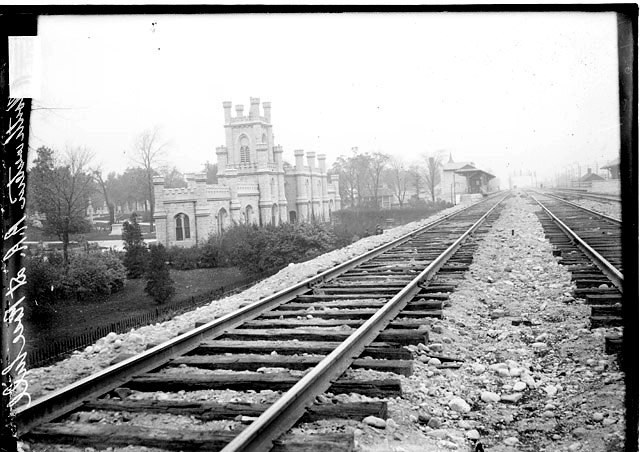 |
| Rosehill Cemetery station in Chicago, accessed by train. |
Traveling from Chicago's West side, where many Jewish people lived, to Forest Park took most of the day when Waldheim
was organized in the early 1870’s.
To remedy this, the Metropolitan Elevated Company started funeral
service to Forest Park in 1914 and ended 20 years later.
Special cars were designed to transport the family and the casket to the cemetery. Eventually funeral service was expanded to
serve many Chicago area cemeteries, elaborate entrances were built adjacent to the
railroad tracks just outside the cemetery. The remnants of the old stop can be seen
at Rosehill Cemetery on the Metra North line.
.jpg) |
| Funeral cars on the Chicago Elevated Line |
%20WEB.jpg)