Friday, May 17, 2013

The Genealogy of the Monkovsky Family

Beile Monkovsky

Chiam Pesach Monkovsky Family. First row from left: Udis, Mrs Monkovsky, Chaim Pesach Monkovsky. top row from left: unknown, Lachie, unknown woman, unknown man, Esther, unknown girl.

Some of Rose Krause's family
 members in Poland.
.
My mother-in-law, Lillian Krause Gerstein, was a member of the Monkovsky family.  Her mother, Rose (Karbovsky) Krause was born to Beile and Velvil Monkovsky in Szczuczyn, Poland, The town was known as Shtutzin in Yiddish. When she was born, it was a part of the Russian Empire, added to Russia by the third partition of Poland during the reign of Catherine II (The Great). That was the end of the Kingdom of Poland, and it disappeared from maps until after World War I. Rose was a member of the Stuchiner Society in Chicago and is buried next to her husband Avrom, in the Stuchiner section in Jewish Waldheim Cemetery in Chicago.

Szczuczyn was a town of 3,336 people in 1900, shortly before Rose and her husband immigrated to the United States.  It is about 45 miles northwest of Bialystok, the town which gives the bialy its name, and about 60 miles due west of the present day Russian border.
Velvil and Beile Monkovsky had six children, of which four immigrated to the United States; one to Tel Aviv, Israel, and one to Argentina. Rose Monkovsky was born in 1887, Fanny in 1890, Jacob (Jake) in 1891, Eva in 1912, and a daughter, name and birth date unknown.  I do not know anything about the children who did not move to the United States. Velvil had at least one sibling, Chiam Pesach, and he had seven children.  I do not know the history of this branch of the family.

Rose married Avrom Karbovsky, a baker, in Szczuczyn in either 1902 or 1903 and immigrated to Chicago in 1903.  She and Avrom had six children, Mollie, William, Paul, Florence, Lillian, and Jack. Jack served in the army in World War II, participating in the Battle of Saipan. The best known person in this branch of the family is Jerry Krause, son of Paul.  He was the General Manager of the Chicago Bulls during the Michael Jordan era and was honored as the NBA Executive of the Year.

Fannie married  Abraham Center, a tailor,  in Chicago, and had two sons, William (Red) and Eddie. Red and Eddie were in the coffee supply business.

Jacob, known as Jake Markin, married Sarah and had two children Betty and Victor Markin.

Eva married Joe Krause,  and had two children, William (Vee) and Beverly.  Joe, born in England, was a cousin of Avrom, Rose's husband.  Joe was a jeweler and Eva worked at Marshall Field's in Chicago, in the department that made chocolate candy. Beverly was a model and a buyer for Marshall Field's.
One of unknown children was a daughter who married Yankel R__.  The surname was changed to Ross. I do not know anything about this daughter, and Jack Krause, who gave me information about the Mankovsky family, could not remember her name.  There were three children, Libby (Lillian), Velvil and Paul.  Libby served in the US Army in World War II as a Private First Class. Jerry Fretzin, her husband also served in the Army in World War II.


Family reunion--1950's.  Front row from left: Fannie Center, Mrs Velvil Ross, Esther Center, Estelle Center, Libby Ross Fretzin, Lillian Gerstein, Rose Krause.  Top row from left: unknown woman, Abe Center, Velvil Ross, Eddie Center, Red Center, Jerry Fretzin, Beverly Krause Miller, Herb Miller, Dave Gerstein, unknown woman.

Wedding of William Krause and Muriel Friedman.  Rose Krause is to the left of the bride,  Avrom Krause is behind Rose and the bride, and Lillian Krause is in the second row on the left. 

In closing, I would like to share an article I found in the Chicago Tribune on May 14, 2013.  It explains so poignantly why I research my roots and study genealogy. Click on the following link to read the article. Remembering the Blessings of Our Ancestors.

Information for this entry came from my research, Jack Krause and Libby Ross Fretzin, who identified some of the people in the oldest pictures.

Wednesday, May 15, 2013

More Recent History

 Pictures are from Hong Kong, Beijing, Shanghai and the Yangtze River. 
Old  British Stable Kowloon, Hong Kong

Restaurant in the Produce Market, Kowloon

Kowloon

Kowloon skyscrapers, seen from Hong Kong Island   

Hong Kong traffic--and it's not rush hour

Buddhist Temple, Hollywood Road, Hong Kong Island

Hong Kong and Kowloon from Victoria Peak

Shanghai from our Hotel window

New skyscrapers in Shanghai

The Bund--British Shanghai

Old Town, Shanghai

Yu Gardens, Shanghai


Restaurant in a former home in the French Concession, Shanghai

Monkey, Tribe of the Three Gorges Theme area

Tea Shop, Yi Chang

Tribe of the Three Gorges Theme Area, Yangtze River

Food Stand, Tribe of the Three Gorges, Yangtze River


Temple of Heaven, Beijing

Tai Chi in the park, Beijing

Friday, May 10, 2013

Some Very Recent History

Rooted in Eastern Europe Blog  is back. 
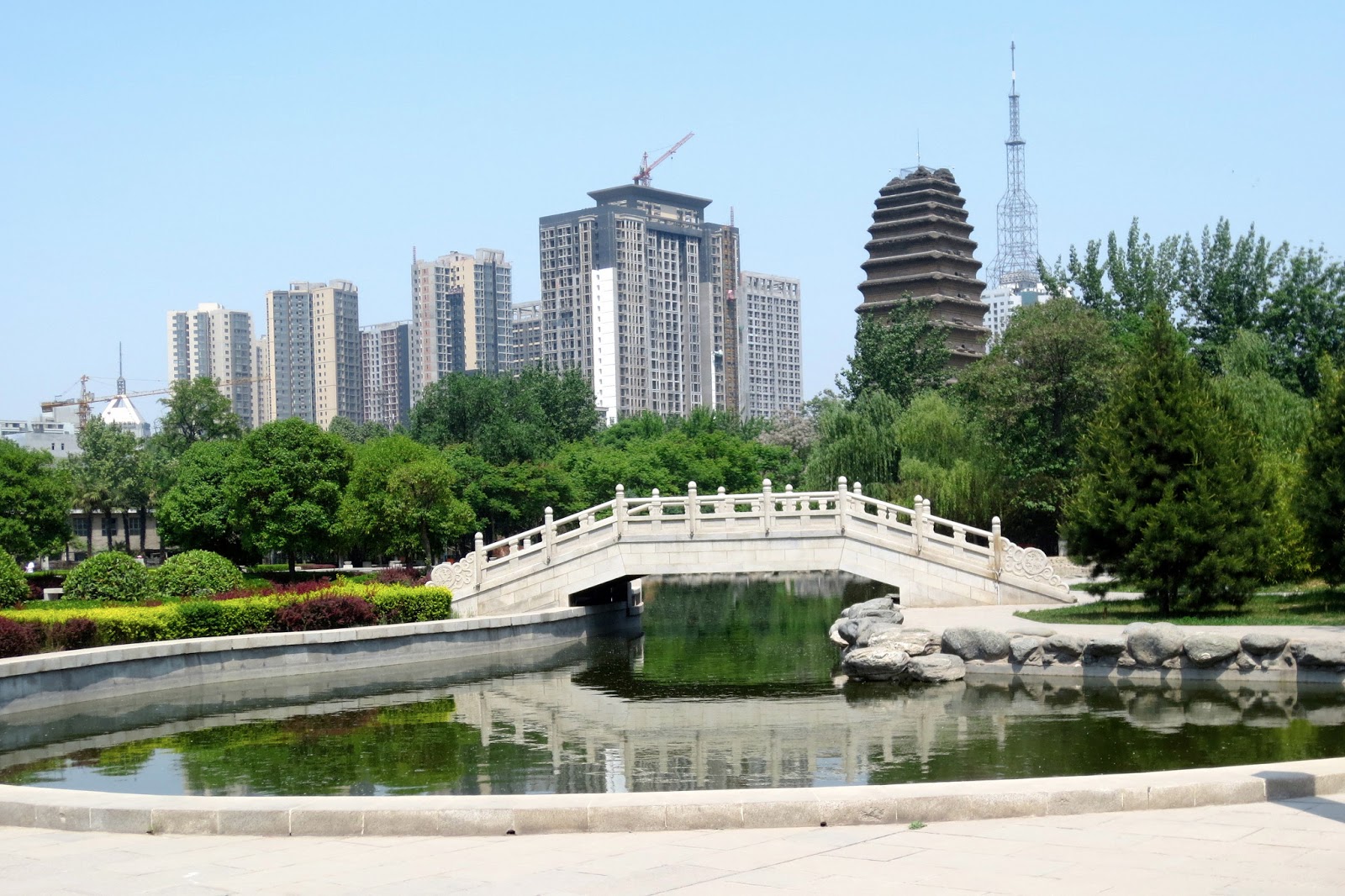
I been traveling for the past three weeks in Hong Kong and mainland China and haven't worked on genealogy at all.   The next posts are an exception-I will illustrate/write about the very recent past and about my own activities.  One of the most interesting things I saw  in China was the juxtaposition of the old and the new, which I will try to show in the pictures below. More on Wednesday.

Peapod boats in the Shendong Stream of the Yangtze River

Fengdu, "The Ghost City"

Giant Panda in the Chongqing Zoo.

Yangtze River cruise boats, Fengdu.

Chongqing

Li River, Guilin.

Guilin, view from Shangri-la hotel

 
Pizza Hut lunch, Xian.

Terracotta Warriors Museum, Xian

Din Sum lunch, Xian

Xian, the old and the new

Terracotta Warriors, Xian

Artist and calligrapher in his Hutong courtyard, Beijing

Pedi-shaws and car, Beijing
 
Gate of Heavenly Peace, Tienanmen Square, Beijing.
Great Wall, Badaling.

Dr Sun Yat-Sen, Tienanmen Square, Labor Day holiday, Beijing


Friday, April 12, 2013

The Genealogy of the Rychly Family

I am related to the Rychly( also spelled Rychlyj or Rychlij) family on my mother's side.  Since I knew nothing about my father's family until I started to do genealogy research, this was "my family".  Most of the anecdotal information I have came from my grandmother, Pauline Rychly Koshuba Haydak, my great aunt, Anna Rychly Romanchuk and my mother Julia Koshuba Noznick.  I have more recent information from an oral history from my great aunt, Katherine Rychly Pylatuik, recorded and edited by her daughter Julia Pylatuik Lawryk, and from my cousin, Mairanne Pylatuik Theis.

The oldest known ancestor of the family, is Pawlo Rychlyj, who was born about 1850, possibly in Bohemia or in Bila, Tarnopil, Austria, now Ukraine.  He married Varvara Wojtuik, who was born in Bila around 1850.  Pawlo may have been previously married to Maria Manchouri, but I can find no verification for this person except  in an unsourced family tree.  The source  for Varvara Wojtuik is my grandmother's baptismal certificate.
Pauline Rychliy's Official Baptismal Certificate, 1933


Pawlo and Varvara married in Bila,  Tarnopil, around 1870-1871.  They had five children: Sylvester born 1872, Katherine born 1879, Constantine (Stanley) born 1886, Pelagia, born 1890, and Oleksa, born in 1892.  The All of the children immigrated to the United States except for Oleksa, who went to Canada.  Pawlo and Varvara stayed in Europe.

Pawlo's place of birth and ethnic background is a question--according to my grandmother, Pauline Haydak, and aunt, Anna Romanchuk, the Rychly name is Czech.  Anna Romanchuk told me that the Rychly family left Bohemia after losing their property and moved to Bila.  From what I have read, there was movement of people within the Austrian-Hungarian Empire, and Bohemians often found employment in other parts of the Empire.  In my research on Ancestry.com, I have found many Rychlys, none of whom are listed as Ukrainian or Ruthenian (an old name for Ukrainian) except for my ancestors.  Most of the other Rychlys were listed as Bohemian. I do not know if Pawlo  or his parents or both moved to Bila. The Rychly name means quick or fast in Czech.

In Bila, the Rychly family were farmers, growing hemp.  Hemp was an important agricultural product, used for making rope, and various fabrics, including burlap and a type of linen.  The custom in Eastern Europe was to divide property between sons when the father died.  By the end of the nineteenth century,  many family farms were so small, often only 2 acres, that farming couldn't support a family of 5 or more children. Many farming families were impoverished, and immigration was a viable alternative for many.  My great-grandfather, Sylvester Rychly, said that he left Bila in 1907 because he didn't want his children to work like slaves and never get ahead.  In other words--they came for a better life.

The two oldest of Pawlo's sons, Sylvester and and Constantine came to Pennsylvania, to the town of Tower City, because there were other immigrants from Bila living there. They worked as farm laborers. Eventually sister Katherine's husband, Michael Domelko immigrated, and was followed by Katherine in 1912.
The pattern of immigration was for the husband to come to the USA first, work and save money and eventually send for the wife and children. The Rychly family followed this pattern.  Although the fare to the USA seems inexpensive to us today, it often took an immigrant man over a year to save enough money to pay for passage for his wife and several more years to save enough for fares for the children.
Katherine and her husband remained in the Reinerton, Pennsylvania, area. Anna Rychly was the first of Sylvester's children to come to Pennsylvania in 1912-3. Sylvester, Anna and Constantine moved to Minneapolis, Minnesota around 1913-4. Pelagia's husband, Dymytro Popko, came to the USA and was followed to Minnesota by Pelagia and daughter Stefania. Oleksa immigrated to Canada, probably to the Winnipeg, Manitoba area.  Pauline Rychly came to Minneapolis with Constantine, his wife Maria and daughter Jenny, in July of 1914, just before World War I began.  No more Rychlys were able to immigrate until the 1920's because of major anti-immigration changes in American immigration policy.

I will be taking a break from eeroots for three weeks.  Next post will be Friday May 10.


Pauline Rychly (bride), John Koshuba, Anna Rychly and Sylvester Rychly (seated), 1916


For more information about the reasons why Eastern Europeans immigrated, click  here
 Take a virtual tour of a New York City tenement and see how immigrants lived, click here


.

Wednesday, April 10, 2013

Snicker, snicker, snickerdoodles!

Snickerdoodle cookie recipe
Dr. Mykola Haydak working with a bee hive.
My grandmother, Pauline Haydak loved to bake.   One of her specialties was Honey Cookies, made with Minnesota honey.  Since my grandfather, Mykola Haydak, was Professor of Entomology and Economic Zoology at the University of Minnesota, and specialized in bees, you can understand why Minnesota honey was specified.  So far, I haven't found the recipe for honey cookies.  
Another cookie she made for us when we visited St Paul, was  Snickerdoodle Cookies.  I think that she used a Betty Crocker recipe, but I tried this recipe myself and it is really good.  
I have been told that a good snickerdoodle cookie has to be made with shortening.  This recipe is from Crisco, the shortening people.  I use turbinado sugar to top the cookies, and grind cinnamon sticks for a stronger flavor.
Click on the link for the complete recipe.

Snickerdoodle cookie recipe

Pauline Haydak 1995 at the Chicago Botanic Garden

Friday, April 5, 2013

The Genealogy of the Krause-Karbovsky Family

One of the families that I am researching is my mother-in-law's family, the Krause-Karbovsky family.
The family name was originally Karbovsky and was Americanized and shortened in the 1930's by Bill Krause when he graduated law school.
Avrom Karbovsky was born in Russia, probably in the town of Szczuczyn, on December 6, 1876.  I do not know the names of his parents. His wife, Rose Monkovsky also born in Szczuczyn, on July 10, 1887.  She was the daughter of Velvil and Biele Monkovsky.
They were married in 1903 and immigrated to the United States, arriving in Baltimore, Maryland on May 10, 1903.  Since there were rumors of a war; Avrom and Rose thought that leaving was a good idea, because young Jewish men in Russia were often drafted for army service that could last as long as 20 years.

Avrom, Rose and Lillian in the 1920's
Mollie, their first child was born in 1904 in Chicago.  William, was born in 1906 and he was followed by Paul, born in 1909.  In 1910  the family was living at 6117 W. Aberdeen St in Chicago, and Avrom's occupation as a baker. Florence, their second daughter, was born in 1913.  

Sometime between 1913 and 1917, the family moved to Peoria, Illinois, where Avrom opened a bakery, and the family lived at 215 Reid St.
Mollie died in the Influenza Pandemic on October 15, 1918, and was buried in the Jewish Cemetery in Peoria  Ten days later, Lillian was born.
1920 finds the Karbovsky family living at 523 5th Ave in Peoria and  Avrom was now working at the Perfection Bakery.  Florence died in 1921 of unknown causes.  The sixth child and son, Jack was born in 1924. In 1925, Avrom became a naturalized citizen of the United States.   The family was living at 701 Spencer St. in Peoria.

In 1930, the Karbovsky's were back in Chicago and living at 3702 W. Agitite Ave. William was working as a shoe salesman and Paul worked at the Post Office as a sorter.  Avrom continued to work as a baker. Lillian and Jack were in school.

Avrom and Rose, 1940.
Between 1930 and 1940, the family changed their surname to Krause . They now lived at 4251 N. St Louis Ave in the Albany Park neighborhood of Chicago. and had lived there since 1935. Lillian graduated high school and was working as a switchboard operator. Avrom's occupation was listed as a painter. Jack was in high school.  Both Bill and Paul were married and had their own households..  Rose became a  U.S. citizen during the 1940's.
Avrom died on February 4, 1946 in Chicago and is buried in Waldheim Cemetery in the Stuchiner section.  After Avrom died, Rose lived with Lillian and her husband, Dave Gerstein,  Rose died in 1956 in Chicago.  She is buried next to Avrom in Waldheim Cemetery.

Rose's certificate of Naturalization
Avrom's Certificate of Naturalization

Tuesday, April 2, 2013


New Zealand Style Pavlova

I enjoyed Pavlova as a special dessert when I lived in New Zealand in 1978-9.  I learned how to make it and served it for special occasions when I returned to the US.
The meringue is crisp on the outside and soft inside.   The recipe makes delicious meringue cookies too.
Serves 6-8

For the Meringue
Set oven at 275.
Large spring form pan, use ring only.

4 egg whites
1 cup sugar
1 tbsp cornstarch
pinch of cream of tartar
1/2 tsp vanilla
3/4 tsp white vinegar

For the topping:
1 pint of heavy cream
1 pint of fresh fruit/strawberries, raspberries, blueberries, peaches or bananas or a mixture of your choice

1.  Beat egg whites until stiff.  
2.  Gradually add the sugar, beating until incorporated
3.  Add the cornstarch,  cream of tartar, vanilla and vinegar
4.  Cover a cookie sheet with parchment paper. 
5.  sprinkle water on paper to moisten it.
6. Spray inside of the spring with cooking oil spray. Place spring form ring on the parchment covered cookie sheet 7.  Spoon large tablespoon fulls of egg white mixture around the edge of the circle, making sure that that they are touching each other. 
8.  When you have made the circle, spoon the rest in the center.9. Bake in the oven for 1 hour at 275.  Turn off the oven and leave in for one hour.
9. Remove from oven and run a spatula around the edge of the spring and carefully open the spring  and remove it.
11.  Place cookie sheet on wire rack to cool.

Carefully run a spatula under the Pavlova, remove the parchment paper, and put it on a nice plate.


Finishing it up:1 pint of very cold heavy cream
1 pint of fresh strawberries or other fresh fruit. 

1. Whip the cream until thick.  You will not need any sugar, as the Pavlova is quite sweet. 
2. Spoon the whipped cream on the Pavlova covering it almost to the edge.
3. Top with fresh fruit--cut the strawberries in half and spoon on top of the cream.

To serve: Cut in wedges.  Serves 6-8

To learn more about the story behind the Pavlova dessert, click here.