Showing posts with label Constantine Rychly. Show all posts

Thursday, July 3, 2014

The 100th Anniversary of Pauline Rychly’s Arrival in the United States.


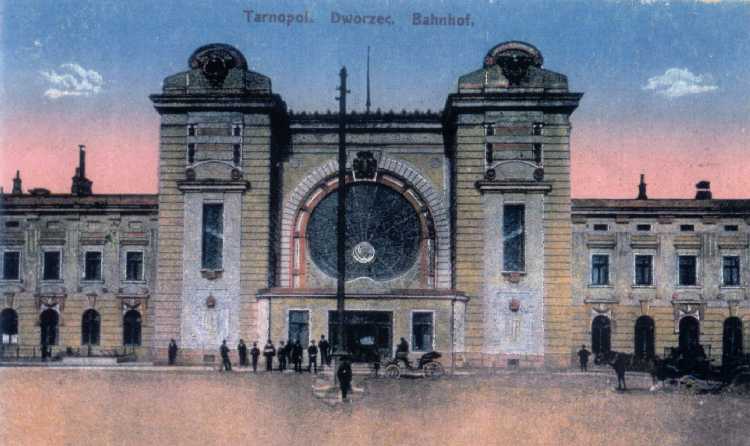
The Train Station in Ternopil', the beginning of my Grandmother's journey to the United States.


Tomorrow, the 4th of July, 2014 is the 100th anniversary of my grandmother, Pauline Rychly Koshuba Haykak’s arrival in Minneapolis, Minnesota.  She left her home in the village of Bila, just outside of the city of Ternopil’ (aka Tarnopol), in June 1914.  I am not sure of the exact date, but I do know that she left on the ship, The Kronprinz Wilhem, from Bremen Germany, on June 23, 1914, bound for New York City.   
 
The Kronprinz Wilhem, built in 1901, shortly after my Grandmother arrived in the US in 1914 it became a German warship.

According to the ship’s manifest, she was 14 years old.  She traveled with her Uncle and Aunt, Constantine and Maria Bilan Rychly and their young daughter, Anna.  All of her belongings were in a trunk, which for some reason, she kept for her entire life.  One of her grandsons has the trunk now.
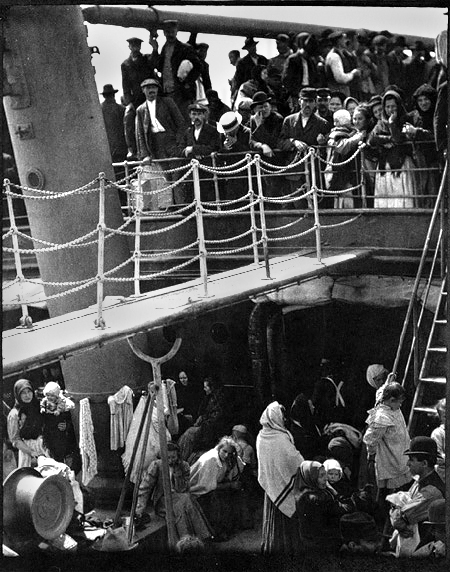
The voyage was difficult for Pauline, since she was seasick for most of the time.  She was traveling on 3rd class tickets, commonly known as steerage, and was processed at Castle Garden, the old immigrant processing center, reopened because Ellis Island could not handle of the large number of ships arriving in New York.  Castle Garden is located near Battery Park and the terminal for the Staten Island Ferry in lower Manhattan. 
 
Photo by Alfred Stieglitz, Steerage class on a ship bound for Bremen, Germany is 1907

Castle Garden, where my Grandmother first stepped on American soil.


Passengers who had first or second class tickets were processed on board, and left from a dock near where the Verrazano Narrows Bridge is today.  Third class passengers were taken by ferry to Ellis Island, or Castle Garden for immigration processing.  If there were no problems, the immigrants took another ferry to the railroad station in New Jersey, where they continued the journey to their final destination.  Third class tickets for the trip from Europe to the United States big money makers for the shipping lines and railroads, and were often offered as package deals, costing about $25.  I have to mention that although the price of a trans-Atlantic ticket appears to be low, it took an average immigrant working in the United States at that time, about a year to save the money to buy a ticket for a relative in Europe. The shipping lines made no money on first or second class tickets, the profit was made on the third class tickets. 
 
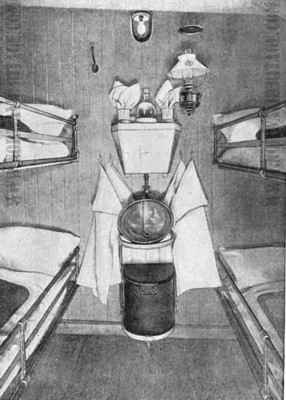
Four bunks in a steerage class cabin.

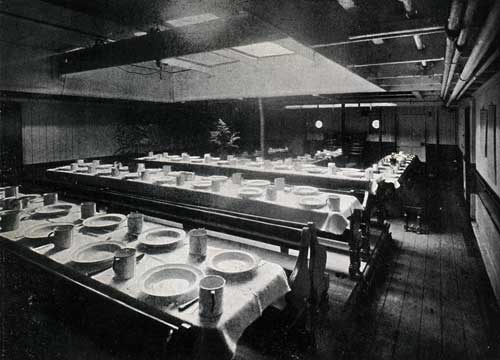
Third Class Dining Room on a Trans-Atlantic passenger ship

Accommodations on the voyage in third class were Spartan. The steerage section was in the front of the ship, which felt all the pitching and rolling.  Meals were included in the fare, but the food served was unfamiliar to many of the immigrants, so they didn’t eat it.  My great-aunt, Katherine remembers that she was served liverwurst sandwiches and ripe bananas, which she had never seen before.   The accommodations were basic, on the lower decks, travelers slept in bunk beds, which were sometimes in large rooms, sometimes in cabins. There were portholes in some of the cabins, but they didn’t open. Passengers spent the day walking on the deck.   There were no lounges or entertainment offered to immigrants. 

Ellis Island Train Station--after being processed, many immigrants boarded a train here for the trip to the West.
 
Inside a car on an immigrant train
Pauline’s sea voyage from Germany to New York took about nine days. My grandmother must have been on a slow train, because it took four days to go from New Jersey to Minneapolis. Often all the passengers on a train were immigrants, so the facilities on the trains were meager, especially if the train and ship were a package deal.

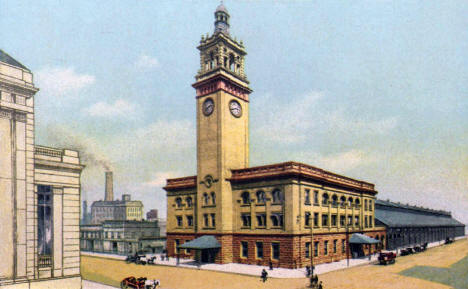
Milwaukee Station, Minneapolis MN.

On July 4th, Pauline, Constantine, Maria and Anna arrived in Minneapolis, and were met their family members.  Pauline’s father, Sylvester had been in the United States since 1908, and her sister Anna, since 1913.  Fourth of July fireworks made a big impression on Pauline, since she had never seen such a display.  Within a few days, she was working in the laundry at the Nicollet Hotel in downtown Minneapolis.


Gateway Park and the Nicollet Hotel where my Grandmother worked when she first came to Minneapolis


Pauline and Anna Rychly in 1915.  This is the oldest picture I have of my Grandmother.

Friday, April 12, 2013

The Genealogy of the Rychly Family

I am related to the Rychly( also spelled Rychlyj or Rychlij) family on my mother's side.  Since I knew nothing about my father's family until I started to do genealogy research, this was "my family".  Most of the anecdotal information I have came from my grandmother, Pauline Rychly Koshuba Haydak, my great aunt, Anna Rychly Romanchuk and my mother Julia Koshuba Noznick.  I have more recent information from an oral history from my great aunt, Katherine Rychly Pylatuik, recorded and edited by her daughter Julia Pylatuik Lawryk, and from my cousin, Mairanne Pylatuik Theis.

The oldest known ancestor of the family, is Pawlo Rychlyj, who was born about 1850, possibly in Bohemia or in Bila, Tarnopil, Austria, now Ukraine.  He married Varvara Wojtuik, who was born in Bila around 1850.  Pawlo may have been previously married to Maria Manchouri, but I can find no verification for this person except  in an unsourced family tree.  The source  for Varvara Wojtuik is my grandmother's baptismal certificate.
Pauline Rychliy's Official Baptismal Certificate, 1933


Pawlo and Varvara married in Bila,  Tarnopil, around 1870-1871.  They had five children: Sylvester born 1872, Katherine born 1879, Constantine (Stanley) born 1886, Pelagia, born 1890, and Oleksa, born in 1892.  The All of the children immigrated to the United States except for Oleksa, who went to Canada.  Pawlo and Varvara stayed in Europe.

Pawlo's place of birth and ethnic background is a question--according to my grandmother, Pauline Haydak, and aunt, Anna Romanchuk, the Rychly name is Czech.  Anna Romanchuk told me that the Rychly family left Bohemia after losing their property and moved to Bila.  From what I have read, there was movement of people within the Austrian-Hungarian Empire, and Bohemians often found employment in other parts of the Empire.  In my research on Ancestry.com, I have found many Rychlys, none of whom are listed as Ukrainian or Ruthenian (an old name for Ukrainian) except for my ancestors.  Most of the other Rychlys were listed as Bohemian. I do not know if Pawlo  or his parents or both moved to Bila. The Rychly name means quick or fast in Czech.

In Bila, the Rychly family were farmers, growing hemp.  Hemp was an important agricultural product, used for making rope, and various fabrics, including burlap and a type of linen.  The custom in Eastern Europe was to divide property between sons when the father died.  By the end of the nineteenth century,  many family farms were so small, often only 2 acres, that farming couldn't support a family of 5 or more children. Many farming families were impoverished, and immigration was a viable alternative for many.  My great-grandfather, Sylvester Rychly, said that he left Bila in 1907 because he didn't want his children to work like slaves and never get ahead.  In other words--they came for a better life.

The two oldest of Pawlo's sons, Sylvester and and Constantine came to Pennsylvania, to the town of Tower City, because there were other immigrants from Bila living there. They worked as farm laborers. Eventually sister Katherine's husband, Michael Domelko immigrated, and was followed by Katherine in 1912.
The pattern of immigration was for the husband to come to the USA first, work and save money and eventually send for the wife and children. The Rychly family followed this pattern.  Although the fare to the USA seems inexpensive to us today, it often took an immigrant man over a year to save enough money to pay for passage for his wife and several more years to save enough for fares for the children.
Katherine and her husband remained in the Reinerton, Pennsylvania, area. Anna Rychly was the first of Sylvester's children to come to Pennsylvania in 1912-3. Sylvester, Anna and Constantine moved to Minneapolis, Minnesota around 1913-4. Pelagia's husband, Dymytro Popko, came to the USA and was followed to Minnesota by Pelagia and daughter Stefania. Oleksa immigrated to Canada, probably to the Winnipeg, Manitoba area.  Pauline Rychly came to Minneapolis with Constantine, his wife Maria and daughter Jenny, in July of 1914, just before World War I began.  No more Rychlys were able to immigrate until the 1920's because of major anti-immigration changes in American immigration policy.

I will be taking a break from eeroots for three weeks.  Next post will be Friday May 10.


Pauline Rychly (bride), John Koshuba, Anna Rychly and Sylvester Rychly (seated), 1916


For more information about the reasons why Eastern Europeans immigrated, click  here
 Take a virtual tour of a New York City tenement and see how immigrants lived, click here


.