Showing posts with label Pauline Haydak. Show all posts

Friday, March 27, 2015

Pysanky, A Bit of Family History

Easter card from the 1940's

Easter is only two weeks away, so its time to get out those hard boiled eggs and dyes from the grocery store and make some Easter Eggs.  Yes, I made those eggs when I was a child, but I also learned to paint Ukrainian Easter Eggs from my Mother and Grandmother.  In those days, I really didn't know much about the history or symbols used in the eggs, or why people painted them.  I am going to share some of that information in this week's post.

When my Grandmother first came to St Paul Minnesota in 1914, nobody painted eggs.  As far as I know, no one in my grandmother's family painted eggs in Ukraine. It wasn't until a relative brought a pysanka from Ukraine, probably in the 1920's or early 1930's, that the they actually saw one. Painting Easter eggs caught on quickly in the Ukrainian community. Every spring, my Grandmother and Mother, along with other women members painted hundreds of eggs for the annual Easter egg sale which helped raise money for their church. When she was in high school my Mother demonstrated the art and craft of making Ukrainian Easter eggs all over the Twin Cities of Minneapolis and St Paul.

My mother, Julia Koshuba Noznick at an Easter egg demonstration, 1937. Photo: Minneapolis Star.


 The word for the eggs in Ukrainian is pysanka.  it is pronounced "pih-sahn-ka" all the vowels are short.  It is not pronounced "pih-zonk-ka" or "pie-san-kee".  The plural is pysanky, pronounced "pih-sahn-ki", again all short vowels.  Pysanky can be made from all kinds of eggs, chicken, quail, goose and even ostrich.  Most are made with white eggs, but brown ones are sometimes used.  
Making pysanky is called pysankarstvo in Ukrainian, which means writing pysanky.  It was  a folk tradition, practiced in the villages and small towns, but now is a decorative art practiced not only in Ukraine, the United States and Canada, but worldwide.  The pysanka is a national symbol of Ukraine.

Easter egg with Trypillian pattern. Source: Pysanky.info

Trypillian pottery. Source: Pysanky.info

Among the oldest civilizations in Ukrainian territory were the Tyrpillians, a neolithic people who lived between 5500-2750 BCE. If they decorated eggs, none of them survived. Trypillian patterned eggs are popular today, but it is Trypillian pottery that is the source and inspiration for Trypillian patterned eggs. 
The most ancient Ukrainian decorated eggs were ceramic, made in the 7th and 8th centuries C.E. Decorated ceramic eggs were produced in the city of Kyiv during the 10th to the 12th centuries C.E.  The city was a center for making tile, bricks  and ceramics  which were exported to Poland, the Baltic countries and Scandinavia.  The oldest actual decorated egg was a goose egg and was found in the city of Lviv, Ukraine.  It dates back to the 15th-16th century.
  
The oldest known Ukrainian Easter egg, from Liviv, Ukraine.  Source: the Kyiv Post.

The Soviets tried to destroy the custom of pysanky making in Ukraine.   Between 1938 and the 1980's there was no egg painting or even any information about pysanky available in Ukraine.  In spite of the Soviet efforts, the custom survived in the United States and Canada.  Although all the parts of Ukraine were under the rule of the Soviet Union, the custom thrived in the United States and Canada.   Ukrainian folk dancing, folk singing, embroidery and pysanka making not only helped preserve Ukrainian culture and customs, it also informed Americans that Ukraine was a country, not just a part of Russia.
What compelled women in Ukraine to make pysanky?  Luba Petrusha,who has been making and studying about pysanky for over 40 years suggests several reasons:

 "Ukrainians have been decorating eggs, creating these miniature jewels, for countless generations. There is a ritualistic element involved, magical thinking, a calling out to the gods and goddesses for health, fertility, love, and wealth.  There is a yearning for eternity, for the sun and stars, for whatever gods that may be."   Pysanky.info/PYSANKY

Why did Ukrainian immigrant women choose to decorate eggs?  They are fragile, hard to work with and easily destroyed. Writing on them using a stick with a funnel attached to the end is difficult--I know, since I have never been successful making pysanky.  Making eggs linked Ukrainian women to their homeland, a place that many would never see again. They were  expressing themselves by making something unique, because no pysanka is like another. As they created their designs on the eggs, they used symbols that dated back to ancient times.  In a way, they were linking themselves to their ancestors who painted eggs using simple tools, beeswax and the light of a candle. As they painted,they became part of something bigger than themselves, a culture, a heritage and  history that went back thousands of years.
My grandmother, Pauline Koshuba Haydak, painting a pysanka , probably in the early 1930's.

In many cultures the egg symbolizes new life. In Ukraine before Christianity,  pysanky represented spring and the rebirth of the sun.  They were a symbol of rebirth, the beginning of the agricultural year, the end of cold and snow.  When Ukraine became Christian, pysanky became a symbol of the Resurrection of Christ.

All the lines and designs on pysanky have meaning, some of them have several meanings.The drawings below explain some of the popular designs used in pysanky.

Source: Ukrainian Gift Shop, Roseville, MN

In next week's post, I will be explain the symbols in actual pysanky from my collection.


 You don't have to be Ukrainian to make pysanky! Kits with tools and dyes are available online, and there are many sites with instructions on line. The Ukrainian Gift Shop in Roseville, Minnesota, has all kinds of pysanka making items, as well as pysanky for sale. Click here for the link: Pysanky  

For more information about pysanky check out the link below.

Luba Petrusha's comprehensive site for all things pysanky

Thursday, July 3, 2014

The 100th Anniversary of Pauline Rychly’s Arrival in the United States.


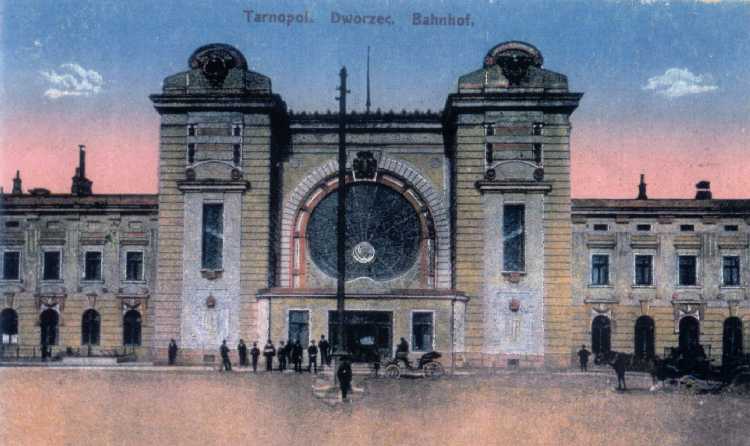
The Train Station in Ternopil', the beginning of my Grandmother's journey to the United States.


Tomorrow, the 4th of July, 2014 is the 100th anniversary of my grandmother, Pauline Rychly Koshuba Haykak’s arrival in Minneapolis, Minnesota.  She left her home in the village of Bila, just outside of the city of Ternopil’ (aka Tarnopol), in June 1914.  I am not sure of the exact date, but I do know that she left on the ship, The Kronprinz Wilhem, from Bremen Germany, on June 23, 1914, bound for New York City.   
 
The Kronprinz Wilhem, built in 1901, shortly after my Grandmother arrived in the US in 1914 it became a German warship.

According to the ship’s manifest, she was 14 years old.  She traveled with her Uncle and Aunt, Constantine and Maria Bilan Rychly and their young daughter, Anna.  All of her belongings were in a trunk, which for some reason, she kept for her entire life.  One of her grandsons has the trunk now.
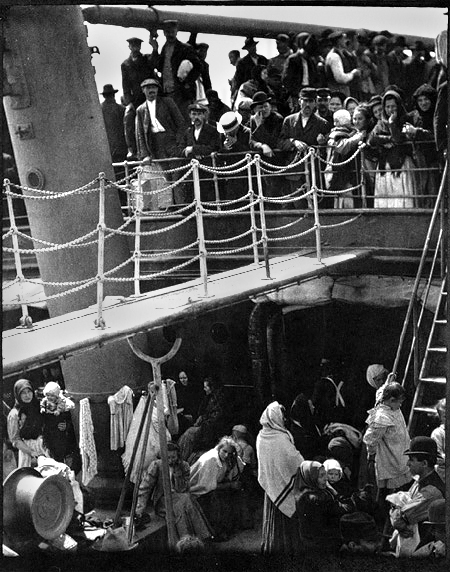
The voyage was difficult for Pauline, since she was seasick for most of the time.  She was traveling on 3rd class tickets, commonly known as steerage, and was processed at Castle Garden, the old immigrant processing center, reopened because Ellis Island could not handle of the large number of ships arriving in New York.  Castle Garden is located near Battery Park and the terminal for the Staten Island Ferry in lower Manhattan. 
 
Photo by Alfred Stieglitz, Steerage class on a ship bound for Bremen, Germany is 1907

Castle Garden, where my Grandmother first stepped on American soil.


Passengers who had first or second class tickets were processed on board, and left from a dock near where the Verrazano Narrows Bridge is today.  Third class passengers were taken by ferry to Ellis Island, or Castle Garden for immigration processing.  If there were no problems, the immigrants took another ferry to the railroad station in New Jersey, where they continued the journey to their final destination.  Third class tickets for the trip from Europe to the United States big money makers for the shipping lines and railroads, and were often offered as package deals, costing about $25.  I have to mention that although the price of a trans-Atlantic ticket appears to be low, it took an average immigrant working in the United States at that time, about a year to save the money to buy a ticket for a relative in Europe. The shipping lines made no money on first or second class tickets, the profit was made on the third class tickets. 
 
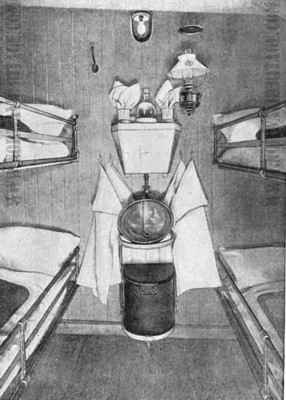
Four bunks in a steerage class cabin.

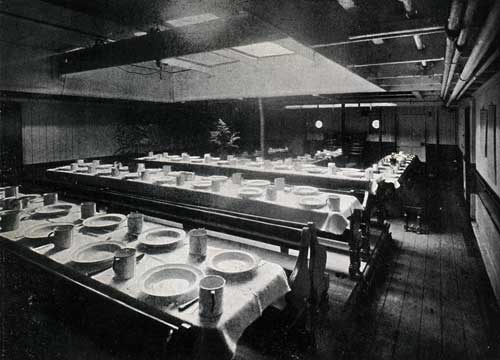
Third Class Dining Room on a Trans-Atlantic passenger ship

Accommodations on the voyage in third class were Spartan. The steerage section was in the front of the ship, which felt all the pitching and rolling.  Meals were included in the fare, but the food served was unfamiliar to many of the immigrants, so they didn’t eat it.  My great-aunt, Katherine remembers that she was served liverwurst sandwiches and ripe bananas, which she had never seen before.   The accommodations were basic, on the lower decks, travelers slept in bunk beds, which were sometimes in large rooms, sometimes in cabins. There were portholes in some of the cabins, but they didn’t open. Passengers spent the day walking on the deck.   There were no lounges or entertainment offered to immigrants. 

Ellis Island Train Station--after being processed, many immigrants boarded a train here for the trip to the West.
 
Inside a car on an immigrant train
Pauline’s sea voyage from Germany to New York took about nine days. My grandmother must have been on a slow train, because it took four days to go from New Jersey to Minneapolis. Often all the passengers on a train were immigrants, so the facilities on the trains were meager, especially if the train and ship were a package deal.

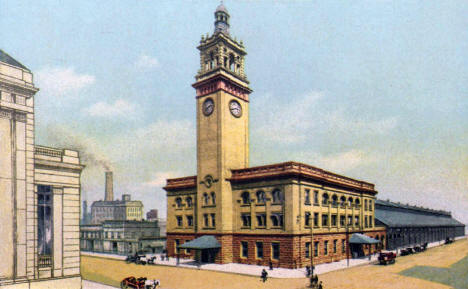
Milwaukee Station, Minneapolis MN.

On July 4th, Pauline, Constantine, Maria and Anna arrived in Minneapolis, and were met their family members.  Pauline’s father, Sylvester had been in the United States since 1908, and her sister Anna, since 1913.  Fourth of July fireworks made a big impression on Pauline, since she had never seen such a display.  Within a few days, she was working in the laundry at the Nicollet Hotel in downtown Minneapolis.


Gateway Park and the Nicollet Hotel where my Grandmother worked when she first came to Minneapolis


Pauline and Anna Rychly in 1915.  This is the oldest picture I have of my Grandmother.

Friday, May 9, 2014

The Five Helen Rychlys--A Genealogy Surprise


When I first began to ask my grandmother, Pauline Rychly Haydak about her family, I was surprised to find that both of her grandmothers were named Barbara (Varvara).

As I started to construct a family tree for her family, the Rychlys, I realized that two great-grandmothers having the same name wasn’t that special—I discovered that there were FIVE women in the Rychly family by the name of Helen and all closely related!  To simplify this, I am going to show how each woman was related to my grandmother.


I will start with Helen Rychly, my grandmother’s younger sister.  She was the first Helen, although her name was originally spelled Olena.  She was born in Bila, Ternopil’, Galicia, in 1906.  She came to the United States in 1922, and settled in Minneapolis.   Her first husband was Stephen Koshuba, who was the brother of my grandmother’s first husband, John Koshuba.  Her second marriage was to Anthony Tkachyk.  After her second marriage, she moved to Montana, raised a family, and lived there until her death in 1996.

 
Helen Rychly, my grandmother's sister at her wedding to Stephen Koshuba in 1924.


The second Helen married my great uncle, Onofrey Rychly, she was my grandmother’s sister-in-law.  She was born to John and Rosalia Tkachyk in 1908 in Franklin, Manitoba, Canada. (Her brother Anthony is mentioned in the paragraph above). Helen came to the United States with her family in 1910, and settled in Sheridan, Montana. They later moved to Scobey, Montana, where they had a farm. Helen worked in Scobey after she finished school, and moved Minneapolis about 1930-31. She met and married Onofrey around 1932; they had three children. The family lived in Minneapolis for many years, moving to Columbia Heights, MN, around 1956.  Helen lived there until her death in July 2005.  She was an artist and painted portraits of several family members, as well as a skilled seamstress and pysanka painter.


Helen Tkachyk Rychly, my grandmother's sister-in-law at her wedding in 1932.


The next Helen, the daughter of Stanley and Maria Rychley, was born in 1920 in Minneapolis.  She was my grandmother’s first cousin. Helen’s father, Stanley Rychley, was my grandmother's uncle.  Helen was known for her beautiful singing voice and  great memory.  She never married, and lived in the same house for over 70 years.  She died in July, 2000.

 
Helen Rychley, my grandmother's first cousin, (top center), 1937.  Ukrainian Day, Detroit Lakes MN


The fourth Helen Rychly was born in Canada in March 1930, the daughter of John and Teckla Rychly. She was my grandmother’s niece. John was one of my grandmother’s two brothers. He was born in Bila; he and his family immigrated to Canada in the 1920’s. The family moved to Anoka MN, in the late 1930’s.  Helen married Erling (Ed) Grotberg and was survived by five children, 11 grandchildren and 5 great-grandchildren when she died in December 2010.  
I do not have any pictures of Helen Rychly Grotberg.


The last Helen Rychly is the person that I know the least about. She was my grandmother’s sister-in-law.   She was born Helen Hrymiak in Bila Ternopil’ and married Stephen Rychly.  Stephen was one of my grandmother’s brothers. Both brothers, Stephen and John Rychly, stayed in Bila, farming the family property after the rest of the family immigrated to the United States.  Stephen and Helen married around 1923 had two daughters, Kerava born in 1924, and Miroslava, born in 1927.  Stephen was sent to Siberia during World War 2 and died there.  Helen and her daughters continued to live in Ternopil’ and both girls raised families there.  Again, no pictures of  Helen Hrymiak Rychly.


You never know what you will find when you start a family tree.  Looking through long lists of names is tedious, running into dead ends is common, and big finds are rare.  But everyone in a while, a surprise comes along and makes all the hunting worthwhile!


Friday, July 5, 2013

Sylvester Rychlyj, My Founding Father

Sylvester Rychlyj outside St Michael's Church, 1940

Ninety-nine years ago, on July 4, 1914, my grandmother, Pauline Rychlyj arrived in Minneapolis, MN, the last stop on her journey from Bila, Ternopil', Ukraine.  She was accompanied by her aunt and uncle, Constantine (Stanley) Rychlyj and Maria Bilan Rychlyj and their daughter Jenny. New York Harbor was crowded with steamships the day their ship arrived, so they were processed at Castle Garden instead of Ellis Island.  They left New York on a train for Minnesota and arrived on July 4.  What a day to arrive at their new home!

This story isn't about my grandmother, or her aunt and uncle, it is about  my great-grandfather Sylvester Rychly,j the person I consider my founding ancestor.  Sylvester first came to the United States in 1908 and settled in Tower City, PA.  According to his immigration documents, Sylvester was an agricultural worker, and his contact person in the United States was Wasyl Boyko, listed as his brother-in-law.  Wasyl is a mystery, since I can find no Boykos in the Rychlyj family.  My guess is that he and his wife were friends from the village, perhaps cousins.  Sylvester left Tower City for Ukraine in 1910 because his wife Maria was very ill. When she recovered, he returned to Pennsylvania in November 1910, with his brother Constantine. This time Sylvester was listed as an non-immigrant alien.

Eventually Sylvester moved to Minneapolis, and brought his wife and seven of his 8 children to this country.  The first child to come was Anna, followed by Pauline.  World War I intervened, and the rest of the family came in 1922, 1924 and 1926.  This in itself was an amazing feat, since the average immigrant laborer earned about $1.00 per day, and had to work for about a year to pay the fare of one person to come to the USA. Why did he invest so much time and money  bringing his family to the United States?  My grandmother Pauline said that he didn't want his children to have a life with no opportunities to better themselves.  In the old country, poor people stayed poor, they worked very hard to feed and clothe their children.  Children worked at young ages and schools taught only the basics.  He knew that he could provide a better life for his children in the United States.

Sylvester did more than bring his family to this country.  Although he had an accident at work and lost his hand, he continued working.  He bought two houses in Minneapolis in 1924.  He was a founder of two churches, St Constantine Ukrainian Catholic Church, and later, St Michael's Ukrainian Orthodox Church.  He also served as the first president of St Michael's. 

When he lived in Europe, he played the violin for events in the village, after his accident, he could no longer play, so he sang.  He served as the Choir director for many years at St Michael's, and also as a Diak (cantor). He was a member of the Ukrainian Folk Choir in Minneapolis, which performed all over the Twin Cities area. 

Sylvester helped his children to get settled in this country, providing them a place to live when they arrived and later helping them to purchase homes of their own.  Several of his children and grandchildren lived in the same neighborhood in southeast Minneapolis, around Como Ave. After the death of his wife, Maria, his life was devoted to his family, his church and to the Ukrainian community of Minneapolis.  His descendants live all over the United States.  He died in 1944 of cancer. I was born in 1946, so I never met him, but I am proud to be one of his  descendants, and his great-granddaughter.

Sylvester (seated) with daughters Pauline (bride) and Anna, 1916
Sylvester with daughters Katherine and Ksenia in 1935

Wednesday, April 10, 2013

Snicker, snicker, snickerdoodles!

Snickerdoodle cookie recipe
Dr. Mykola Haydak working with a bee hive.
My grandmother, Pauline Haydak loved to bake.   One of her specialties was Honey Cookies, made with Minnesota honey.  Since my grandfather, Mykola Haydak, was Professor of Entomology and Economic Zoology at the University of Minnesota, and specialized in bees, you can understand why Minnesota honey was specified.  So far, I haven't found the recipe for honey cookies.  
Another cookie she made for us when we visited St Paul, was  Snickerdoodle Cookies.  I think that she used a Betty Crocker recipe, but I tried this recipe myself and it is really good.  
I have been told that a good snickerdoodle cookie has to be made with shortening.  This recipe is from Crisco, the shortening people.  I use turbinado sugar to top the cookies, and grind cinnamon sticks for a stronger flavor.
Click on the link for the complete recipe.

Snickerdoodle cookie recipe

Pauline Haydak 1995 at the Chicago Botanic Garden