Friday, September 26, 2014


Friday, September 19, 2014
"Rise, Rise for Evanston"
 |
| Evanston Township High School today, |
Last weekend I attended my 50th High School Class Reunion. I graduated from Evanston Township High School in June 1964. Our class was large, almost 800 students in the class, about 300 attended the Reunion. The class had many bright and accomplished students, many attended Ivy League and other prestigious universities. Many went on to graduate and professional schools. There were high hopes for our class, and for the most part, the hopes were realized.
 |
| Evanston Township High School in 1964, pictured in our yearbook, the Key |
All of us came from the towns of Evanston and Skokie, Illinois. We were fortunate to attend such a fine high school, and even more fortunate to live in these great towns. In the 1960's Evanston was the "headquarters" city, home to many corporations. It is also the home of Northwestern University. It was known as a city of 'Homes, schools and churches" many of architectural significance. It was a great place to raise a family, there were plenty of things for children to do, beautiful parks, Lake Michigan beaches, and only a short train ride from Chicago. In 1964, Our high school was considered one of the best in the nation and still is today.
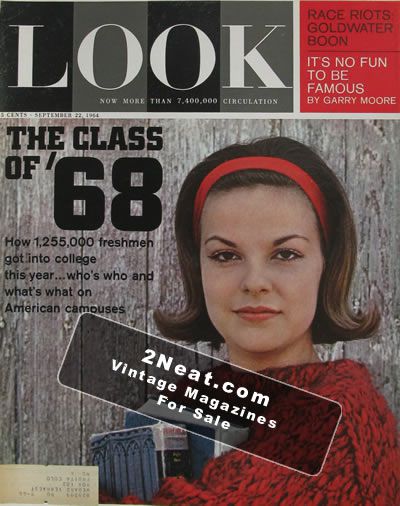 |
| Evanston was one of the high schools featured in Look Magazine in 1964. |
 |
| Graduating seniors |
 |
| Commencement Program |
 |
| I was on the yearbook staff in 1964 |
 |
| The Washington Post picked Evanston High School as one of American most challenging High schools in 2013. |
 |
| Evanston Township High School was picked a one of the top high schools in 2014 |
Saturday, September 13, 2014
What's My Name?
My surname is Noznick--or is it?
My surname has been problematic for most of my life. It is often mispronounced unintentionally, and sometimes intentionally. I have had some strange nicknames derived from my last name--like nozzie or just noz. So I always assumed that when I married, I would change my name immediately. But, I didn't. My husband's surname, Gerstein, is fairly common, easy to spell and pronounce. So why didn't I change? When I got married, in 1981, many women did not change their names when they married, and I was also a bit lazy, so I just kept the status quo.
Now I will get to the interesting part. In spite of keeping this surname, I have found out in my genealogical research, that Noznick isn't my family surname at all. My real surname is Nyznyk.
Many people assume that surnames were changed when people went through Ellis Island--but actually that didn't happen. An immigrant's name was recorded on ships' manifests at the port of embarkation, and written according to the immigrant's passport. When the person got to Ellis Island, that manifest was copied, often in longhand, and the immigrant's personal information was recorded. From what I have seen, nothing was changed at this time.
Many immigrants changed, shortened or Americanized their names after they were in the United States. On my side of the family, my mother's family name went from Kociuba to Koshuba. My grandmother's surname, Rychlyj, was changed to either Rychly or Rychley. In my husband's family, his grandmother's surname was changed from Monkovski, to Markin by some cousins. Karbovsky was changed to Krause in the 1930's. In the Gerstein family, his great Aunt's Biele Schwartz's married name was changed from Mankevetsky---to Mancoff. Her first name became Becky.
So, how did Nyznyk become Noznick? First of all, there is no evidence that the name was legally changed. My father found this out when he applied for a passport in 1965. He found no records under Peter Paul Noznick,
born August 18, 1915, in New York City. He made a trip to New York
City to locate information that would prove his identity. He found his
birth certificate, his last name was spelled Nausneck--no
first name listed. More searching located his baptismal certificate
and his parent's marriage license. On both of these documents the name
was spelled Nyznyj. His father's name was written in Latin as Ionnes Nyznyj--in English he was John Nyznyk. My Dad still could not prove that Peter Paul Nyznyj was Peter Paul Noznick.
I came across on of my Dad's report card with his name listed as Noznick. He signed his mother's name to the card as Mary Noznick. In 1930, she was married to Peter Zackowski and was known as Mary Zackowski. In the 1930 census, I found the Noznick
family at 624 E. Eleventh St, NYC, which was the address where my Dad
told me he lived. I believe that my Dad gave the census taker the information since both his parents worked three jobs, and were not at home. The head of the house was listed as John Noznick, wife as Mary Noznick and son as Peter Noznick. According to his application for US citizenship, dated 1930, my Dad's father, John Nyznyk, lived at 533 E. 6th St, his occupation was upholsterer. But In the
1960's, the 1930 Census information was not available and my father did not know that his father applied for United States citizenship.
How did he solve the problem of establishing his identity? He did get the passport and made the trip abroad. He obtained an affidavit stating that he was Peter Noznick and had been known by that name since high school.
How did Nyznyk become Noznick? The fact that his mother was illiterate, and did not speak English very well may have contributed to the transformation of nyznyk to noznick. Since the name sounded a bit like noznick, he became Peter Noznick. Perhaps the teachers knew of the Noznick family, who lived in New York City, and spelled my dad's surname in a was that was familiar to them. My Dad's father was literate, so his name was never changed, misspelled or mangled like my Dad's was.
So what about the Noznick surname? It is an uncommon name, but as I researched my family history, I found there were several Noznick families living in New York City. I have no idea what their ethnic background was, and I have found no family connection with any of these people.
My surname has been problematic for most of my life. It is often mispronounced unintentionally, and sometimes intentionally. I have had some strange nicknames derived from my last name--like nozzie or just noz. So I always assumed that when I married, I would change my name immediately. But, I didn't. My husband's surname, Gerstein, is fairly common, easy to spell and pronounce. So why didn't I change? When I got married, in 1981, many women did not change their names when they married, and I was also a bit lazy, so I just kept the status quo.
Now I will get to the interesting part. In spite of keeping this surname, I have found out in my genealogical research, that Noznick isn't my family surname at all. My real surname is Nyznyk.
Many people assume that surnames were changed when people went through Ellis Island--but actually that didn't happen. An immigrant's name was recorded on ships' manifests at the port of embarkation, and written according to the immigrant's passport. When the person got to Ellis Island, that manifest was copied, often in longhand, and the immigrant's personal information was recorded. From what I have seen, nothing was changed at this time.
Many immigrants changed, shortened or Americanized their names after they were in the United States. On my side of the family, my mother's family name went from Kociuba to Koshuba. My grandmother's surname, Rychlyj, was changed to either Rychly or Rychley. In my husband's family, his grandmother's surname was changed from Monkovski, to Markin by some cousins. Karbovsky was changed to Krause in the 1930's. In the Gerstein family, his great Aunt's Biele Schwartz's married name was changed from Mankevetsky---to Mancoff. Her first name became Becky.
 |
| Peter Noznick in Central Park, NYC,about 1930. |
 |
| 1930 United States Census, listing the Noznick family. |
 |
| John Nyznyk's application for US Citizenship, 1930. |
How did he solve the problem of establishing his identity? He did get the passport and made the trip abroad. He obtained an affidavit stating that he was Peter Noznick and had been known by that name since high school.
 |
| My Dad in the 1934 Crystal, the yearbook of Windham High School. |
How did Nyznyk become Noznick? The fact that his mother was illiterate, and did not speak English very well may have contributed to the transformation of nyznyk to noznick. Since the name sounded a bit like noznick, he became Peter Noznick. Perhaps the teachers knew of the Noznick family, who lived in New York City, and spelled my dad's surname in a was that was familiar to them. My Dad's father was literate, so his name was never changed, misspelled or mangled like my Dad's was.
So what about the Noznick surname? It is an uncommon name, but as I researched my family history, I found there were several Noznick families living in New York City. I have no idea what their ethnic background was, and I have found no family connection with any of these people.
Friday, September 5, 2014
Ternopil', Ternopol, Tarnopol.
 |
| Old postcard view of Ternopil' Ukraine |
Ternopil', a city in Western Ukraine is my subject--why did I choose
this city? First of all, although none of my ancestors lived in
Ternopil', most of them came from villages near this city, as did many
other Ukrainian and Jewish immigrants to the United States. Second,
Ternopil's names give a hint of its history--Ternopil' is its Ukrainian
name, Tarnopol is the name in Polish, in Russian it is Ternopol, in
German, Tarnopol. All these powers ruled it at one time.
Ternopil' is located in Western Ukraine, in Galicia, (in Ukrainian, Halachyna), a very old and important part of Ukraine, about 70 miles east of Lviv. Ternopil' is one of the major cities of Ukraine today. It is located on the Syret River, a tributary of the Dniester River. The population was 218,614 in 2010 and about 13,000 in 1900, when many of my ancestors lived in the area. According to the Encyclopedia Britannica, Ternopil' today is a railroad junction and industrial city. Its industries include light engineering, food processing and manufacturing consumer goods. As I mentioned earlier, none of my ancestors lived in this city, but my maternal grandmother's families, the Rychlyjs and the Bryniaks, lived in Bila, a village just outside the city walls of Ternopil', about a 15 minute walk to the city center. My other ancestors, the Kocuiba (Koshuba), family lived in Ozerna, about 13 miles to the west, the Nyznyk family came from Pomorany, 30 miles west, and the Klak family lived in Zarvanytsia, about 25 miles southwest.
Galicia played an important part in Ukrainian history. Early Ukrainian history took place in Kiev, but as the influence of Kiev began to weaken, Galicia became more important. The ruler of Kiev, Volodymyr the Great (980-90) is best known for bringing Christianity to Ukraine. Volodymyr won Galicia from Poland and integrated it into his realm.
In the 13th century, Prince Danylo of Halych, a descendent of Volodymyr, took control of Galicia. During his rule he initiated several important policies in Galicia. Orest Subtely, author of Ukraine, a History (1988), said that Danylo sought the support of townspeople and peasants to offset the powers of the noblemen. In order to populate his new towns, he encouraged artisans and merchants from Poland and Germany to settle them. Armenians and Jews also came to Galicia, which developed a multi-ethnic population, that continued until the 20th century. When Galicia was conquered by the Mongols in 1246, Danylo pledged loyalty to them. This didn't stop him from establishing relations with European powers , Poland, Hungary, and Rome. Danylo died in 1264, and by working to keep the Mongol/Eastern influence out of Galicia, he turned Galicia towards Western Europe. (Subtelny pp. 61-63).
 |
| Jan Tarnowski, founder of the city of Ternopil' |
Now to Ternopil'. The city was founded in 1540 by Jan Tarnowski, a Polish nobleman. He build a walled town with a castle and a defensive moat/pond. Galicia and the city of Ternopil' were governed by various Polish kings and nobles until 1772, when they became part of the Austrian Empire in the first partition of Poland. The people of Galicia, especially Ukrainians and Jews did well under Austrian rule, and the the city of Lviv became a center of Yiddish culture and Ukrainian nationalism.
In 1870, a railroad line was built that connected Ternopil' to Lviv. Ternopil' was now connected to the major cities of the Austrian-Hungarian Empire as well as the cities of Europe. It became a railroad center and its population grew. The city of Ternopil' had a diverse population, in 1900 the city population was 28% Ukrainian, 27% Polish and 44% Jewish.
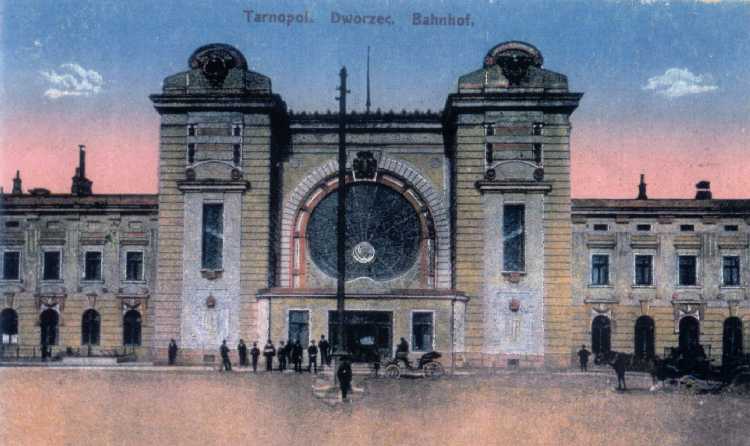 |
| Ternopil Railroad Station |
World War One was very hard on Ternopil', as Austrian, Russian, and German armies invaded the city, its residents suffered great hardship. It wasn't far from the Russian border, and many important battles took place nearby. My Great Aunt Kathrine Pylatuik Lymar told of her village, Bila, being shelled, killing family members, destroying homes, and of having food, possessions and farm animals stolen by soldiers of the various armies. The city was burned by the retreating Russian Army in 1917. After the War ended in 1918, Ternopil' was part of Ukrainian Peoples' Republic. It was captured by Polish and Russian forces in the Polish-Soviet War. According to the Treaty of Riga,which ended the Polish-Soviet War, Galicia and Ternopil' became part of the Republic of Poland in 1920, and remained part of Poland until 1939.
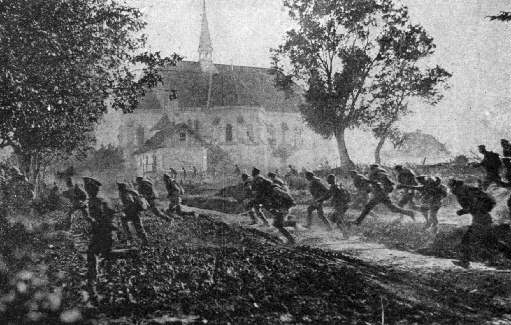 |
| Russian Soldiers Retreating from Ternopil', 1917 |
World War Two was even more destructive to Ternopil'. As a result of the Molotov-Von Ribbentrop Treaty, the Soviets and the Germans divided Poland in 1939. Western Poland came under German control and Eastern Poland, including Galicia became part of the USSR.
 |
| Planned Division of Eastern Europe, 1939 and Actual Changes 1939-1940 |
Many people were deported to Siberia and other eastern areas of the Soviet Union. In 1941, the Nazi armies invaded Galicia and Ternopil', killed most of the Jewish population and sent Ukrainians to forced labor camps in Germany. Most of Ternopil' was destroyed in 1944. After the war, many Polish residents of eastern Galicia, including my great Uncle Andrei Klak and his family, relocated to Western Poland, near the city of Wroclaw. Wroclaw had been part of Germany, known as Breslau. One of the results of the destruction of World War II was that very few buildings in Ternopil' survived, so the city was rebuilt. Ternopil' remained part of the Soviet Union until 1991, when the Soviet Union dissolved and Ukraine became an independent country.
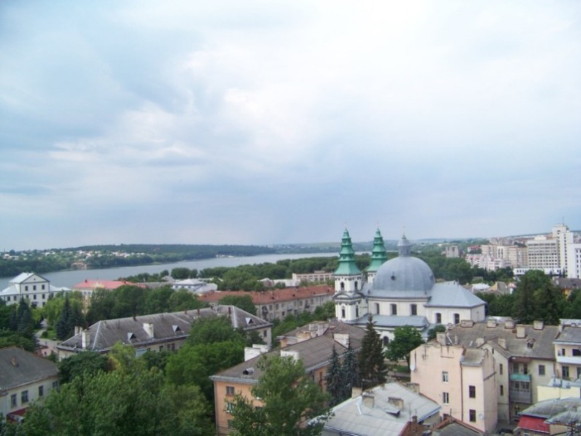 |
| Ternopil' today. Source: The Encyclopedia of Ukraine. |
Friday, August 22, 2014
Living on a battle field: Katherine’s World War I Story
 |
| Village in Galicia destroyed early in World War One. |
Katherine Pylatiuk was ten years old when the Russian Army invaded
her village, Bila, just outside of Ternopil, in Eastern Galicia. She was 18 when the World War One
finally ended in 1921. When the war
started in 1914, Katherine, my great aunt, lived in the Austrian-Hungarian
Empire, when all the associated
conflicts ended in 1921, she lived in Poland. Between 1918 and 1921, when the wars ended, her village was
ruled by the Germans, then by the Ukrainians and finally, the Poles.
Katherine’s father, Sylvester Rychly had immigrated to the
United States and lived in Minneapolis, Minnesota. Her mother, Marya Bryniak Rychly and her six brothers and sisters lived in Bila. It was
difficult being a single mother, but more difficult when you are living in a
battle zone. She and her family
shared their one room house with Russian soldiers for a good part of the
war. The village was often shelled
by the armies, food was scarce.
The armies took whatever they wanted from the villagers, and never
reimbursed them for anything.
 |
| Russian Soldiers in a village on the outskirts of Ternopil'. |
Diadko (Uncle) Panko Bryniak, Marya Rychly’s brother, was
drafted into the Austrian army and left a mare and foal in Marya’s
keeping. Katherine and her cousin
took the animals to a pasture to graze, thinking it was a safe place to take
the horses, since horses were very valuable to the villagers. While they were there, Russian soldiers rode up, took the mare and
the foal followed its mother. The
family was upset about the loss, but there was nothing they could do about it.
 |
| Russian Soldiers in Galicia |
One Christmas, probably in 1914 or 1915, the family had
Russian soldiers in their house and yard, chosing the location because it
was close to a village well. They brought their “magazyn” (supply wagon) and set up a kitchen in the yard. The villagers put straw on the floor of
their houses at Christmas to remind them of the stable in Bethlehem where Jesus
was born. Since the Russian
soldiers slept on the floor, the straw became dirty and matted down. Marya had asthma, and the layers of
straw made her sick, confining her to bed for several weeks.
The good thing about having the “magazyn” was that the
soldiers shared their food with the family. Food was scarce during the war, and for a short while, the
family had enough to eat.
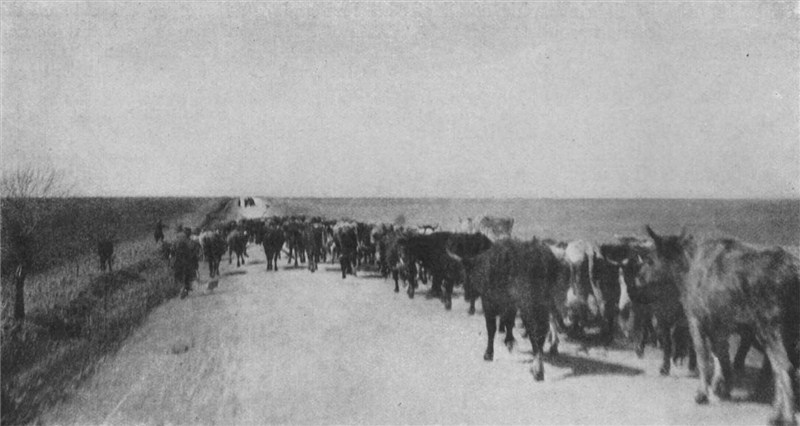 |
| Cattle being Driven to the Russian Army in Galicia, World War One. |
In 1917, when the Russian army retreated back to Russia, the
soldiers ordered the villagers to bring all the cattle to a special enclosed
field. Since Marya had only one
cow and six children to feed, she didn’t want to give it up. As Marya and the other villagers herded
the cattle down the street, she passed her brother’s yard, and quickly pushed
the cow through the gate and hid it.
Fortunately the fence was high and the Russian soldiers didn’t see
anything. The cow was saved, and
the family had food. Since Marya was both
mother and father to her family, so she did what she thought was right. She took a great risk, because if the
soldiers discovered her actions, the punishment would have been a beating or
death. The family would lose both
the cow and its mother.
 |
| This bridge is not in Galicia, but it may be similar to the one built by Russian soldiers over the Syret River. |
On Sundays, the village young people walked to the woods,
and crossed the river Syret to get to there. They used a rickety wooden plank bridge that was built by
the Russian soldiers, The bridge was considered dangerous, but they used anyway. One Sunday, Katherine and friends went
swimming in the lake, and Russian soldiers stole their clothes. They did return the clothing, but it
was the last time she went swimming during the war.
As the war years passed, old customs changed. In early
summer, before the war, the villagers went to their fields on ”Green Sunday” to
bless the grain fields and to ask for a good harvest. The young men and women carried crosses and banners, and
people sang hymns. During the war
this happened only at night. The
soldiers would shoot at anything that they thought was a threat, cultural
events and speaking the Ukrainian language were considered threats. Even though the events were conducted
at night, it was very dangerous.
Living on a battlefield was dangerous. A person never knew
what to expect, life was always changing, and not for the better.
Source:Katerzina(Kaska), Autobiography by Katherine Pylatuik Lymar as told to her Daughter, Julie in 1988.
Friday, August 15, 2014
World War One in Galicia, The Russian Occupation, 1914-1916.
 |
| Easter in Galicia during World War One. Notice the Easter breads and eggs. Austrian soldiers wore gray, Russians brown. It is had to decide the color of these uniforms. Painting by S. Kolesnikov. |
The Russian Grand Duke Nicholas, commander of
the Russian Army, stated in a 1914 manifesto that the people of Galicia were
“brothers who had languished for centuries under a foreign yoke.” He
urged the people of Galicia to unite with Russia under the rule of the Tsar. This idea, Pan-Slavism, called for all people who spoke
Slavic languages and shared culture to be united
under the rule of Russia, which they considered to be the center of Slavic
culture and religion. This was reflected by Russian support of Serbia after the
assassination of the Austrian Archduke Franz Ferdinand by a group of Serbian
nationalists. Russia declared war
on Austria-Hungary, shortly after Austria-Hungary declared war on Serbia in
June of 1914. Although Russia had never
ruled Galicia or Serbia, it considered the people of Galicia, like the Serbs, to be
fellow Slavs, and should be united under Russian rule.
 |
| Grand Duke Nicholas of Russia, in Lviv, 1914 |
When the Russian Army invaded Eastern Galicia in August of 1914, Austrian schools were closed immediately, and eventually replaced with
Russian language schools. Greek Catholic Churches, which served the
Ukrainian population, were closed, the priests arrested and replaced by priests
from the Russian Orthodox Church. The head of the Greek Catholic Church,
Metropolitan Sheptysky, was arrested and exiled to Russia. Ukrainian political
and cultural leaders in Galicia also were arrested and/or deported.
Jews made up 10% population in Galicia, and had
been living there for centuries. At the outbreak of the War, the population of
the city of Ternopil was about half Jewish, half Polish, and 10% Ukrainian. Most of the Jews were tradesmen or craftsmen. Jews were better
educated than the Ukrainians and Poles, as a result, most of the professional
people in Galicia were Jewish. Since the Austrian government encouraged
education of its people, it provided schools for all their subject people in their own language. The Austrian
government also encouraged participation of the people in government, so many
Jews, Poles and Ukrainians were elected to local and regional assemblies. Jews
were allowed to own property in the Austrian-Hungarian Empire, which was not
allowed in Russia. When the war
broke out, most Galician Jews and Ukrainians favored the Austrians, since they
believed that their government had treated them well. Both Ukrainians and Jews supported the Austrians, and because of this, when the war started, many Jews and Ukrainians, including at least two of my uncles, served in the Austrian army.
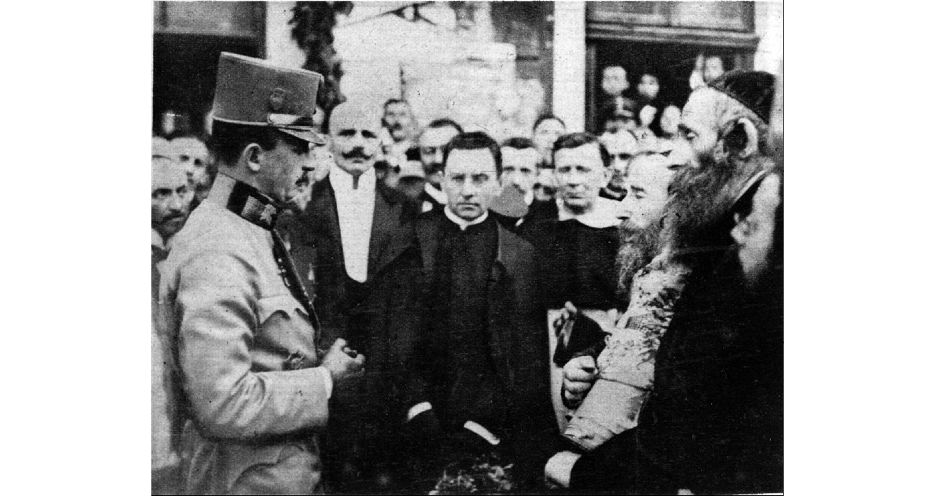 |
| Emperor Franz Joseph of Austria-Hungary visiting Ternopil. He is with Rabbis and a Priest. |
When the Russian Army invaded Eastern Galicia in
August 1914, many Jews decided to leave
Galicia, relocating to other parts of the Empire, especially to Vienna. Those
who remained lost personal property and had their movements limited, some were expelled. In
February 1915, the Russian governor of Galicia banned all correspondence and
publications in the Yiddish language. This was tragic, as Galicia was a center
of Yiddish culture and literature. There were several newspapers published in Yiddish and a thriving Yiddish theater, as well as many book publishers in the larger cities of Galicia.
In the
village of Bila, just east of Ternopil, home of my ancestors, all Christian households were required
to display icons on the gates of their houses, which made identifying Jewish
households easy, and made them subject to punishment. My aunt Katherine said that Jews were beaten unmercifully because the Russians considered
them to be crooked and unjust. they also accused Jews of espionage or collaboration with the enemy. Katherine witnessed the Russians closing saloons run by Jews and
the beer and liquor was poured into the village street.
In 1916, when the Austrian Emperor Franz Joseph died, Katherine said that a picture was sold in the village of the emperor in his casket, surrounded by his family. The villagers honored him by displaying the picture in their homes. At that time, The Russians ruled the area, It was illegal to display the picture. If it wasn't destroyed immediately, people would pay with their lives.
In 1916, when the Austrian Emperor Franz Joseph died, Katherine said that a picture was sold in the village of the emperor in his casket, surrounded by his family. The villagers honored him by displaying the picture in their homes. At that time, The Russians ruled the area, It was illegal to display the picture. If it wasn't destroyed immediately, people would pay with their lives.
 |
| Picture of Emperor Franz Joseph in his coffin, similar to the picture the villagers displayed in Bila |
Katherine said that "The Russians were never sympathetic to the Ukrainians as the Austrians were. The Jews of Galicia also honored the Emperor, and he was mourned by Jewish communities all over Austria. Many Jews believed that the death of Franz Joseph was the end of the freedom they enjoyed to practice their religion and way of life. They didn't think that Austria-Hungary would survive the death of the Emperor. It did survive, but not for long.
Friday, August 8, 2014
World War One in Galicia: Katherine's Story
|
| Russian Soldiers on the outskirts of Ternopil |
Katherine Rychly, my aunt was ten years old when World War
One started. The war continued
until 1917, when the Russian Revolution began, and the Russian army retreated
from the Ternopil area and the village of Bila. The end of the war did not bring peace to Galicia, since
various groups occupied the area as a result of wars between the Russians,
Poles and Germans for control of the area. Calm returned in 1920, when Eastern Galicia became part of
Poland. A good part of Katherine’s
early life took place on the front lines of war. She details her life in the village of Bila, just outside
the city of Ternopol, in her memoir/autobiography: Katheryna (Kashka) Autobiography by Katherine Pylatiuk Lymar, as told
to her daughter, Julia, 1988.
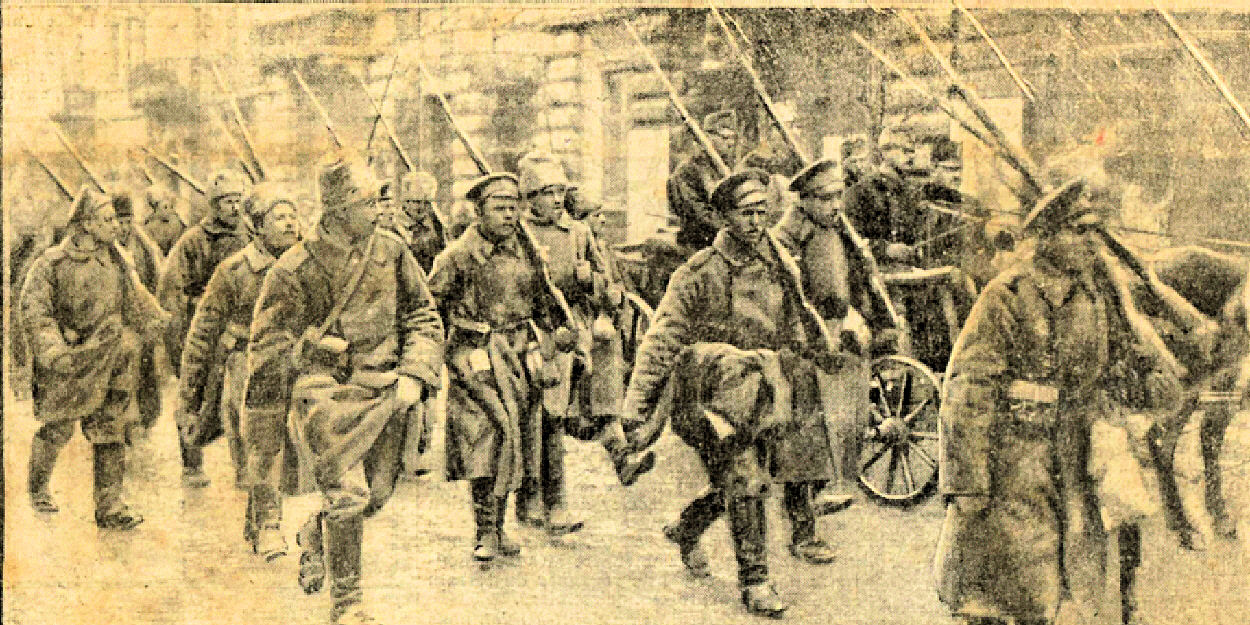 |
| Russian Soldiers entering Przemysl in Galicia on March 22, 1915. (see map below) |
Although the Russian Army did not have great success in
World War One, losing battles and territory in Northern Poland; they were very
successful in Galicia. On August 18, 1914, the Russian Eighth army commanded by General
Brusilov, invaded and captured most of Eastern Galicia by the middle of September. The Russians controlled
this area until the end of 1915, when the Austrian-German Army pushed them back to the”Riga-Jakobstadt-Dunaburg-Baranovichi-Pinsk-Dubno-Ternopil”
line. In 1916, the Russian Army retook much of Eastern Galicia, holding it for
several months. The city of Ternopil, and the areas to the east, remained under
Russian control from 1914 until 1917, after the Bolshevik October Revolution.
From that time until the end of the war in 1918, the easternmost areas of
Galicia returned to Austria.
 |
| Galicia in 1915, showing the "Riga...Ternopil" line. |
The Russian policy in Galicia was very different than that
of the Austrians. The Austrians
were tolerant of ethnic minority
people, including the Ruthenians (Ukrainians) and Jews. They had some representation in the
government, as well as schools taught in their language and were allowed
religious freedom. For the most part, these groups remained loyal to the
Austrian during the Russian occupation.
 |
| Map of Galicia, Eastern Galicia is shown in pink. |
Katherine relates a story of how the War affected her
family. Her uncle, Kassian Bryiak, immigrated to Minneapolis in 1913. Nooshka, wife
and son Paul remained in Bila.
The Russians were fighting the Austrians, so this story probably took place
in 1915. The village of
Bila was in their crossfire, the villagers hid in the fields to avoid the
shelling. Nooshka and Paul were
hiding in a hole. Paul was
hungry and started crying, Nooshka decided to go to the barn and get some milk
from a cow. As she entered the
barn, it was hit by a shell, it exploded, killing her and all the animals. According to custom, her body was
washed and dressed and put on a board in her house. Nooska’s father and brother
were sitting next to her body, receiving visitors paying their respects. They decided to go outside for a few minutes to smoke.
As they sat smoking their pipes, a shell came through the window of the
house, exploded in the room where Nooshka was laid out, destroying everything in the room including
her body. What was left of her
remains was buried in the village cemetery. Kassian, her husband, sent money from Minnesota for a stone
memorial, which was unusual, since most village people could afford only wooden
crosses. Not long after it was installed, a shell hit her grave and exploded,
destroyed the gravestone and left a large hole. Village gossip swirled around Nooshka’s unfortunate
end. People in the village said
that she was having an affair with a Russian soldier who often came to the
village. His wife came to see
Nooshka and “put a curse on her”.
The villagers believed that the curse led to her horrible death and the
destruction of her grave.
 |
| Cemetery in Chernobyl, Ukraine, 1998. Photo: David McMillan |
Nooshka’s demise continued to affect Katherine’s
family. The family decided that
her mother, Marya, and her children should move into Nooshka’s house, since it
was much larger and better than theirs. They moved in, but were never
comfortable, because the family found that living there was frightening. When the shell hit the house, Nooshka’s
body was blown to bits, staining the walls and ceiling. Even though it was scrubbed and painted
many times, the stains always reappeared, reminding them of her horrific end.
Katherine experienced the shelling first hand again when she visited her grandmother’s house in the village. A shell landed on the straw roof of her house, but it didn’t explode, and the house wasn’t damaged.
From June of 1915 until 1916, things in Bila were relatively
calm. The Russian soldiers
continued to live in the village houses, but life returned to a sort of
normal. People worked in their
fields and at their trades.
Adjustments were made, since no one knew when the shooting would
start up again.
Subscribe to:
Posts (Atom)