Showing posts with label Ternopil. Show all posts

Friday, August 8, 2014

World War One in Galicia: Katherine's Story


Russian Soldiers on the outskirts of Ternopil


Katherine Rychly, my aunt was ten years old when World War One started.  The war continued until 1917, when the Russian Revolution began, and the Russian army retreated from the Ternopil area and the village of Bila.  The end of the war did not bring peace to Galicia, since various groups occupied the area as a result of wars between the Russians, Poles and Germans for control of the area.  Calm returned in 1920, when Eastern Galicia became part of Poland.  A good part of Katherine’s early life took place on the front lines of war.  She details her life in the village of Bila, just outside the city of Ternopol, in her memoir/autobiography: Katheryna (Kashka) Autobiography by Katherine Pylatiuk Lymar, as told to her daughter, Julia, 1988.
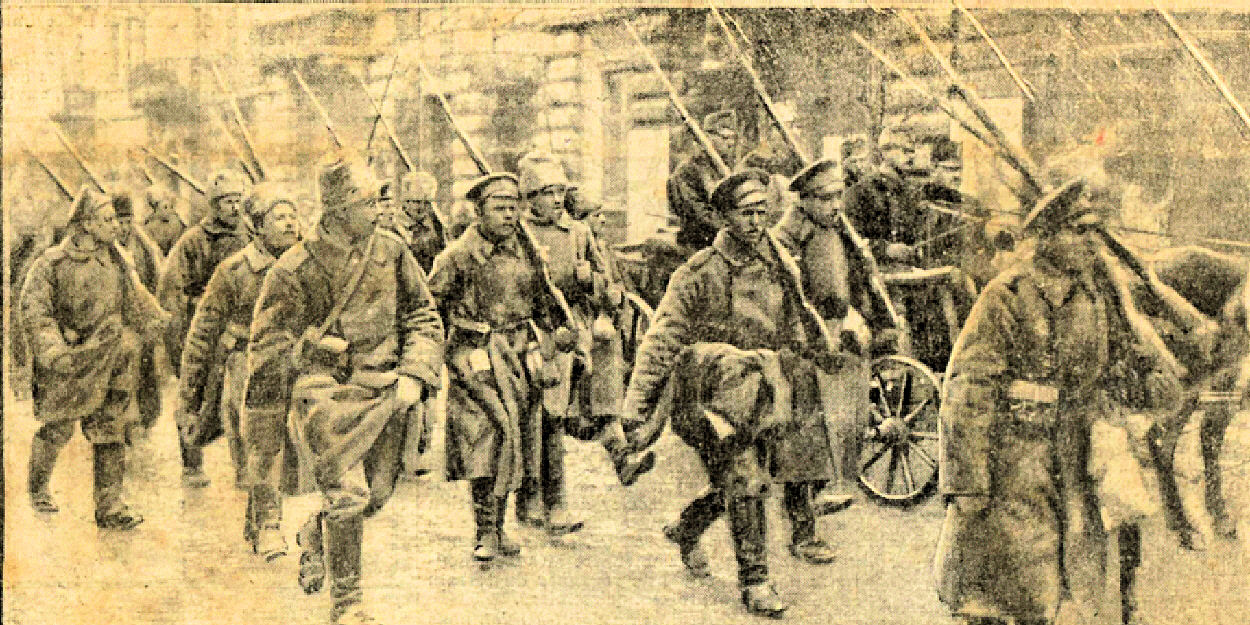
 
Russian Soldiers entering Przemysl in Galicia on March 22, 1915.  (see map below)

Although the Russian Army did not have great success in World War One, losing battles and territory in Northern Poland; they were very successful in Galicia. On August 18, 1914, the Russian Eighth army commanded by General Brusilov, invaded and captured most of Eastern Galicia by the middle of September. The Russians controlled this area until the end of 1915, when the Austrian-German Army pushed them back to the”Riga-Jakobstadt-Dunaburg-Baranovichi-Pinsk-Dubno-Ternopil” line. In 1916, the Russian Army retook much of Eastern Galicia, holding it for several months. The city of Ternopil, and the areas to the east, remained under Russian control from 1914 until 1917, after the Bolshevik October Revolution. From that time until the end of the war in 1918, the easternmost areas of Galicia returned to Austria.

 
Galicia in 1915, showing the "Riga...Ternopil" line.

The Russian policy in Galicia was very different than that of the Austrians.  The Austrians were tolerant of  ethnic minority people, including the Ruthenians (Ukrainians) and Jews.  They had some representation in the government, as well as schools taught in their language and were allowed religious freedom. For the most part, these groups remained loyal to the Austrian during the Russian occupation. 


Map of Galicia, Eastern Galicia is shown in pink. 


Katherine relates a story of how the War affected her family. Her uncle, Kassian Bryiak, immigrated to Minneapolis in 1913.  Nooshka, wife and son Paul remained in Bila.  The Russians were fighting the Austrians, so this story probably took place in 1915. The village of Bila was in their crossfire, the villagers hid in the fields to avoid the shelling.  Nooshka and Paul were hiding in a hole.  Paul was hungry and started crying, Nooshka decided to go to the barn and get some milk from a cow.  As she entered the barn, it was hit by a shell, it exploded, killing her and all the animals.  According to custom, her body was washed and dressed and put on a board in her house. Nooska’s father and brother were sitting next to her body, receiving visitors paying their respects. They decided to go outside for a few minutes to smoke.  As they sat smoking their pipes, a shell came through the window of the house, exploded in the room where Nooshka was laid out, destroying everything in the room including her body.  What was left of her remains was buried in the village cemetery.  Kassian, her husband, sent money from Minnesota for a stone memorial, which was unusual, since most village people could afford only wooden crosses.   Not long after it was installed, a shell hit her grave and exploded, destroyed the gravestone and left a large hole. Village gossip swirled around Nooshka’s unfortunate end.  People in the village said that she was having an affair with a Russian soldier who often came to the village.  His wife came to see Nooshka and “put a curse on her”.  The villagers believed that the curse led to her horrible death and the destruction of her grave.
 
Cemetery in Chernobyl, Ukraine, 1998. Photo: David McMillan

Nooshka’s demise continued to affect Katherine’s family.  The family decided that her mother, Marya, and her children should move into Nooshka’s house, since it was much larger and better than theirs. They moved in, but were never comfortable, because the family found that living there was frightening.  When the shell hit the house, Nooshka’s body was blown to bits, staining the walls and ceiling.  Even though it was scrubbed and painted many times, the stains always reappeared, reminding them of her horrific end.


Katherine experienced the shelling first hand again when she visited her grandmother’s house in the village.  A shell landed on the straw roof of her house, but it didn’t explode, and the house wasn’t damaged.

From June of 1915 until 1916, things in Bila were relatively calm.  The Russian soldiers continued to live in the village houses, but life returned to a sort of normal.  People worked in their fields and at their trades.  Adjustments were made, since no one knew when the shooting would start up again.

Friday, June 27, 2014

June 28, 1914: “The Archduke is Assassinated!”

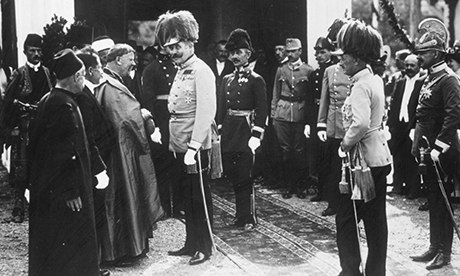
Archduke Franz Ferdinand of Austria-Hungary, being greeted by dignitaries in Sarajevo, June 28, 1914


June 28, 1914 was an ordinary Sunday in the village of Bila, just outside the eastern wall of the city of Ternopil.  The villagers attended church and ate dinner at home. They spent spring and summer afternoons outdoors, visiting with friends and enjoying the summer weather. Nobody had any idea how everyone’s lives would change because of what happened that Sunday morning in Sarajevo, Bosnia-Herzegovina. 

My great-aunt, Katherine Rychly was 10 years old in 1914. Her father, Sylvester, was in Minneapolis, Minnesota, working at a sugar company in order to save enough money to bring his family to the United States.  Katherine’s older sister Anna was newly married and living in Minneapolis. Katherine's other older sister, my grandmother, Paranka (Pauline), had left Bila a few days earlier,  and sailed from Bremen, Germany, on June 23, arriving in New York on July 1, 1914.  Katherine, Anna and Paranka wouldn’t see each other again until 1922.

Map of the Austria-Hungary Empire, showing Bosnia - Herzegovina and the city of Sarajevo


Sarajevo, Bosnia, was located in a province of the Austria-Hungary Empire, added in 1908, after being occupied by the Austrians since 1878.  The province had a mixed population of Serbs, Croats, Muslims and other ethnic groups.  The annexation of Bosnia-Herzegovina by Austria-Hungary was unpopular with its people. I have heard from family stories that my paternal grandfather, John Nyznyk, was a soldier in the Austrian army, stationed in Bosnia-Herzegovina, and he said that there were a lot of problems there.  After the Balkan war of 1912-1913, the neighboring country of Serbia gained territory and power, and growing Serbian nationalism encouraged the Serbs to do something about the status of Bosnia and Herzegovina. 


June 28 is an important day to the Serbians, St Vitus’s Day, the day when, in 1389, the Ottoman Turks destroyed the Serbian Army on the Field of Blackbirds—today known as Kosovo, and ended the Serbian Empire.  The Serbian lands and people became part of the Ottoman Empire.  The visit of the Archduke, Franz Ferdinand to Sarajevo on June 28 was considered an insult to the Serbs.   Austrian authorities were warned that the Archduke’s visit wasn’t a good idea, but nobody took these threats seriously.  Seven young Serbian men volunteered to assassinate the Archduke and his wife. They were members of a secret Serbian nationalist society, The Black Hand. 
Archduke Franz Ferdinand arriving in Sarajevo on the morning of June 28, 1914

 
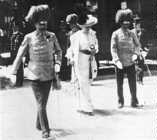
The Archduke and the Duchess Sophie leaving the train station for the ride to City Hall


On Sunday morning, June 28, the Archduke and his wife, the Duchess Sophie, arrived at the Sarajevo train station. There was a six car motorcade waiting, full of Austrian and local dignitaries.  Their first destination was the Sarajevo City Hall, with other stops scheduled later.

The Archduke and the Duchess were in the second car, open so the crowds could see them, along with the Governor of Bosnia and another person. There was no security along the route, normally soldiers line the streets when important dignitaries such as the Archduke visited. The chosen route, Appel Quay runs along the Miljacka River.  Two cells of Serbian terrorists were stationed along the Quay. To insure its success, seven men were assigned to the plot.  Each one had small bomb strapped to his waist, a revolver and a packet of cyanide in his pocket.


The first assassin lost his nerve and did not throw his bomb.  As the second assassin detonated his bomb, it made a noise similar to a blown tire, which alerted people in the motorcade.  The bomb was thrown just as the driver stepped on the gas.  The Archduke batted the bomb away, and it exploded under the third car, injuring several people. The second assassin swallowed the cyanide and jumped over the wall and into the river.  His suicide attempt was unsuccessful, and he was easily captured. 

The motorcade was stopped so the wounded could be attended to, and the proceeded to the Town Hall. 
The third, fourth and fifth assassins lost their confidence and did nothing.

The Archduke and Duchess minutes before the assassination


The Motorcade arrived at the Town Hall, the planned speeches continued after the Archduke expressed his unhappiness with the “welcome” he received.  It was decided to cancel the rest of the day’s activities, however, the Archduke wanted to visit the wounded at the hospital.  Nobody thought to tell the drivers of the changed plans, so when the parties arrived at the cars, the procession went ahead with the original route.  Someone in the Archduke’s party shouted that they were driving in the wrong direction, so the cars stopped.  Since the Archduke’s car did not have a reverse gear, the car had to be pushed backwards to Franz Joseph Street.  

Map of the Archdukes's route.  The green arrows show the trip from the train station to the City Hall.  The yellow star is the first bomb.  The  broken red arrows show the new route from the City Hall to the Hospital.  The red star is the place of the Assassination


The sixth assassin, Gavrilo Princip, saw that the car stopped and ran toward it.  He untied the bomb, but decided to use his revolver.  The first bullet hit the Duchess in the stomach.  The second shot hit the Archduke in the neck.  Both died quickly, by the time the car arrived at the hospital, both were dead.  It was 11 o’clock in the morning.

 
Newspaper depiction of the assassination.  Duchess Sophie was shot in the stomach, the Archduke  was shot in the neck.


The next day, newspaper headlines around the world told the story, but nobody as any idea  how far reaching the consequences of the assassination would be.  Many people remembered for years, exactly what they were doing when they heard the news of the assassination, the effect was similar to how people felt when they heard about the Attack on Pearl Harbor, the Assassination of President Kennedy or 9/11.


The arrest of the assassin, Gavrilo Princip.