 |
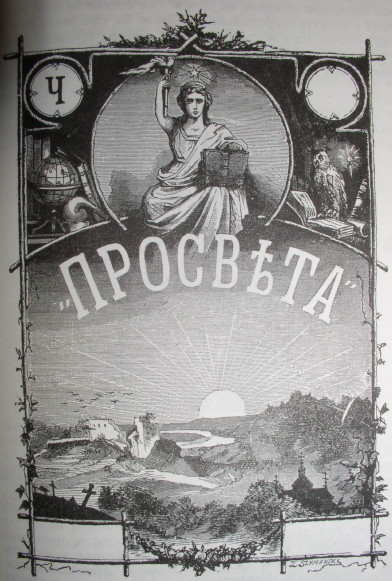
| Cover of a Prosvita Publication |
There was a house in the village of Biala where nobody lived. It was owned by Painko Bryniak, my 2Xtigreat uncle. My great aunt Katherine Rychly Pylatiuk called it the chytalnia, which means reading house in Ukrainian. Monthly meetings were held in the house called Veedchyty (means reading in Ukrainian). These meetings were for the enlightenment of the men, where the more educated shared their knowledge with the less educated.
.jpg) |
| Prosvita reading House in a village. Source: Encyclopedia of Ukraine |
Katherine explains in her autobiography how valuable the veedchyty were to the people of the village. Since her grandmother lived next door to the chytalnia, (Painko Bryniak owned that house as well) she could look through the window and see a bust of the Ukrainian poet an artist, Taras Shevchenko. She heard the men recite Shevchenko's poems and sing patriotic Ukrainian songs. Sometimes one of the men would read an article and then lead a discussion about it. She also saw shelves of books and magazines and portraits of famous Ukrainian s on the wall of the house.
 |
| Statue of Taras Shevchenko on the Mall, Washington D.C. |

What was the Prosvita Society?
This reading house in Biala was a part of the Prosvita Society. Prosvita means enlightenment in Ukrainian, founded in 1868 in Lviv by Ukrainian students in order to "know and edify the people." Until 1914, Prosvita was the most important Ukrainian mass organization in Galicia. Its activities included almost all aspects of Ukrainian life, and it created many cultural, political, economic, farming and sports societies and organizations which eventually became independent organizations.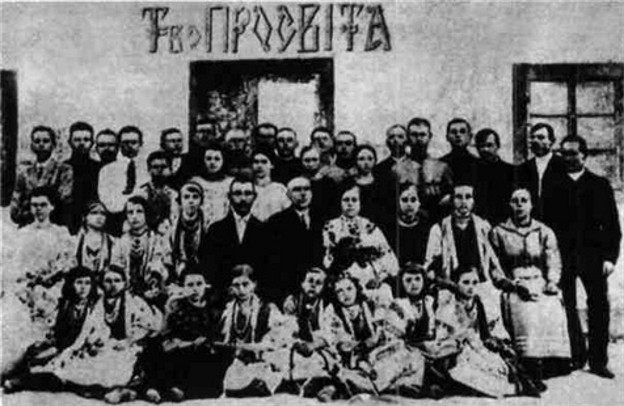 |
| Founders of the Prosvita Society, 1868. Source: Encyclopedia of Ukraine. |
Why did this group of young people feel that it was necessary to edify the people when free public education was available for children in Galicia up to the age of twelve?
This is a question is hard to answer because it involves both politics and history. Biala, Ternopil' and Eastern Galicia were part of the Austrian-Hungarian Empire which was made up of many countries and many ethnic groups. The Austrians kept control of its various peoples by encouraging discord between ethnic groups. This policy worked for a time, but in 1861 Austria became a constitutional monarchy when it recognized the Hungary as an equal partner and changed its name to the Austrian-Hungarian Empire. Both Austria and Hungary had their own legislatures and capitals, Vienna for Austria and Budapest for Hungary. The Austrians had their hands full dealing the demands of the various ethnic groups, and left the governing of Galicia to the Poles. In the 1860's, the Poles controlled the both local and provincial government in Eastern Galicia. The Ukrainians wanted instruction in the Ukrainian language in the schools, more Ukrainian high schools, more representation in government and recognition of their culture. There were many conflicts between the Ukrainians and Poles, but since the Poles held all the positions of power, decisions almost always favored Polish interests. The founders of Prosvita realized that if the Ukrainian people of were to achieve economic and political power, they would have to do it on their own.
 |
| Map of Eastern and Western Galicia. |
Prosvita's Three Goals
Increasing Literacy
Increasing literacy was Prosvita's first goal. A network of libraries and reading rooms were established in Eastern Galicia. Most villages had schools with trained teachers, and lessons were in both Ukrainian and Polish. One of the first actions of Prosvita was to publish basic textbook in the Ukrainian language to be used in schools. The society started a network of chytalnias (reading rooms) in the Lviv area, where books and other reading materials were available. These reading rooms spread quickly and within a few years, reading rooms were established all over Eastern Galicia.Higher education was a concern, elementary schools, run by the government were available, but secondary education was not. To raise the cultural level of the Ukrainian people, access to higher education was a necessity. In 1897, 30 high schools were Polish, two were Ukrainian. in Galicia. By 1914, four more Ukrainian high schools were added by the government. Acting on the idea of self help and knowing that no more high schools would be funded by the government, contributions by the Ukrainian community established eight more private high schools. Private dormitories were built in Lviv so students from rural areas could attend high school and university. Few Ukrainian students attended Lviv University; about 500 students out of a student body of 1700, which had eight Ukrainian professors in of a faculty of eighty. Ukrainian professorships gradually increased and the government promised a Ukrainian university, but this did not happen because of the outbreak of World War One.
 |
| Cover of "Lions" Ukrainian History Book published by Prosvita |
Increasing the Economic Level of the People
Prosvita's second goal was to raise the economic level of the Ukrainian farmers in Galicia. Ukrainians in the Austrian empire were among the Empire's poorest and under represented people. Self help was the key, since there was no help coming from the government. |
| Prosvita Vasyl Orynchuk cooperative members, Roztoky, Lviv Region. Source: wumag.ua |
Cooperatives, stores and warehouses were formed to improve the condition of the peasants. Courses were organized to help the farmers modernize and improve farming methods. Itinerant farming instructors travel the region and taught local farmers how to use modern methods. It started a commercial school in Lviv, a farming school and a women's domestic school. Prosvita gave scholarship for students to study agronomy, dairying and domestic management. Credit unions were started to enable peasants to save money and to borrow it when necessary. Books were published about farming and other subjects such as Ukrainian history and literature. In 1877 Prosvita started to print monthly booklets which were given to members free of charge and established a newspaper was in 1879.
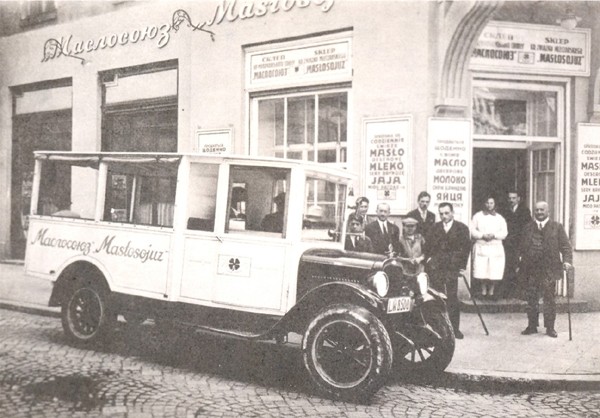 |
| Prosvita Dairy Store/Cooperative in Lviv. Source: Encyclopedia of Ukraine |
Building Cultural Awareness and Patriotism
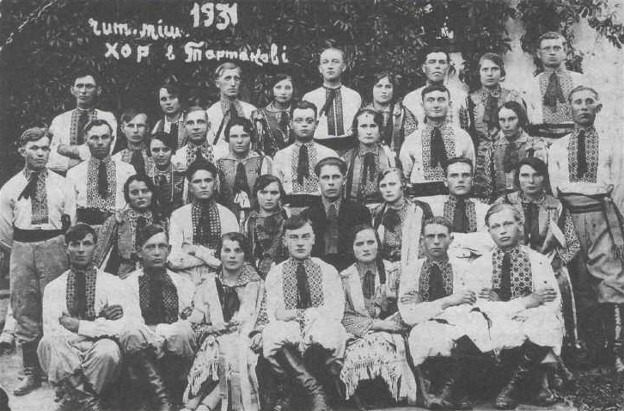 |
| Choir organized by the Prosvita Reading House in Zahiria, 1931. Source: Encyclopedia of Ukraine |
The third goal was to raise awareness of the Ukrainian language and culture among the Ukrainian people. To further awareness, Prosvita encouraged the Ukrainians to form choirs, bands and drama groups; learn about Ukrainian history, read literature in the Ukrainian language and develop Ukrainian patriotism. Prosvita started Sokil and Sich in 1894 to encourage youth appreciation for discipline, cooperation, patriotism and education. Sokil developed physical training and the goal of Sich was to develop patriotic and cultural activities.
 |
| Drama Group, Prosvita Mohyntsa, Ternopil' Source: ebay. |
Prosvita's Support
Prosvita's support came from membership dues, individual donations, subsidies from the provincial and cnetral government. Government support was small and was often cut off by Polish opposition. Profits from Prosvita's printing and its other operations also funded its activities. Between 1869 and 1906, Prosvita made a small profit, of 2000 Kronen.iProsvita's SuccessBy 1900, the Prosvita chytalnia reading houses became the center of village life, displacing the church and tavern. In 1914, Prosvita had 77 regional branches, 3000 reading rooms and over 200,000 members. 75% of the villages cities and towns of Galicia had reading rooms, thelargest number of were in the Ternopil' area. It published over three million copies of 495 books, supported 45 scholarships for high school and university students. Prosvita owned its own headquarters building in Lviv and sponsored a large celebration of the 100th anniversary of Taras Shevchenko's birth there in 1914. It spread out from Eastern Galicia to other parts of the Austrian empire with large numbers of Ukrainians. It also was established in Eastern Ukraine, which was ruled by Russia.
Prosvita played a critical role in the growth of national consciousness among Ukrainians and in the improvement of their standard of living.
Wilhem Feldman said in 1907, "The 20th century has seen many nations rise from the ashes, but there are very few cases of rebirth so rapid and energetic as that of the Ukrainians of Austria... their unexpected and vigorous growth is mostly the result of self-help and hard fought gains." Subtelny, p. 329.
.jpg) |
| The Prosvita Building in Lviv. Source: Encyclopedia of Ukraine. |
Sources:
Encyclopedia of Ukraine, www.encyclopediaofukraine.com
Lawryk, Julia, Kateryna (Kasha) Autobiography by Katherine Pylatiuk Lymar as told to her Daughter, Julie Lawryk in 1988. copyright 1988
Subtely, Orest, Ukraine, A History, University of Toronto Press, Toronto, Canada, 1988
Yaremko, Michael, Galicia-Halachyn: From Separation to Unity, Shevchenko Scientific Society, Toronto, 1967.