Showing posts with label Pauline Rychly. Show all posts

Thursday, July 3, 2014

The 100th Anniversary of Pauline Rychly’s Arrival in the United States.


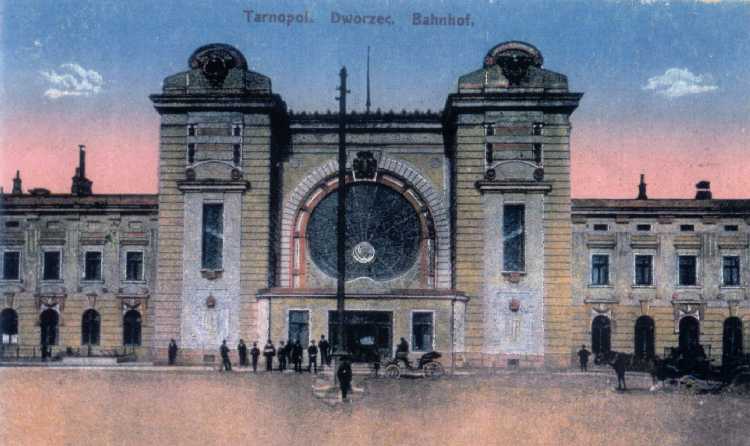
The Train Station in Ternopil', the beginning of my Grandmother's journey to the United States.


Tomorrow, the 4th of July, 2014 is the 100th anniversary of my grandmother, Pauline Rychly Koshuba Haykak’s arrival in Minneapolis, Minnesota.  She left her home in the village of Bila, just outside of the city of Ternopil’ (aka Tarnopol), in June 1914.  I am not sure of the exact date, but I do know that she left on the ship, The Kronprinz Wilhem, from Bremen Germany, on June 23, 1914, bound for New York City.   
 
The Kronprinz Wilhem, built in 1901, shortly after my Grandmother arrived in the US in 1914 it became a German warship.

According to the ship’s manifest, she was 14 years old.  She traveled with her Uncle and Aunt, Constantine and Maria Bilan Rychly and their young daughter, Anna.  All of her belongings were in a trunk, which for some reason, she kept for her entire life.  One of her grandsons has the trunk now.
The voyage was difficult for Pauline, since she was seasick for most of the time.  She was traveling on 3rd class tickets, commonly known as steerage, and was processed at Castle Garden, the old immigrant processing center, reopened because Ellis Island could not handle of the large number of ships arriving in New York.  Castle Garden is located near Battery Park and the terminal for the Staten Island Ferry in lower Manhattan. 
 
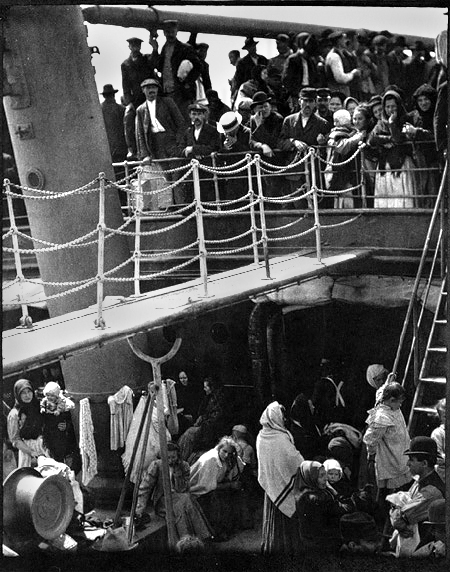
Photo by Alfred Stieglitz, Steerage class on a ship bound for Bremen, Germany is 1907

Castle Garden, where my Grandmother first stepped on American soil.


Passengers who had first or second class tickets were processed on board, and left from a dock near where the Verrazano Narrows Bridge is today.  Third class passengers were taken by ferry to Ellis Island, or Castle Garden for immigration processing.  If there were no problems, the immigrants took another ferry to the railroad station in New Jersey, where they continued the journey to their final destination.  Third class tickets for the trip from Europe to the United States big money makers for the shipping lines and railroads, and were often offered as package deals, costing about $25.  I have to mention that although the price of a trans-Atlantic ticket appears to be low, it took an average immigrant working in the United States at that time, about a year to save the money to buy a ticket for a relative in Europe. The shipping lines made no money on first or second class tickets, the profit was made on the third class tickets. 
 
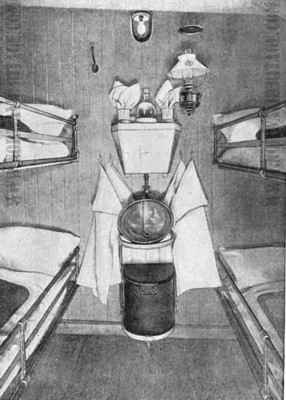
Four bunks in a steerage class cabin.

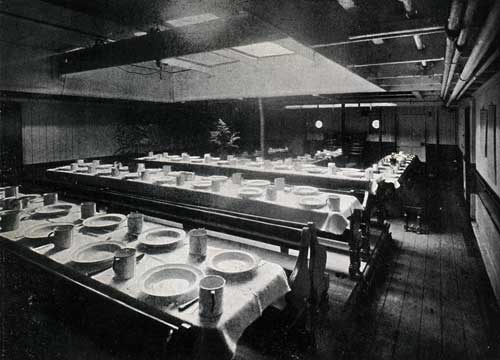
Third Class Dining Room on a Trans-Atlantic passenger ship

Accommodations on the voyage in third class were Spartan. The steerage section was in the front of the ship, which felt all the pitching and rolling.  Meals were included in the fare, but the food served was unfamiliar to many of the immigrants, so they didn’t eat it.  My great-aunt, Katherine remembers that she was served liverwurst sandwiches and ripe bananas, which she had never seen before.   The accommodations were basic, on the lower decks, travelers slept in bunk beds, which were sometimes in large rooms, sometimes in cabins. There were portholes in some of the cabins, but they didn’t open. Passengers spent the day walking on the deck.   There were no lounges or entertainment offered to immigrants. 

Ellis Island Train Station--after being processed, many immigrants boarded a train here for the trip to the West.
 
Inside a car on an immigrant train
Pauline’s sea voyage from Germany to New York took about nine days. My grandmother must have been on a slow train, because it took four days to go from New Jersey to Minneapolis. Often all the passengers on a train were immigrants, so the facilities on the trains were meager, especially if the train and ship were a package deal.

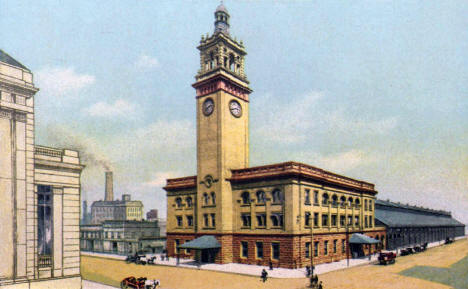
Milwaukee Station, Minneapolis MN.

On July 4th, Pauline, Constantine, Maria and Anna arrived in Minneapolis, and were met their family members.  Pauline’s father, Sylvester had been in the United States since 1908, and her sister Anna, since 1913.  Fourth of July fireworks made a big impression on Pauline, since she had never seen such a display.  Within a few days, she was working in the laundry at the Nicollet Hotel in downtown Minneapolis.


Gateway Park and the Nicollet Hotel where my Grandmother worked when she first came to Minneapolis


Pauline and Anna Rychly in 1915.  This is the oldest picture I have of my Grandmother.

Friday, June 27, 2014

June 28, 1914: “The Archduke is Assassinated!”

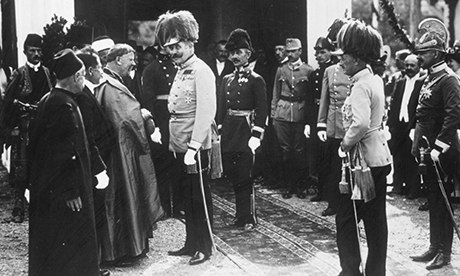
Archduke Franz Ferdinand of Austria-Hungary, being greeted by dignitaries in Sarajevo, June 28, 1914


June 28, 1914 was an ordinary Sunday in the village of Bila, just outside the eastern wall of the city of Ternopil.  The villagers attended church and ate dinner at home. They spent spring and summer afternoons outdoors, visiting with friends and enjoying the summer weather. Nobody had any idea how everyone’s lives would change because of what happened that Sunday morning in Sarajevo, Bosnia-Herzegovina. 

My great-aunt, Katherine Rychly was 10 years old in 1914. Her father, Sylvester, was in Minneapolis, Minnesota, working at a sugar company in order to save enough money to bring his family to the United States.  Katherine’s older sister Anna was newly married and living in Minneapolis. Katherine's other older sister, my grandmother, Paranka (Pauline), had left Bila a few days earlier,  and sailed from Bremen, Germany, on June 23, arriving in New York on July 1, 1914.  Katherine, Anna and Paranka wouldn’t see each other again until 1922.

Map of the Austria-Hungary Empire, showing Bosnia - Herzegovina and the city of Sarajevo


Sarajevo, Bosnia, was located in a province of the Austria-Hungary Empire, added in 1908, after being occupied by the Austrians since 1878.  The province had a mixed population of Serbs, Croats, Muslims and other ethnic groups.  The annexation of Bosnia-Herzegovina by Austria-Hungary was unpopular with its people. I have heard from family stories that my paternal grandfather, John Nyznyk, was a soldier in the Austrian army, stationed in Bosnia-Herzegovina, and he said that there were a lot of problems there.  After the Balkan war of 1912-1913, the neighboring country of Serbia gained territory and power, and growing Serbian nationalism encouraged the Serbs to do something about the status of Bosnia and Herzegovina. 


June 28 is an important day to the Serbians, St Vitus’s Day, the day when, in 1389, the Ottoman Turks destroyed the Serbian Army on the Field of Blackbirds—today known as Kosovo, and ended the Serbian Empire.  The Serbian lands and people became part of the Ottoman Empire.  The visit of the Archduke, Franz Ferdinand to Sarajevo on June 28 was considered an insult to the Serbs.   Austrian authorities were warned that the Archduke’s visit wasn’t a good idea, but nobody took these threats seriously.  Seven young Serbian men volunteered to assassinate the Archduke and his wife. They were members of a secret Serbian nationalist society, The Black Hand. 
Archduke Franz Ferdinand arriving in Sarajevo on the morning of June 28, 1914

 
The Archduke and the Duchess Sophie leaving the train station for the ride to City Hall


On Sunday morning, June 28, the Archduke and his wife, the Duchess Sophie, arrived at the Sarajevo train station. There was a six car motorcade waiting, full of Austrian and local dignitaries.  Their first destination was the Sarajevo City Hall, with other stops scheduled later.

The Archduke and the Duchess were in the second car, open so the crowds could see them, along with the Governor of Bosnia and another person. There was no security along the route, normally soldiers line the streets when important dignitaries such as the Archduke visited. The chosen route, Appel Quay runs along the Miljacka River.  Two cells of Serbian terrorists were stationed along the Quay. To insure its success, seven men were assigned to the plot.  Each one had small bomb strapped to his waist, a revolver and a packet of cyanide in his pocket.


The first assassin lost his nerve and did not throw his bomb.  As the second assassin detonated his bomb, it made a noise similar to a blown tire, which alerted people in the motorcade.  The bomb was thrown just as the driver stepped on the gas.  The Archduke batted the bomb away, and it exploded under the third car, injuring several people. The second assassin swallowed the cyanide and jumped over the wall and into the river.  His suicide attempt was unsuccessful, and he was easily captured. 

The motorcade was stopped so the wounded could be attended to, and the proceeded to the Town Hall. 
The third, fourth and fifth assassins lost their confidence and did nothing.

The Archduke and Duchess minutes before the assassination


The Motorcade arrived at the Town Hall, the planned speeches continued after the Archduke expressed his unhappiness with the “welcome” he received.  It was decided to cancel the rest of the day’s activities, however, the Archduke wanted to visit the wounded at the hospital.  Nobody thought to tell the drivers of the changed plans, so when the parties arrived at the cars, the procession went ahead with the original route.  Someone in the Archduke’s party shouted that they were driving in the wrong direction, so the cars stopped.  Since the Archduke’s car did not have a reverse gear, the car had to be pushed backwards to Franz Joseph Street.  

Map of the Archdukes's route.  The green arrows show the trip from the train station to the City Hall.  The yellow star is the first bomb.  The  broken red arrows show the new route from the City Hall to the Hospital.  The red star is the place of the Assassination


The sixth assassin, Gavrilo Princip, saw that the car stopped and ran toward it.  He untied the bomb, but decided to use his revolver.  The first bullet hit the Duchess in the stomach.  The second shot hit the Archduke in the neck.  Both died quickly, by the time the car arrived at the hospital, both were dead.  It was 11 o’clock in the morning.

 
Newspaper depiction of the assassination.  Duchess Sophie was shot in the stomach, the Archduke  was shot in the neck.


The next day, newspaper headlines around the world told the story, but nobody as any idea  how far reaching the consequences of the assassination would be.  Many people remembered for years, exactly what they were doing when they heard the news of the assassination, the effect was similar to how people felt when they heard about the Attack on Pearl Harbor, the Assassination of President Kennedy or 9/11.


The arrest of the assassin, Gavrilo Princip.

Saturday, September 14, 2013

THE KOSHUBA BROTHERS

Unlike many immigrants from Eastern Europe in the early 20th century, my grandfather John Koshuba,  and great uncles, Joseph and Stephen Koshuba, were businessmen.  Born in the village of Ouzurnaya, Galicia, Austria, they were the sons of Feodor Koshuba and Maria Kleviak.  I have no idea what Feodor did for a living, but I have heard family stories that they were a town family.  

John Koshuba and Family, Stephen and Helen Koshuba (standing)1925

Joseph Koshuba 1916


John was born in 1880, Joseph in 1885 and Stephen in 1899.  There were three other children, Teckla, Anna and Michael, but that is story for another time.
Joseph came to the United States first, according to the 1910 census, in 1904.  John came next, possibly in 1908 (1910 census) and Stephen in 1914 (immigration records). 
The first records I could find of the older brothers were the 1910 US Census.  John was living in Peabody, MA, with this sister and brother-in-law, Teckla and Peter Wons, their two children, and was employed as a baker.
Joseph was in St Paul, Minnesota, living in a rooming house and was doing general work. Family stories said that John also lived in Grand Rapids Michigan, and was apprenticed to a tailor.
The next mention I find of Joseph and John was in 1912, in the St Paul City Directory.  Joseph was the manager of the National Window Cleaning Company, located on 408 St. Peter St, St Paul; John was also employed there as a foreman. 
Joseph married Florence Holmberg in 1913.  In the 1914 St Paul Directory,  Joseph and Florence were living at 491 Topping St, St Paul. John was still working for Joseph.
In 1915, Joseph was the owner and manager of two companies, National Window Cleaning Company and  National Sanitary While Washing Company, both located at 314 People's Bank Building.  He was doing well enough to have two advertisements in the Directory, a telephone, and stated in the ad that whitewashing could be done by either brush or machine.
In 1916, John is listed as a saloon keeper,  located at 751 Wabasha St, St Paul. In the St Paul City Council minutes,  there was a transfer of a licence to sell liquor to Joseph, recorded on June 12, 1916.  However, on October 21, 1916, the license is transferred again, from Joseph to Onefec Blalys.  In November, 1916, John married my grandmother, Pauline Rychly. 
In 1918, when he registered for the World War I draft,  John was in business for himself.  He started the Expert Window Cleaning Company at 458 Jackson St, St Paul, in competition with his brother Joseph.   At that time, Stephen was working for Joseph as a window cleaner. 
Joseph died suddenly of heart disease in January 1919, at the age of 33.  His business was sold, although his family continued to live at 886 Central, for the next 10 years.

 In 1923, Stephen was working at the Union News Agency and continued to live on Curtice St. He married Helen Rychly (yes, she was my grandmother's sister) in 1924, and moved to 152 Charles St.  He was back in the window washing business, working for John.

John and Stephen went into business together in 1934, and started Stephen's Buffet on Robert Street in downtown St Paul.  Although they sold the restaurant in 1939, it continued in business until the 1960's, under several different names.  It had a bar in the front, and a restaurant behind the bar.  According to my grandmother, the one thing that John didn't know when he started the business, was that she planned to work there.  On the first day she showed up with her apron and went to work in the kitchen, waited on tables and tended the bar, if necessary.  Since the restaurant was in downtown St Paul it served businessmen and people working in the retails stores nearby. I had lunch there in the 1960's with my mother and grandmother, and was surprised  that one of the waitresses who had worked for them in the 30's was still working there!  John sold Expert Window Washing Company  to National Window Washing Company, his brother's old business, when he went into the restaurant business.  Stephen continued to work for them as a window cleaner. 

In 1937, Stephen went into business with Victor Schlaff , and started Stephen's Bar, at 425 Jackson Street in St Paul.  They also owned a hotel that served mainly men working on the railroad. He continued to work as a partner at Stephen's Buffet for the next few years.
In 1939, the brothers sold Stephens's Buffet and Stephen and John ended their partnership.  John was at a loss without his business, and he committed suicide in March of 1940.
Stephen stayed in the bar and hotel business, and sold life insurance on the side.  He continued as a successful businessman in the Twin Cities  until he moved to Colorado in the 1970's.  He purchased a liquor store in Golden, Colorado, which he owned until he retired.  He died in 1982.

These tokens were issued to John Koshuba, which gave him a license to sell liquor. I noticed that the address was 751 Wabasha, which is interesting since the restaurant and bar was on Robert Street.


Obverse Image TC-151414: JOHN KOSHUBA, / 751 / WABASHA / ST. / ST. PAUL, MINN.
Reverse Image TC-151414: 2½


Saint Paul, Minnesota (Ramsey County), U.S.A.
Obverse Thumbnail Image: JOHN KOSHUBA, / 751 / WABASHA / ST. / ST. PAUL, MINN.Reverse Thumbnail Image: 2½


A S12 26
JOHN KOSHUBA, / 751 / WABASHA / ST. / ST. PAUL, MINN.
2½
TC-151414 *** Koshuba Bros. Restaurant & Tavern 1934-1939
Contributed by: wlrotz