Showing posts with label Katherine Rychly Pylatiuk. Show all posts

Saturday, July 25, 2015

Living in Ukraine 100 Years Ago: The Prosvita Society

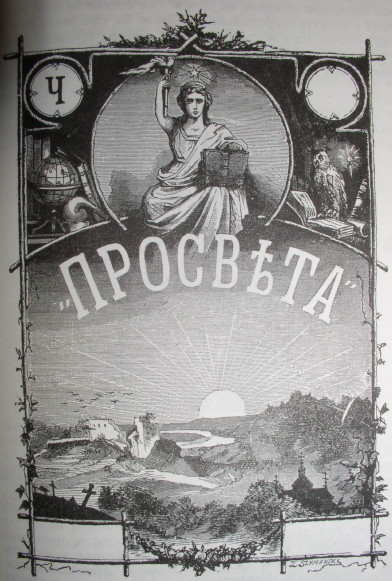
Cover of a Prosvita Publication

There was a house in the village of Biala where nobody lived.  It was owned by Painko Bryniak, my 2Xtigreat uncle.  My great aunt Katherine Rychly Pylatiuk called it the chytalnia, which means reading house in Ukrainian. Monthly meetings were held in the house called Veedchyty (means reading in Ukrainian). These meetings were for the enlightenment of the men, where the more educated shared their knowledge with the less educated.


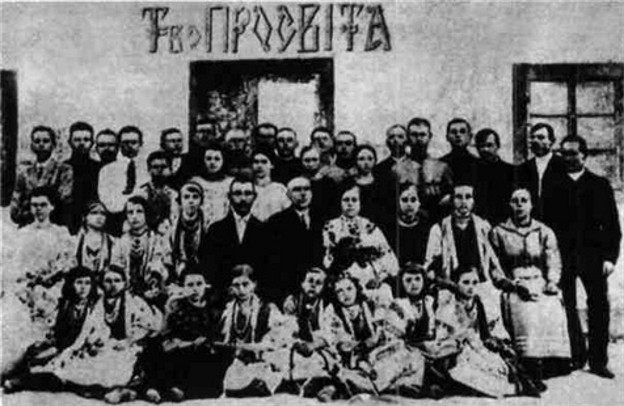
Prosvita reading House in a village. Source: Encyclopedia of Ukraine


Katherine explains in her autobiography how valuable the veedchyty were to the people of the village. Since her grandmother lived next door to the chytalnia, (Painko Bryniak owned that house as well) she could look through the window and see a bust of the Ukrainian poet an artist, Taras Shevchenko. She heard the men recite Shevchenko's poems and sing patriotic Ukrainian songs.  Sometimes one of the men would read an article and then lead a discussion about it.  She also saw shelves of books and magazines and portraits of famous Ukrainian s on the wall of the house.


Statue of Taras Shevchenko on the Mall, Washington D.C.


What was the Prosvita Society?

This reading house in Biala was a part of the Prosvita Society.  Prosvita means enlightenment in Ukrainian,  founded in 1868 in Lviv by Ukrainian students  in order to "know and edify the people." Until 1914, Prosvita was the most important Ukrainian mass organization in Galicia.  Its activities included almost all aspects of Ukrainian life, and it created many cultural, political, economic, farming and sports societies and organizations which eventually became independent organizations.
Founders of the Prosvita Society, 1868. Source: Encyclopedia of Ukraine.

Why did this group of young people feel that it was necessary  to edify the people when free public education was available for children in Galicia up to the age of twelve?
This is a question is hard to answer because it involves both politics and history.  Biala, Ternopil' and Eastern Galicia were part of the Austrian-Hungarian Empire which was made up of many countries and many ethnic groups. The Austrians kept control of its various peoples by encouraging discord between ethnic groups.  This policy worked for a time, but in 1861 Austria became a constitutional monarchy when it recognized the Hungary as an equal partner and changed its name to the Austrian-Hungarian Empire. Both Austria and Hungary had their own legislatures and capitals, Vienna for Austria and Budapest for Hungary. The Austrians had their hands full dealing the demands of the various ethnic groups, and left the governing of Galicia to the Poles. In the 1860's, the Poles controlled the both local and provincial government in Eastern Galicia. The Ukrainians wanted instruction in the Ukrainian language in the schools, more Ukrainian high schools,  more representation in government and recognition of their culture. There were many conflicts between the Ukrainians and Poles, but since the Poles held all the positions of power, decisions almost always favored Polish interests.   The founders of Prosvita realized that if the Ukrainian people of were to achieve economic and political power, they would have to do it on their own.


Map of Eastern and Western Galicia.

 Prosvita's Three Goals

Increasing Literacy 

Increasing literacy was Prosvita's  first goal. A network of libraries and reading rooms were established in Eastern Galicia. Most villages had schools with trained teachers, and lessons were in both Ukrainian and Polish. One of the first actions of Prosvita  was to publish basic textbook in the Ukrainian language to be used in schools. The society started a network of chytalnias (reading rooms) in the Lviv area, where books and other reading materials were available. These reading rooms spread quickly and within a few years, reading rooms were established all over Eastern Galicia.

Higher education was a concern, elementary schools, run by the government were available, but secondary education was not. To raise the cultural level of the Ukrainian people, access to higher education was a necessity. In 1897, 30 high schools were Polish, two were Ukrainian. in Galicia.  By 1914, four more Ukrainian high schools were added by the government. Acting on the idea of self  help and knowing that no more high schools would be funded by the government, contributions by the Ukrainian community established eight more private high schools. Private dormitories were built in Lviv so students from rural areas could attend high school and university.  Few Ukrainian students attended Lviv University; about 500 students out of a student body of 1700, which had eight Ukrainian professors in of a faculty of eighty.   Ukrainian professorships gradually increased and the government promised a Ukrainian university, but this did not happen because of the outbreak of World War One.


Cover of "Lions" Ukrainian History Book published by Prosvita


Increasing the Economic Level of the People

Prosvita's second  goal was to raise the economic level of the Ukrainian farmers in Galicia. Ukrainians in the Austrian empire were among the Empire's poorest and under represented people. Self help was the key, since there was no help coming from the government.

Prosvita Vasyl Orynchuk cooperative members, Roztoky,  Lviv Region. Source: wumag.ua

Cooperatives, stores and warehouses were formed to improve the condition of the peasants.  Courses were organized to help the farmers modernize and improve farming methods. Itinerant farming instructors travel the region and taught local farmers how to use modern methods. It started a commercial school in Lviv, a farming school and a women's domestic school. Prosvita gave scholarship for students to study agronomy, dairying and domestic management.  Credit unions were started to enable peasants to save money  and to borrow it when necessary.  Books were published about farming and other subjects such as Ukrainian history and literature. In 1877 Prosvita started to print monthly booklets which were given to members free of charge and established a newspaper was in 1879.
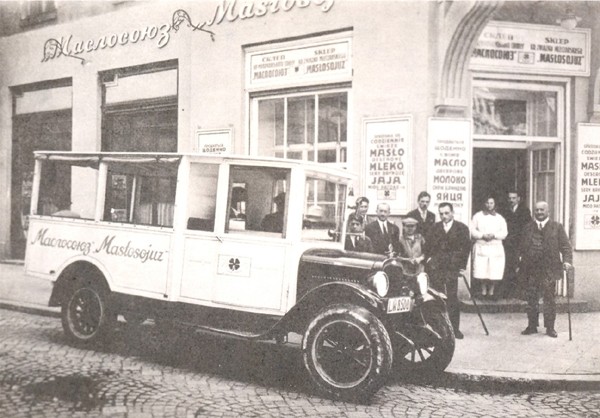
Prosvita Dairy Store/Cooperative in Lviv. Source: Encyclopedia of Ukraine


Building Cultural Awareness and Patriotism
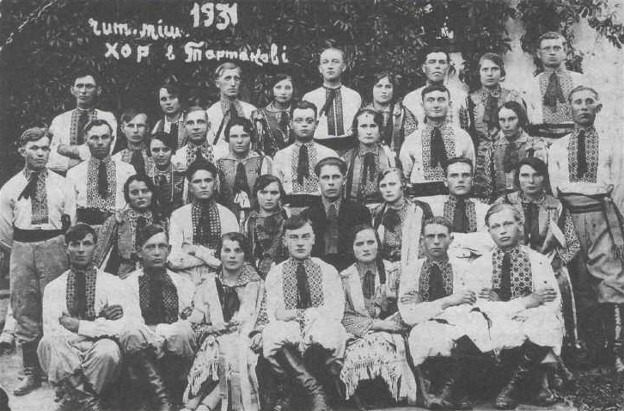
Choir organized by the Prosvita Reading House in Zahiria, 1931. Source: Encyclopedia of Ukraine


The third goal was to raise awareness of the Ukrainian language and culture among the Ukrainian people. To further awareness, Prosvita encouraged the Ukrainians to form choirs, bands and drama groups;  learn about Ukrainian history, read literature in the Ukrainian language and develop Ukrainian patriotism.  Prosvita started Sokil and Sich in 1894 to encourage youth appreciation for discipline, cooperation, patriotism and education. Sokil developed physical training and the goal of Sich was to develop patriotic and cultural activities.

Drama Group, Prosvita Mohyntsa, Ternopil' Source: ebay.


Prosvita's Support

Prosvita's support came from membership dues, individual donations, subsidies  from the provincial and cnetral government.  Government support was small and was often cut off by Polish opposition. Profits from Prosvita's printing and its other operations also funded its activities.  Between 1869 and 1906, Prosvita made a small profit, of 2000 Kronen.iProsvita's Success
By 1900, the Prosvita chytalnia reading houses became the center of village life, displacing the church and tavern. In 1914, Prosvita had  77 regional branches, 3000 reading rooms and over 200,000 members. 75% of the villages cities and towns of Galicia had reading rooms, thelargest number of were in the Ternopil' area.  It published over three million copies of  495 books, supported 45 scholarships for high school and university students.  Prosvita owned its own headquarters building in Lviv and sponsored a large celebration of the 100th anniversary of Taras Shevchenko's birth there in 1914. It spread out  from Eastern Galicia to other parts of the Austrian empire with large numbers of Ukrainians.  It also was established in Eastern Ukraine, which was ruled by Russia.
Prosvita played a critical role in the growth of national consciousness among Ukrainians and in the improvement of their standard of living.

Wilhem Feldman said in 1907, "The 20th century has seen many nations rise from the ashes, but there are very few cases of rebirth so rapid and energetic as that of the Ukrainians of Austria... their unexpected and vigorous growth is mostly the result of self-help and hard fought gains." Subtelny, p. 329.


The Prosvita Building in Lviv. Source: Encyclopedia of Ukraine.

Sources: 
Encyclopedia of Ukraine, www.encyclopediaofukraine.com
Lawryk, Julia, Kateryna (Kasha) Autobiography by Katherine Pylatiuk Lymar as told to her Daughter, Julie Lawryk in 1988. copyright 1988
Subtely, Orest, Ukraine, A History,  University of Toronto Press, Toronto, Canada, 1988
Yaremko, Michael, Galicia-Halachyn: From Separation to Unity, Shevchenko Scientific Society,  Toronto, 1967.


Friday, June 12, 2015

LIving in Ukraine 100 Years Ago: Dealing with Sickness and Injury


Sickness was dangerous in Bila, according to my great aunt Katherine Rychly Pylitiuk. Bila was village bordering Ternopil', a city in eastern Galicia   She was born in Bila in 1904, grew up in there,  and immigrated to the United States, in 1922.  Later in life told her life story to her daughter, Julia Pylatiuk Lawryk.  That story is the information source for this blog post.
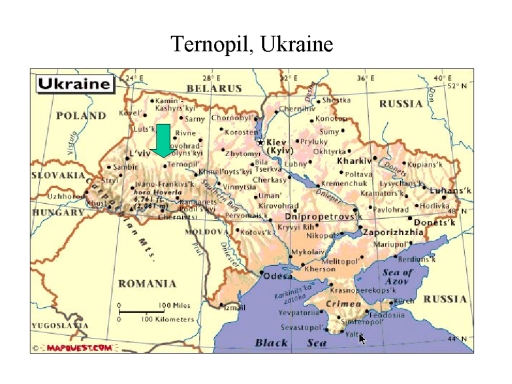
Map of Ukraine showing the location of Ternopil. Source: Bowdoin College

Katherine lived in Bila with her mother,  2 sisters and 3 brothers.  Her father, Sylvester Rychly was in the United States,  working to provide a better life for his family in Bila and hoping to bring them to America.  Katherine's older sisters, Anna and Pauline were in the United States, immigrating in 1913 and 1914.  It was difficult to make ends meet in Bila; the family had a farm, but it was too small to support a family of 6.  The younger children attended school, but everybody had to work so there was food on the table.  Since Sylvester was gone, Maria, Katherine's mother, had a heavy load of responsibility.

The family grew hemp and grain on their land, as well as fruits and vegetables.  Hemp was a versatile crop, it grew quickly and could be used for many things.  Its fibers were used for rope,  and could be woven into a fabric.  This fabric was used to make sacks as well as clothing for the family.  The grain was ground into flour that provided the family's bread. Cooking oil was extracted from the seeds. 

Cutting hemp in Ukraine.  Source: Library of Congress
One of Maria's responsibilities was to prepare the grain and hemp.  Before the grain could be sent to the mill, it had to be cut,  and the chaff separated from the seeds. Everybody in the family had to help with the grain harvest.  The hemp was cut, bundled and put into the neighboring lake to rot. After several weeks, it was dredged up and cut.  The fibers inside of the stalk were removed, combed and sent to the tkach (weaver) to be made into cloth.  The women were in charge of cutting the hemp stalks and preparing the fibers.  These jobs took a toll on Maria's health.  She developed allergies to the grain and the dust that came with the threshing.  The mold associated with the hemp also irritated her. She developed asthma.  There was no treatment for asthma except for bed rest, and often Maria was laid up in bed for several weeks.

Maria gave birth to daughter Ksenia in 1908.  In the village, women were expected to go back to work after giving birth.  She had to take care of the baby and her other small children as well as cooking, cleaning and farm work. This time she never recovered her strength.  Her asthma flared up and and she developed pneumonia.  She was sick in bed for weeks and the family thought that she might die.  The family wrote to Sylvester, who was working in Pennsylvania, asking him to return to Bila. By the time he arrived, Maria was feeling better.  He stayed for a several months, then returned to Pennsylvania, but Maria's asthma continued to affect her health.

A typical whitewashed house in Ukraine.

 In 1913, when Katherine's youngest brother Onufrey was two years old, he fell into a bucket of "vapno." Vapno is whitewash,  a type of paint made from calcium hydroxide and chalk.  It is very effective on surfaces made from clay because it absorbs easily and makes the clay harder.   Most of the peasant houses in Galicia, including the Rychly's, had walls made from clay on a wooden frame,  and were painted with whitewash inside and out.  Onufrey was sitting on a bench watching his mother mixing the vapno, and while she looked away for a second, he fell head first into the bucket.  The ingredients in whitewash can cause serious skin irritation, chemical burns, blindness and lung damage. For Onufrey, the results of this accident stayed with him for the rest of his life.  He could not see for the several months after the accident.  One eye was larger than the other, and did not focus properly.  I remember that one his eye bulged , but I never knew why, or that his vision was impaired.  He never saw a doctor for this injury, and was treated with home made remedies.

 In 1916, when Katherine was twelve, she and her younger brother Onufrey, who was four, came down with "prypasnytsia" an illness similar to malaria.  World War I was going on around them since they were living on the Eastern Front.  Malaria is a disease that comes with war.  Today, it exists in tropical areas, but 100 years ago, it was prevalent in many parts of Europe.  Since there were soldiers in the village, and they were staying in village homes, it is possible that the disease came with them.  It is caused by mosquito bites, and in those days, there was no cure. Its symptoms are a high fever, chills, shivering and fatigue.  After six months, Onufrey recovered.  However Katherine was sick for two years.  I wondered how this disease could last so long,  I found that an affected person can suffer relapses.  Since the family was so poor, they were reluctant to see a doctor.  But her mother was worried that the Katherine wasn't getting better, so she went to a pharmacy in Ternopil'.  It was recommended that she treat Katherine with "keenova voda," which means horse's water.  It was prepared by soaking rusty nails in water.  Katherine took this "medicine", which had a bad taste.  She recovered eventually.  I could find no evidence that iron oxide mixed with water has any effect on malaria.

Illness and injury were often ignored because of the cost of treatment and because the family could not get by without everybody working.  Katherine cut her finger harvesting oats.  She had to continue cutting the oats because the crop needed to be harvested immediately.  Her finger had a serious cut,  so it was bandaged and she went back to work.  A few days later, the family cow became sick.  In those days, sick cows were treated by blood letting.  They took the cow to have her blood let, but couldn't pay the bill.  Katherine had to work in the doctor's field in order to play the bill even though her finger was not healed.  Debts had to be paid right away.

Painting of women harvesting grain in Ukraine.
When Maria came to the United States in 1923, she was still suffering from the effects of a asthma.  Now it was possible for her to see a doctor who could treat her illness, but it was too late.  The doctor told her that there was nothing that could be done for her condition.  She died on April 12, 1925 at the age of 52.  According to her death certificate, the cause of her death was bronchial pneumonia.

Friday, June 27, 2014

June 28, 1914: “The Archduke is Assassinated!”

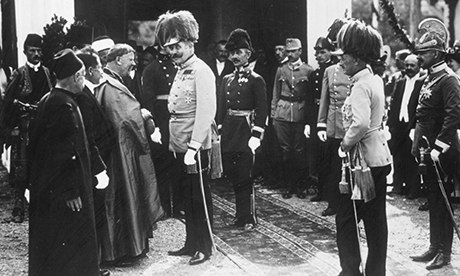
Archduke Franz Ferdinand of Austria-Hungary, being greeted by dignitaries in Sarajevo, June 28, 1914


June 28, 1914 was an ordinary Sunday in the village of Bila, just outside the eastern wall of the city of Ternopil.  The villagers attended church and ate dinner at home. They spent spring and summer afternoons outdoors, visiting with friends and enjoying the summer weather. Nobody had any idea how everyone’s lives would change because of what happened that Sunday morning in Sarajevo, Bosnia-Herzegovina. 

My great-aunt, Katherine Rychly was 10 years old in 1914. Her father, Sylvester, was in Minneapolis, Minnesota, working at a sugar company in order to save enough money to bring his family to the United States.  Katherine’s older sister Anna was newly married and living in Minneapolis. Katherine's other older sister, my grandmother, Paranka (Pauline), had left Bila a few days earlier,  and sailed from Bremen, Germany, on June 23, arriving in New York on July 1, 1914.  Katherine, Anna and Paranka wouldn’t see each other again until 1922.

Map of the Austria-Hungary Empire, showing Bosnia - Herzegovina and the city of Sarajevo


Sarajevo, Bosnia, was located in a province of the Austria-Hungary Empire, added in 1908, after being occupied by the Austrians since 1878.  The province had a mixed population of Serbs, Croats, Muslims and other ethnic groups.  The annexation of Bosnia-Herzegovina by Austria-Hungary was unpopular with its people. I have heard from family stories that my paternal grandfather, John Nyznyk, was a soldier in the Austrian army, stationed in Bosnia-Herzegovina, and he said that there were a lot of problems there.  After the Balkan war of 1912-1913, the neighboring country of Serbia gained territory and power, and growing Serbian nationalism encouraged the Serbs to do something about the status of Bosnia and Herzegovina. 


June 28 is an important day to the Serbians, St Vitus’s Day, the day when, in 1389, the Ottoman Turks destroyed the Serbian Army on the Field of Blackbirds—today known as Kosovo, and ended the Serbian Empire.  The Serbian lands and people became part of the Ottoman Empire.  The visit of the Archduke, Franz Ferdinand to Sarajevo on June 28 was considered an insult to the Serbs.   Austrian authorities were warned that the Archduke’s visit wasn’t a good idea, but nobody took these threats seriously.  Seven young Serbian men volunteered to assassinate the Archduke and his wife. They were members of a secret Serbian nationalist society, The Black Hand. 
Archduke Franz Ferdinand arriving in Sarajevo on the morning of June 28, 1914

 
The Archduke and the Duchess Sophie leaving the train station for the ride to City Hall


On Sunday morning, June 28, the Archduke and his wife, the Duchess Sophie, arrived at the Sarajevo train station. There was a six car motorcade waiting, full of Austrian and local dignitaries.  Their first destination was the Sarajevo City Hall, with other stops scheduled later.

The Archduke and the Duchess were in the second car, open so the crowds could see them, along with the Governor of Bosnia and another person. There was no security along the route, normally soldiers line the streets when important dignitaries such as the Archduke visited. The chosen route, Appel Quay runs along the Miljacka River.  Two cells of Serbian terrorists were stationed along the Quay. To insure its success, seven men were assigned to the plot.  Each one had small bomb strapped to his waist, a revolver and a packet of cyanide in his pocket.


The first assassin lost his nerve and did not throw his bomb.  As the second assassin detonated his bomb, it made a noise similar to a blown tire, which alerted people in the motorcade.  The bomb was thrown just as the driver stepped on the gas.  The Archduke batted the bomb away, and it exploded under the third car, injuring several people. The second assassin swallowed the cyanide and jumped over the wall and into the river.  His suicide attempt was unsuccessful, and he was easily captured. 

The motorcade was stopped so the wounded could be attended to, and the proceeded to the Town Hall. 
The third, fourth and fifth assassins lost their confidence and did nothing.

The Archduke and Duchess minutes before the assassination


The Motorcade arrived at the Town Hall, the planned speeches continued after the Archduke expressed his unhappiness with the “welcome” he received.  It was decided to cancel the rest of the day’s activities, however, the Archduke wanted to visit the wounded at the hospital.  Nobody thought to tell the drivers of the changed plans, so when the parties arrived at the cars, the procession went ahead with the original route.  Someone in the Archduke’s party shouted that they were driving in the wrong direction, so the cars stopped.  Since the Archduke’s car did not have a reverse gear, the car had to be pushed backwards to Franz Joseph Street.  

Map of the Archdukes's route.  The green arrows show the trip from the train station to the City Hall.  The yellow star is the first bomb.  The  broken red arrows show the new route from the City Hall to the Hospital.  The red star is the place of the Assassination


The sixth assassin, Gavrilo Princip, saw that the car stopped and ran toward it.  He untied the bomb, but decided to use his revolver.  The first bullet hit the Duchess in the stomach.  The second shot hit the Archduke in the neck.  Both died quickly, by the time the car arrived at the hospital, both were dead.  It was 11 o’clock in the morning.

 
Newspaper depiction of the assassination.  Duchess Sophie was shot in the stomach, the Archduke  was shot in the neck.


The next day, newspaper headlines around the world told the story, but nobody as any idea  how far reaching the consequences of the assassination would be.  Many people remembered for years, exactly what they were doing when they heard the news of the assassination, the effect was similar to how people felt when they heard about the Attack on Pearl Harbor, the Assassination of President Kennedy or 9/11.


The arrest of the assassin, Gavrilo Princip.