 |
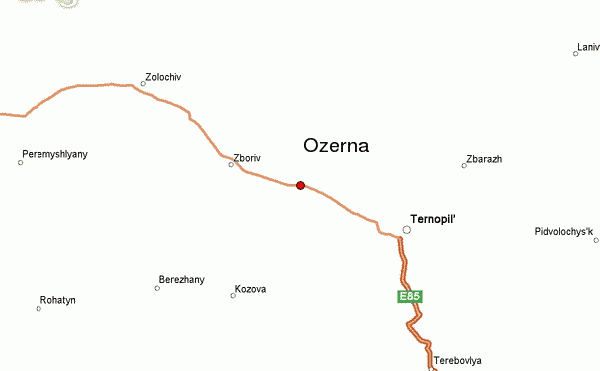
| Ozerna is located 13 miles west of Ternopil" and 9 miles west of Zbirov |
 | |||
| Ternopil' in relation to Ukraine and surrounding countries |
The Kociuba family emigrated from the town of Ozerna, Ukraine, to the United States in the beginning of the 20th century. They Americanized their surname, Kociuba to Koshuba when they settled in the United States. When they lived in Ozerna, it was part of the Austrian-Hungarian Empire and was known as Jezierna.
Ozerna is on the Vysuska River and Lake Vysuska. The Vysuska is a tributary of the Strypa River, which flows into the Dniester, and eventually into the Black Sea. The population is about 3,000 today, but when the Koshubas lived there, around 1900 it was almost 5,000 people. Although I know quite a bit about the Koshuba family in Minnesota, I know very little about their life in Europe. Feodor and Maria Koshuba had five children, three boys and two girls. Of the boys, the oldest was Joseph, born in 1885, John, born in 1891 and Stephen, born in 1899. The girls included Tecla, the oldest child, born in 1883 and Anna, born in 1897. Tecla married Peter Wons in 1903 in Ozerna. My grandmother told me that that there was another son, Michaylo, but I have found no information about him.
 |
| The Koshuba Family. Tecla, Maria, Anna, Joseph, Feodor, and John. This was probably taken around 1898, since Stephen, born in 1899 is not in the picture. Photo: collection of Ed Wons. |
The town's strategic location, on a river and surrounded by mountains made it an attractive place for Polish lords to settle. In 1545, Jan Tarnowski, founder of Ternopil' took over the village located where Ozerna is today. In 1615, it was purchased by Yakob Sobieski, father of the future king of Poland, Jan Sobieski. He built a castle on a mountain overlooking the town and in 1636, built a Roman Catholic Church. In 1667, the Tartars destroyed the town, but it was rebuilt and thrived. Many members of the Sobieski family continued to lived there.
I n 1772, Ozerna became part of the Austrian Empire in the first partition of Poland. It remained part of the Empire until 1918, when the Austrian Empire collapsed in 1919 after World War One. The Western Ukrainian Republic ruled for a short time, and Ozerna became part of the new Republic of Poland in 1920, after the Polish-Ukrainian War, and the Polish-Soviet War.
During the 19th century, Ozerna was a transfer point. Not only was it located on a river, it also was on the Ternopil'-Lviv railroad line and the Ternopil'-Lviv highway, near the intersection of the Kaiser-Strasse, a main highway. There was a toll-gate at the entrance of the town, on the Ternopil (east) side of the Vysuska River bridge, and all who crossed had to pay a toll before entering town. This practice ended when World War One began.
The people living outside the town were farmers, growing grain potatoes, beets, flax, honey; raising chickens and eggs, cattle, horses and pigs. There were several grain mills and oil presses in town. Most of the businesses in the town including the mills, were owned by Jews. The mills were located on tributaries of the River Vysuska. In earlier times, the mills used a system called "own strength." The farmers brought in their grain, ground it themselves, and paid the miller for the use of his equipment. Later, hand work was replaced by machinery. The oil presses extracted oil from hemp and flax seeds, both grown by local farmers.
Business men in town bought farm products from the peasants, resold them to major dealers, who consolidated the products and shipped them by train to the grain exchange in Lviv. The streets around the train station were lined with warehouses. Ozerna had several markets; a general market, as well as horse, cattle and pig markets.
The town square was lined with retail businesses, small shops that sold everything, and larger ones that specialized in clothing, hats or shoes, dry and household goods. There were two bakeries with modern equipment to provide bread and baked goods to the population. There was a Roman Catholic Church, a Greek(Ukrainian) Catholic Church and a synagogue. Since the Austrian government encouraged education, there were two public elementary schools; one for the Jewish children, the Baron Hirsch School, and the other for the rest of the children in the community. If students wanted to continue their education and attend high school, they traveled to Ternopil' by train, stayed there for the week and returned for the weekend. In addition to public schools there were private and religious schools. Four inns provided food, drink and a place to stay the night. The Brandy Inn was the place for the wealthy to meet.
According to my mother, the Koshuba family lived in the town, not outside on a farm. I do not know how the Koshuba family made their living in Ozerna. They were comfortable enough to be able to afford family photographs. Of all my Ukrainian ancestors, only the Koshubas could afford to have family portraits made in Europe. They also could afford to have their children attend school. All the Koshuba children attended the public school, and were able to read and write when they came to the United States, according to immigration and census records. Tecla, Joseph and John completed the eighth grade of elementary school, Anna and Stephen completed 6th grade.
 |
| The Koshuba family, probably in 1903. Standing from left: John, Anna, Joseph, Tecla, Stephen. Seated from left: Maria, unknown girl, Feodor, Peter Wons. Photo: collection of Ed. Wons. The boys are wearing embroidered Ukrainian shirts. |
A note on my sources: I had a difficult time finding information about Ozerna. Finally, on Jewish-Gen, a genealogy website, I found a Yizkor book from Ozerna, This book was a compilation of memoirs from the Jewish people who lived in Ozerna who survived the Holocaust. The book is called The Memorial Book of Jezierna, published in 1971. I found detailed descriptions of the town, and how the people lived.


