Showing posts with label John Koshuba. Show all posts

Friday, May 29, 2015

Ozerna/Jezeirna: Ancestral Home of the Koshuba Family


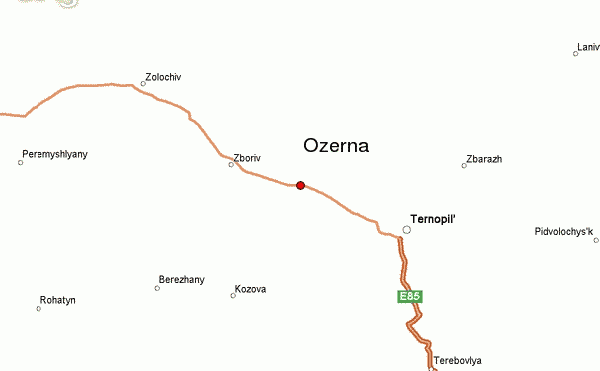
Ozerna is located 13 miles west of Ternopil" and 9 miles west of Zbirov
Ternopil' in relation to Ukraine and surrounding countries


The Kociuba family emigrated from the town of Ozerna, Ukraine, to the United States in the beginning of the 20th century.  They Americanized their surname, Kociuba to Koshuba when they settled in the United States. When they lived in Ozerna, it was part of the Austrian-Hungarian Empire and was known as Jezierna.
Ozerna is on the Vysuska River and Lake Vysuska.  The Vysuska is a tributary of the Strypa River, which flows into the Dniester, and eventually into the Black Sea. The population is about 3,000 today, but when the Koshubas lived there, around 1900 it was almost 5,000 people. Although I know quite a bit about the Koshuba family in Minnesota, I know very little about their life in Europe.  Feodor and Maria Koshuba had five children, three boys and two girls. Of the boys, the oldest was Joseph, born in 1885, John, born in 1891 and Stephen, born in 1899.  The girls included Tecla, the oldest child, born in 1883 and Anna, born in 1897.  Tecla married Peter Wons in 1903 in Ozerna. My grandmother told me that that there was another son, Michaylo, but I have found no information about him.
The Koshuba Family. Tecla, Maria, Anna, Joseph, Feodor, and John. This was probably taken around 1898, since Stephen, born in 1899 is not in the picture. Photo: collection of Ed Wons.

The town's strategic location, on a river and surrounded by mountains made it an attractive place for Polish lords to settle.  In 1545, Jan Tarnowski,  founder of Ternopil' took over the village located where Ozerna is today.  In 1615, it was purchased by Yakob Sobieski, father  of the future king of Poland, Jan Sobieski.  He built a castle on a mountain overlooking the town and in 1636, built a Roman Catholic Church.  In 1667, the Tartars destroyed the town, but it was rebuilt and thrived. Many members of the Sobieski family continued to lived there.

 I n 1772, Ozerna became part of the Austrian Empire in the first partition of Poland. It remained part of the Empire until 1918, when the Austrian Empire collapsed in 1919 after World War One.  The Western Ukrainian Republic ruled for a short time, and Ozerna became part of the new Republic of Poland in 1920, after the Polish-Ukrainian War, and the Polish-Soviet War.

During the 19th century, Ozerna was a transfer point.  Not only was it located on a river, it also was on the Ternopil'-Lviv railroad line and the Ternopil'-Lviv highway, near the intersection of the Kaiser-Strasse, a main highway.  There was a toll-gate at the entrance of the town, on the Ternopil (east) side of the  Vysuska River bridge, and all who crossed had to pay a toll before entering town.  This practice ended when World War One began.

The people living outside the town were farmers, growing grain potatoes, beets, flax, honey;  raising chickens and eggs, cattle, horses and pigs.  There were several grain mills and oil presses in town.  Most of the businesses in the town including the mills, were owned by Jews. The mills were located on tributaries of the River Vysuska.  In earlier times, the mills used a system called "own strength." The farmers brought in their grain, ground it themselves, and paid the miller for the use of his equipment. Later, hand work was replaced by machinery.  The oil presses extracted oil from hemp and flax seeds, both grown by local farmers.
Business men in town bought farm products from the peasants, resold them to major dealers, who consolidated the products and shipped them by train to the grain exchange in Lviv.  The streets around the train station were lined with warehouses. Ozerna had several markets; a general market, as well as horse, cattle and pig markets.

The town square was lined with retail businesses, small shops that sold everything, and larger ones that specialized in clothing, hats or shoes, dry and household goods. There were two bakeries with modern equipment to provide bread and baked goods to the population.  There was a Roman Catholic Church, a Greek(Ukrainian) Catholic Church and a synagogue. Since the Austrian government encouraged education,  there were two public elementary schools; one for the Jewish children, the Baron Hirsch School, and the other for the rest of the children in the community.  If students wanted to continue their education and attend high school, they traveled to Ternopil' by train, stayed there for the week and returned for the weekend.   In addition to public schools there were private and religious schools.  Four inns  provided food, drink and a place to stay the night.   The Brandy Inn was the place for the wealthy to meet.

According to my mother, the Koshuba family lived in the town, not outside on a farm. I do not know how the Koshuba family made their living in Ozerna.   They were comfortable enough to be able to afford family photographs.  Of all my Ukrainian ancestors, only the Koshubas could afford to have family portraits made in Europe. They also could afford to have their children attend school.  All the Koshuba children attended the public school, and were able to read and write when they came to the United States, according to immigration and census records. Tecla, Joseph and John completed the eighth grade of elementary school, Anna and Stephen completed 6th grade.

The Koshuba family, probably in 1903.  Standing from left: John, Anna, Joseph, Tecla, Stephen.  Seated from left: Maria, unknown girl, Feodor, Peter Wons.  Photo: collection of Ed. Wons. The boys are wearing embroidered Ukrainian shirts.
During the last years of the 19th century and the first years of the 20th, the population of Ozerna began to decline.  This was because many of the residents were immigrating to the United States or Canada.  The Koshuba  family was one of the families that decided to send their children to the United States.  Joseph left in 1904 at the age of 19. Tecla and Peter Wons left in 1906 with their two sons and settled in Massachussets. In 1908, John, 17,  joined them  in Massachusetts.   Anna and Stephen came together in 1914 and joined the family, now living in St Paul, Minnesota.  Moving to the United States worked out well for the Koshuba family.  The sons started their own businesses, their children were educated and several graduated university and became professionals. The daughters were successful, both married and their children were educated and successful as well.

A note on my sources:  I had a difficult time finding information about Ozerna.  Finally, on Jewish-Gen, a genealogy website, I found a Yizkor book from Ozerna,  This book was a compilation of memoirs from the Jewish people who lived in Ozerna who survived the Holocaust.  The book is called The Memorial Book of Jezierna, published in 1971. I found detailed descriptions of the town,  and how the people lived.

Friday, December 19, 2014

Genealogical Mysteries: The Final Word on Joseph Koshuba


The mysterious Joseph Koshuba was the subject of my first blog post in March of 2013.  Since then I solved the puzzle of the identity of Joseph, several times, and most of my solutions were way off.

Joseph Koshuba was my great uncle, and brother of my grandfather, John Koshuba.  Joseph died suddenly in 1919, leaving his wife Florence and three children.  I have a lot of family pictures, and my main source, my mother, identified many (unknown to me) family members.  In the wedding picture below, my mother identified the man in the first row, on the  far left as Joseph Koshuba. 
  
Wedding of John Koshuba and Pauline Rychly , November 1916.

The picture above is  of my grandmother Pauline Rychly Koshuba's wedding to John Koshuba in November, 1916.  Florence Koshuba is in the first row on the far right. My mother also identified her. I assumed that the man standing behind her, with his arm on her shoulder was Joseph Koshuba. At the time I assumed that because his hand was on Florence's shoulder. Since my mother was born in 1918, two weeks before Joseph died, I assumed that she was just guessing that the man on the left was Joseph. Now I know that she was right.  How could I prove it?


Top row from the left: Florence and unknown man,. Front row: Fred Koshuba, Joseph Koshuba and Katherine Florence. Source: Susan Strickler.

This picture was also taken at my grandmother's wedding.  It is of Florence, her two children and  the man I assumed  to be her husband Joseph standing next to her. The seated man with the little girl on his lap appears to be the man on the left in the picture above.  Why is he in this picture?  I revised my theory.  Maybe he was John Koshuba's brother-in-law, Peter Wons or perhaps he was Dymtro Popko, since his wife, Pelagia Rychly Popko was standing behind him in the large wedding picture. This picture was sent to me by Joseph Koshuba's grand-daughters, and they said that the baby girl was their aunt, Katherine Florence. So why was she sitting on Peter Wons' lap?  Well, since I assumed he was her uncle, it would make sense.

 
Wedding of Florence Holmberg to Joseph Koshuba, Feburary 1913.  Source: Ed Wons.

This picture is from the wedding of Florence Holmberg Koshuba's to Joseph Koshuba in February, 1913.  It was sent to me by Ed Wons,the grandson of Peter Wons and a Koshuba family cousin. This picture proved my theory about the identity of the man in the pictures from my grandmother's wedding wrong. Ed said that in this picture Peter Wons is in the second row, on the left right behind his wife, and John and Joseph's sister, Teckla Koshuba Wons.The two little boys in the picture are their sons. Now I know that Peter Wons is definitely not the man behind Florence in the group picture of my grandmother's wedding.

 Florence was identified as the bride by her grand-daughters. The groom is Joseph Koshuba, since I have the record showing that he married Florence Holmberg in February, 1913. The man on the left with with little girl on his lap in the 1916 wedding picture is Joseph. The man standing next to Florence in the Koshuba family picture taken at my grandmother's wedding in 1916 is not Joseph, neither is the man standing behind Florence in the large group picture from her wedding.

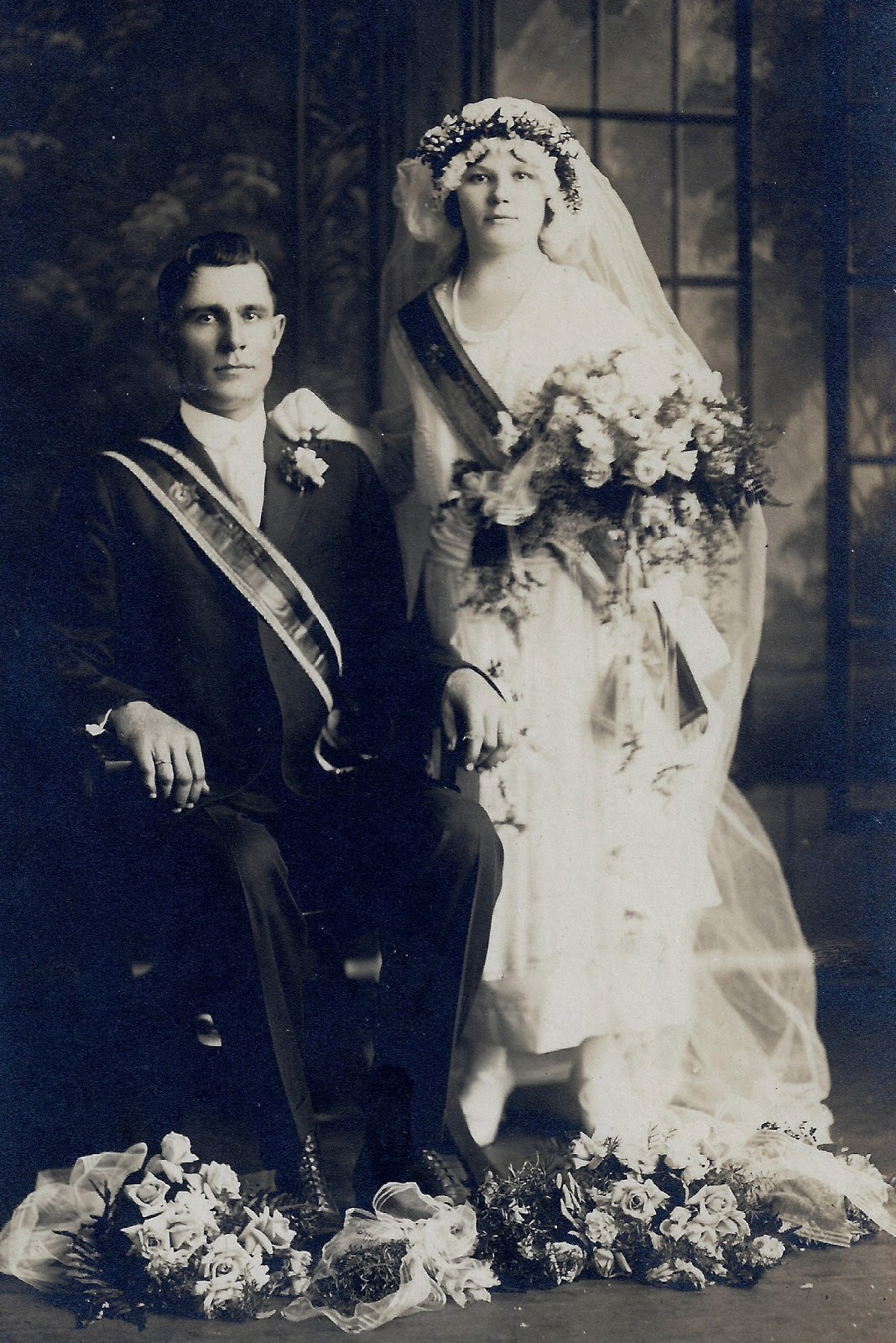
Joseph  and John Koshuba with an unknown man in the middle, wearing sashes and hats of the Zapororzhie Sich Society. 1912. Source: Pauline Noznick.


The next mystery:  who was the man with the moustache?  In this  picture from 1912,  Joseph Koshuba is on the left and John Koshuba is on the right.  The man with the mustache is in the middle. He may either be a relative or a close family friend.  Look again at the Holmberg-Koshuba wedding--is the man with the moustache in the second row on with right--without the mustache? If it is him, he had regrown the mustache by 1916.

What conclusions have I drawn from this mystery? Don't be a lazy or sloppy genealogist . DO NOT ASSUME ANYTHING.  Wait until proof is found.   Remember, patience is the genealogist's friend. I have fallen into these traps myself--first, I assumed that my mother misidentified Joseph Koshuba.  Then I assumed that another man was Joseph, mainly because he had his hand on Florence Koshuba's shoulder. In order to make my story work, I assumed that the man who turned out to be Joseph was either Dymtro Popko or Peter Wons.  All wrong.  I found documentation of Joseph and Florence's marriage when Joseph's grand-daughters identified Florence as the bride in the 1913 wedding picture.  I also had a copy of the marriage license, documenting the marriage. That solved the mystery of Joseph Koshuba--and the identity of the man in my grandmother's wedding picture.

BLOG POSTS ABOUT THE KOSHUBA FAMILY

Big Breakthrough in the Koshuba Family
Finding Fred Koshuba
Joseph Koshuba One Year Later 
Assumptions: The Fred Koshuba Story
The Koshuba Brothers
The Genealogy of the Holmberg-Koshuba Family
The Genealogy of the Kleviak Koshuba Family

Friday, March 21, 2014

Big Breakthrough in the Koshuba Family Tree


One of the reasons I started to blog about genealogy was to find missing pieces on my family trees.  For most of the year, this wish was not fulfilled.  My biggest break was to find Jose Gutstein and he helped my to find a lot information about the Monkovski family.  I found his site on the internet when I was searching for information about the village where my husband’s maternal grandparents once lived.  I contacted him and this led to finding several generations of Monkovskis. This was very satisfying, and I felt that it made blogging worthwhile. 


I do keep track of the statistics from Blogger about my blog, and I saw that the posts about the Koshuba-Kleviak family were popular.  Someone was looking at them, and hopefully they would contact me with questions some day.

Pauline Rychly-John Koshuba Wedding, November 1916.  This picture helped solve the mystery of the Joseph Koshuba Family.


Last week I wrote an update of my first blog post, which was about my great-uncle, Joseph Koshuba.  On Monday, I got a phone call from a woman who left a message saying that she might have some information about the Koshuba family.  I called her back, and one of the first things she told me was that she was Joseph Koshuba’s granddaughter!  What an unexpected surprise!  She and I are second cousins and I had no idea she even existed. She told me that she had a copy of my grandparents wedding picture—although she had no idea who they were.   We talked for a while and she filled in several gaps in the Koshuba family tree for me.  Now I know what happened to Katherine Koshuba, the child of Joseph Koshuba and Florence Holmberg, that I had almost no information about.  I also know for sure that the man with the baby on his lap is Peter Wons, not Dymtro Popko.

 
My cousin sent me this picture of her grandparents, Joseph and Florence Kkoshuba, and children Katherine Florence and Frederick, and brother-in-law, Peter Wons, qt the wedding of my grandparents, November 1916.


So now, my genealogy energy is revived.  Searching for family members can be very tedious, and there are a lot of blind alleys and information that might be helpful, but you are not really sure about it.  There is a lot of scrolling through lists of names, which is a little bit like counting grains of sand on the beach.  I think that I am very fortunate to have two big breakthroughs in the first year of writing this blog.  Now, I am ready to tackle the second year.

Friday, October 18, 2013

Who are They?

I am the inheritor of many boxes of old family pictures.  My mother and I tried to identify the people on the pictures while she was alive, but in the oldest pictures, even she couldn't identify all of them.
There are several people  in these pictures that I think I may know, but I am not sure.
This man, for instance:  He appears in several old Koshuba and Rychly family pictures, usually weddings.  I think that he is either Peter Wons, my grandfather John Rychly's brother-in-law or Dmytro Popko, my grandmother's uncle.  
The photo below is of Joseph and John Koshuba, and Peter Wons. I have enlarged the picture to feature Peter Wons.  It was taken about 1915, and shows them in the uniforms of a fraternal organization that they belonged to.  I am sure that the Wons family was in St Paul at that time but I am not not sure about the Popko family.

This is the oldest photo, from about 1915.
The next picture was  taken at the wedding of my grandparents, Pauline Rychly and John Koshuba in November 1916.  The man in question could be either Peter Wons or Dymtro Popko. 
The third picture is from the wedding of Anna Koshuba to Joseph Graskow, which was probably sometime in 1917-1918.
Anna Koshuba was my grandfather John Koshuba's youngest sister.  Other than my grandmother, there doesn't appear to be any Rychly family members in the picture, so I am fairly sure that it is Peter Wons.
The next photo is from the wedding of Stephen Koshuba, my  grandfather's youngest brother to Helen Rychly, my grandmother's sister, in 1924.  The man could be either Peter Wons or Dmytro Popko. 
The last picture is from the wedding of Stephen Koshuba and Sally Popko.  Sally was my grandmother's first cousin.  Stephen and Helen divorced, and his second marriage was sometime after 1930.   The man in question is either Dmytro Popko, Sally's father, or Peter Wons, Stephen's brother-in-law. The man in question is  behind and between the bride, Sally, and one of the bridesmaids.  My guess is that this Dymtro Popko, Sally's father.
What do you, my readers think?  Please comment and let me know your thoughts.


November 1916


Peter Wons 1917-1918.


This could be either Peter
Wons of Dmytro Popko, 1924.

Wedding of Stephen Koshuba and Sally Popko. About 1930-31


Saturday, September 14, 2013

THE KOSHUBA BROTHERS

Unlike many immigrants from Eastern Europe in the early 20th century, my grandfather John Koshuba,  and great uncles, Joseph and Stephen Koshuba, were businessmen.  Born in the village of Ouzurnaya, Galicia, Austria, they were the sons of Feodor Koshuba and Maria Kleviak.  I have no idea what Feodor did for a living, but I have heard family stories that they were a town family.  

John Koshuba and Family, Stephen and Helen Koshuba (standing)1925

Joseph Koshuba 1916


John was born in 1880, Joseph in 1885 and Stephen in 1899.  There were three other children, Teckla, Anna and Michael, but that is story for another time.
Joseph came to the United States first, according to the 1910 census, in 1904.  John came next, possibly in 1908 (1910 census) and Stephen in 1914 (immigration records). 
The first records I could find of the older brothers were the 1910 US Census.  John was living in Peabody, MA, with this sister and brother-in-law, Teckla and Peter Wons, their two children, and was employed as a baker.
Joseph was in St Paul, Minnesota, living in a rooming house and was doing general work. Family stories said that John also lived in Grand Rapids Michigan, and was apprenticed to a tailor.
The next mention I find of Joseph and John was in 1912, in the St Paul City Directory.  Joseph was the manager of the National Window Cleaning Company, located on 408 St. Peter St, St Paul; John was also employed there as a foreman. 
Joseph married Florence Holmberg in 1913.  In the 1914 St Paul Directory,  Joseph and Florence were living at 491 Topping St, St Paul. John was still working for Joseph.
In 1915, Joseph was the owner and manager of two companies, National Window Cleaning Company and  National Sanitary While Washing Company, both located at 314 People's Bank Building.  He was doing well enough to have two advertisements in the Directory, a telephone, and stated in the ad that whitewashing could be done by either brush or machine.
In 1916, John is listed as a saloon keeper,  located at 751 Wabasha St, St Paul. In the St Paul City Council minutes,  there was a transfer of a licence to sell liquor to Joseph, recorded on June 12, 1916.  However, on October 21, 1916, the license is transferred again, from Joseph to Onefec Blalys.  In November, 1916, John married my grandmother, Pauline Rychly. 
In 1918, when he registered for the World War I draft,  John was in business for himself.  He started the Expert Window Cleaning Company at 458 Jackson St, St Paul, in competition with his brother Joseph.   At that time, Stephen was working for Joseph as a window cleaner. 
Joseph died suddenly of heart disease in January 1919, at the age of 33.  His business was sold, although his family continued to live at 886 Central, for the next 10 years.

 In 1923, Stephen was working at the Union News Agency and continued to live on Curtice St. He married Helen Rychly (yes, she was my grandmother's sister) in 1924, and moved to 152 Charles St.  He was back in the window washing business, working for John.

John and Stephen went into business together in 1934, and started Stephen's Buffet on Robert Street in downtown St Paul.  Although they sold the restaurant in 1939, it continued in business until the 1960's, under several different names.  It had a bar in the front, and a restaurant behind the bar.  According to my grandmother, the one thing that John didn't know when he started the business, was that she planned to work there.  On the first day she showed up with her apron and went to work in the kitchen, waited on tables and tended the bar, if necessary.  Since the restaurant was in downtown St Paul it served businessmen and people working in the retails stores nearby. I had lunch there in the 1960's with my mother and grandmother, and was surprised  that one of the waitresses who had worked for them in the 30's was still working there!  John sold Expert Window Washing Company  to National Window Washing Company, his brother's old business, when he went into the restaurant business.  Stephen continued to work for them as a window cleaner. 

In 1937, Stephen went into business with Victor Schlaff , and started Stephen's Bar, at 425 Jackson Street in St Paul.  They also owned a hotel that served mainly men working on the railroad. He continued to work as a partner at Stephen's Buffet for the next few years.
In 1939, the brothers sold Stephens's Buffet and Stephen and John ended their partnership.  John was at a loss without his business, and he committed suicide in March of 1940.
Stephen stayed in the bar and hotel business, and sold life insurance on the side.  He continued as a successful businessman in the Twin Cities  until he moved to Colorado in the 1970's.  He purchased a liquor store in Golden, Colorado, which he owned until he retired.  He died in 1982.

These tokens were issued to John Koshuba, which gave him a license to sell liquor. I noticed that the address was 751 Wabasha, which is interesting since the restaurant and bar was on Robert Street.


Obverse Image TC-151414: JOHN KOSHUBA, / 751 / WABASHA / ST. / ST. PAUL, MINN.
Reverse Image TC-151414: 2½


Saint Paul, Minnesota (Ramsey County), U.S.A.
Obverse Thumbnail Image: JOHN KOSHUBA, / 751 / WABASHA / ST. / ST. PAUL, MINN.Reverse Thumbnail Image: 2½


A S12 26
JOHN KOSHUBA, / 751 / WABASHA / ST. / ST. PAUL, MINN.
TC-151414 *** Koshuba Bros. Restaurant & Tavern 1934-1939
Contributed by: wlrotz


Friday, July 19, 2013

Two Mysteries (The Genealogy Kind) Solved

Genealogy research is like solving a puzzle.  You have most of the pieces but you just can't find that one missing piece to complete the puzzle. There are plenty of mysteries in my family trees, most unsolved, but happily, I did find that missing piece for two of them.


The Mystery of the Sashes.
Katherine Rychly and Olexa Pylatuik

The wedding picture of my great aunt Katherine Rychly and Olexa Pylituik contained a mystery.  As you can see in the picture, they were wearing sashes with their wedding attire.  I asked their daughter, if she could tell me about the sashes, and she said that she was wondering about them herself. 
When I was going through boxes of old stuff, I found a picture of my grandfather John Koshuba, and his brother, Joseph Koshuba, both rearing a uniform with the same sash.  The answer came from  a reader of this blog, who send me an link to the University of Minnesota Media Archive--Connecting Our Collections With Yours.  The sashes were worn by members of a Ukrainian Society, The Zaporozs"ka Sich in Minneapolis Minnesota. 

Peter Wons, Joseph Koshuba, John Koshuba


Zaporozs'ka Sich Society 1914


 The Mystery of the Grandmother's Name


This a portrait of my husband's great grandmother.  It came to me in a box of old pictures from my mother-in-law, Lillian Gerstein after she died.  My sister-in-law had it and when she moved, she gave it to me.  My mother-in-law told me that her mother's name was "Bellie", so I wrote it as Bella, or Belle.  I was never sure that it was her correct name.  The light went on in my head when I was looking through old family pictures from the Gerstein family.   My husband's great aunt's first name was Beile.  Perhaps the woman in the portrait was really Beile.  In my research for this blog, I came across a site for the town of Szczuzcyn, Poland, where my husband's ancestors once lived.  I contacted the site administrator and found out that the mysterious woman was Bejla Pienanzek, who married Wolf Berek (Velvil) Monkowski, and was the mother of my husband's grandmother, Rose. 
To connect with the Szczyczyn Site mentioned here: