Showing posts with label Koshuba. Show all posts

Friday, May 29, 2015

Ozerna/Jezeirna: Ancestral Home of the Koshuba Family


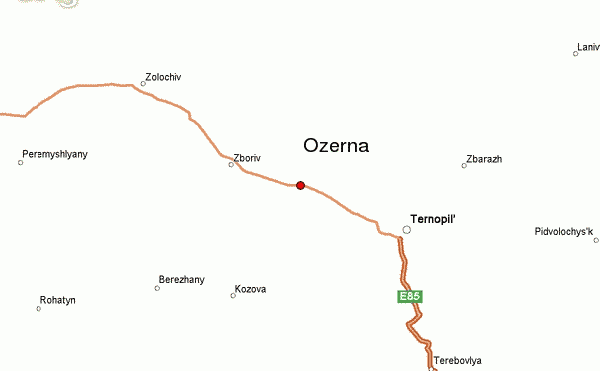
Ozerna is located 13 miles west of Ternopil" and 9 miles west of Zbirov
Ternopil' in relation to Ukraine and surrounding countries


The Kociuba family emigrated from the town of Ozerna, Ukraine, to the United States in the beginning of the 20th century.  They Americanized their surname, Kociuba to Koshuba when they settled in the United States. When they lived in Ozerna, it was part of the Austrian-Hungarian Empire and was known as Jezierna.
Ozerna is on the Vysuska River and Lake Vysuska.  The Vysuska is a tributary of the Strypa River, which flows into the Dniester, and eventually into the Black Sea. The population is about 3,000 today, but when the Koshubas lived there, around 1900 it was almost 5,000 people. Although I know quite a bit about the Koshuba family in Minnesota, I know very little about their life in Europe.  Feodor and Maria Koshuba had five children, three boys and two girls. Of the boys, the oldest was Joseph, born in 1885, John, born in 1891 and Stephen, born in 1899.  The girls included Tecla, the oldest child, born in 1883 and Anna, born in 1897.  Tecla married Peter Wons in 1903 in Ozerna. My grandmother told me that that there was another son, Michaylo, but I have found no information about him.
The Koshuba Family. Tecla, Maria, Anna, Joseph, Feodor, and John. This was probably taken around 1898, since Stephen, born in 1899 is not in the picture. Photo: collection of Ed Wons.

The town's strategic location, on a river and surrounded by mountains made it an attractive place for Polish lords to settle.  In 1545, Jan Tarnowski,  founder of Ternopil' took over the village located where Ozerna is today.  In 1615, it was purchased by Yakob Sobieski, father  of the future king of Poland, Jan Sobieski.  He built a castle on a mountain overlooking the town and in 1636, built a Roman Catholic Church.  In 1667, the Tartars destroyed the town, but it was rebuilt and thrived. Many members of the Sobieski family continued to lived there.

 I n 1772, Ozerna became part of the Austrian Empire in the first partition of Poland. It remained part of the Empire until 1918, when the Austrian Empire collapsed in 1919 after World War One.  The Western Ukrainian Republic ruled for a short time, and Ozerna became part of the new Republic of Poland in 1920, after the Polish-Ukrainian War, and the Polish-Soviet War.

During the 19th century, Ozerna was a transfer point.  Not only was it located on a river, it also was on the Ternopil'-Lviv railroad line and the Ternopil'-Lviv highway, near the intersection of the Kaiser-Strasse, a main highway.  There was a toll-gate at the entrance of the town, on the Ternopil (east) side of the  Vysuska River bridge, and all who crossed had to pay a toll before entering town.  This practice ended when World War One began.

The people living outside the town were farmers, growing grain potatoes, beets, flax, honey;  raising chickens and eggs, cattle, horses and pigs.  There were several grain mills and oil presses in town.  Most of the businesses in the town including the mills, were owned by Jews. The mills were located on tributaries of the River Vysuska.  In earlier times, the mills used a system called "own strength." The farmers brought in their grain, ground it themselves, and paid the miller for the use of his equipment. Later, hand work was replaced by machinery.  The oil presses extracted oil from hemp and flax seeds, both grown by local farmers.
Business men in town bought farm products from the peasants, resold them to major dealers, who consolidated the products and shipped them by train to the grain exchange in Lviv.  The streets around the train station were lined with warehouses. Ozerna had several markets; a general market, as well as horse, cattle and pig markets.

The town square was lined with retail businesses, small shops that sold everything, and larger ones that specialized in clothing, hats or shoes, dry and household goods. There were two bakeries with modern equipment to provide bread and baked goods to the population.  There was a Roman Catholic Church, a Greek(Ukrainian) Catholic Church and a synagogue. Since the Austrian government encouraged education,  there were two public elementary schools; one for the Jewish children, the Baron Hirsch School, and the other for the rest of the children in the community.  If students wanted to continue their education and attend high school, they traveled to Ternopil' by train, stayed there for the week and returned for the weekend.   In addition to public schools there were private and religious schools.  Four inns  provided food, drink and a place to stay the night.   The Brandy Inn was the place for the wealthy to meet.

According to my mother, the Koshuba family lived in the town, not outside on a farm. I do not know how the Koshuba family made their living in Ozerna.   They were comfortable enough to be able to afford family photographs.  Of all my Ukrainian ancestors, only the Koshubas could afford to have family portraits made in Europe. They also could afford to have their children attend school.  All the Koshuba children attended the public school, and were able to read and write when they came to the United States, according to immigration and census records. Tecla, Joseph and John completed the eighth grade of elementary school, Anna and Stephen completed 6th grade.

The Koshuba family, probably in 1903.  Standing from left: John, Anna, Joseph, Tecla, Stephen.  Seated from left: Maria, unknown girl, Feodor, Peter Wons.  Photo: collection of Ed. Wons. The boys are wearing embroidered Ukrainian shirts.
During the last years of the 19th century and the first years of the 20th, the population of Ozerna began to decline.  This was because many of the residents were immigrating to the United States or Canada.  The Koshuba  family was one of the families that decided to send their children to the United States.  Joseph left in 1904 at the age of 19. Tecla and Peter Wons left in 1906 with their two sons and settled in Massachussets. In 1908, John, 17,  joined them  in Massachusetts.   Anna and Stephen came together in 1914 and joined the family, now living in St Paul, Minnesota.  Moving to the United States worked out well for the Koshuba family.  The sons started their own businesses, their children were educated and several graduated university and became professionals. The daughters were successful, both married and their children were educated and successful as well.

A note on my sources:  I had a difficult time finding information about Ozerna.  Finally, on Jewish-Gen, a genealogy website, I found a Yizkor book from Ozerna,  This book was a compilation of memoirs from the Jewish people who lived in Ozerna who survived the Holocaust.  The book is called The Memorial Book of Jezierna, published in 1971. I found detailed descriptions of the town,  and how the people lived.

Friday, June 7, 2013

The Genealogy of the Holmberg-Koshuba Family

The Joseph Koshuba family continues to fascinate the genealogist in me.  My great uncle, Joseph Koshuba, married Florence Elizabeth Holmberg on Febuary 4, 1913, in St Paul, Minnesota. I have been researching the Holmberg-Koshuba family off and on for the few past years.

Florence Holmberg Koshuba was the daughter of Ida Christine Larson and Erick Carl Holmberg, both born in Sweden; Ida in 1857, Erick's birth date is unknown. I have found no information about Ida and Erick's wedding, neither date nor place. Ida came to the United States sometimes between 1871 and 1885, again, no immigration information about Erick.

Erick and Ida had three children: Julius Herman(1889-1970); William R.(1892-1972), and Florence Elizabeth, born in 1894, death date unknown.

In 1900 US Census, Ida is listed as a widow. Erick Holmberg died  between 1894 and 1900. Ida and her children were living at 257 Williams St, St Paul.

In the 1910 US Census, Ida is listed as married to Gilbert Nelgard,  who was born in Norway.

In 1913, Florence married Joseph Koshuba. They had three children, Fred, (1914-1941), Catherine Florence (1915-unknown) and Marie Olga (1917-1993). They lived at 886 W. Central Ave. in St Paul.  Joseph died in January 1919.

Joseph, Florence and Fred Koshuba, 1916

In the 1920 US Census, Florence Koshuba is listed as a widow. She is still living on Central Ave in St Paul, and continued to live there until 1929-/30. Her mother Ida, is listed as Holmberg, so her second husband, Gilbert Nelgard, may have died, or they divorced.   William Holmberg, Florence's brother, divorced and was now living with the Koshuba family. Ida Holmberg died on Sept 14, 1920.

In the 1930 US Census, Florence Koshuba is living at 177 St Albans Ave,  St Paul, and  worked as a housekeeper in a private home. Fred is a printers helper/apprentice and William Holmberg worked as a pressman at the St Paul Pioneer Press/Dispatch.  The daughters, Marie and Olga attended school but Catherine was also working as a waitress.


According to the St Paul City Directories, Catherine continued to work as a waitress until 1934.  Fred worked in various printing companies.  Catherine attended Central High School in St Paul until 1933. In 1934, Florence and her family moved to Inglehart Ave. in St Paul.  In the 1935 and 1937 St Paul City Directories, Catherine worked at 3M company as a key punch operator.  Marie also worked as a key punch operator at the Minnesota State Employment Office in 1937.

The last entry in the St Paul Directory for Fred Koshuba is 1937.  Fred married Charlotte (surname unknown) between 1937 and 1941.  Marie married John W. Poppler in 1937 in St Paul.  They had two children, Jacklyn Poppler born in 1938, and Richard John Poppler (1941-1976).  
 
In the 1940 Census, only William Holmberg and Marie Koshuba Poppler are listed in St Paul.  I have found no records in the 1940 Census in Minnesota for anybody else in this branch of the Koshuba family.

In December of 1941, Fred was killed in a automobile accident in Dolton, IL.  According to his death certificate, worked in Detroit, MI, as a payroll clerk for the Ford Motor Company. He was buried in St Paul.

Catherine moved to Los Angeles, California, between 1937-1941, and is listed in the Los Angeles Directory as working as a key punch operator at the SFR Company.   In 1946  the Poppler family was living in Compton California, according to the Compton City Directory. Marie and John divorced and she later remarried.  She died in San Diego California, in 1993.

I have found no further information about Florence or Catherine Koshuba.

Friday, May 31, 2013

The Genealogy of the Kleviak-Koshuba Family

The Kleviak-Koshuba family came from Ozernaya, Tarnopol Region, Ukraine.  The town was called Jezierna when it was part of Poland and appears as Jezierna on immigrant ship's manifests. In 1900, the town had a population of 1095.  It is 14 miles west of Tarnopol, Ukraine, in Galicia, or Halachyna, in Ukrainian.

John Koshuba and Family, Stephen and Helen Koshuba 1924


Feodor (Fitko) Kociuba was born around 1858. Fitko married Maria Kleviak around 1878-1879.  Neither Feodor or Maria immigrated to the United States.
The surname Kocuiba was Americanized to Koshuba. Feodor and Maria had six children.


John (1880-1940) and came to the Boston MA area around 1908.  He married Pauline Rychlyj (1898-1997) in 1916, in Minneapolis MN. They had three children: Walter Joseph, (1917-2002,)  Julia Mary, (1918 -2007), and Joseph Fred, (1920-1957). He owned several businesses in St Paul MN, including  a window washing Company and  a restaurant in downtown St Paul.  He was a founding member of St Michael's Ukrainian Orthodox Church in Minneapolis, MN, and was active with his wife, Pauline, in the Ukrainian community in the Twin Cities.

Teckla (Maria) Koshuba Wons
  Teckla (Tillie), also known as Maria, was born in 1883, married Peter Wons in Ozernaya sometime in 1906, and came to the United States in 1906,  also to the Boston MA area.  She died in St Paul MN, in 1976. Peter and Teckla had five sons: Fred, (1907-1960); Michael (1909-1981);  John W. (1916-1973); Nestor (1921-1986); and Joseph T., (1926-1988). 


Joseph was born in 1885, came to the US around 1906, and died in St Paul, MN, in 1919.  He married Florence Holmberg (1894-unknown) in 1913.  They had three children: Frederick, (1914-1941),  Catherine Florence (1915-unknown); and Marie Olga (1917-1993).  Joseph also owned a window washing company in St Paul.


Peter Wons, Joseph and John Koshuba c.1915
Anna was born in in Ozernaya in 1897, came to the United States with her brother Stephen in 1914.  She married Joseph Grashkow (1893-1975), Americanized from Greskiw, around 1917-18. They had two children, Paul Nestor (1919-2002) and Eugenia (dates unknown). Anna died in Minneapolis MN in 1977.  


Anna Koshuba Graskow


Stephen, born in 1899, came to the US with Anna in 1914.  He married Helen Rychlyj in 1924, they divorced in 1932.  He married Sally Popko, in 1932-33, they later divorced.  In 1947-8, he married Eugenia (maiden name unknown).  Stephen and Helen had one child, Evelyn Eve (1925-1976) . Stephen was a businessman and owned, a bar and restaurant, in downtown St Paul, with his brother John; and later owned a hotel and bar near downtown St Paul.  He retired to Wheat Ridge CO, and owned a liquor store in Golden Co.  He died in Colorado in 1982.  He was very active in the Ukrainian community in Minnesota.
Stephen and Eugenia Koshuba

Stephen and Sally Koshuba
 Michaylo, birth and death dates are unknown, as is his immigration status.

Thursday, March 7, 2013

The Mysterious Joseph Koshuba

This is a blog about family.  I will be posting weekly about a family member and will include a  family recipe as well. 

My first post on this blog is about my Great-Uncle Joseph Koshuba. He is a mystery to me, since I know so little about him.  He died about 2 weeks after my mother was born.  All I know about him is what she told me, which was told to her as a child.

He was born in Ouzurnaya--or Jerzirna, Ukraine about 1880.
I'm not sure when he immigrated to the USA, but he was living in St Paul, Minnesota in 1913.
He married Florence Elizabeth Holmberg on February, 4, 1913.  He and Florence had 3 children, Fred, who was born in 1914, Marie Olga and Catherine. The family lived on Central Ave in St Paul.  
Joseph was the President and owner of  a window washing company,  National Window Washing Co. in St Paul.
Then tragedy struck, Joseph died suddenly in 1919 at the age of 33 of heart disease.  He left Florence and three young children.
The family continued to live in St Paul until 1939.  I have been searching for information about them, and  the trail stops in December, 1941, when Fred Koshuba was killed in a car accident.
I have no idea what happened to Florence or Catherine.  I have found a death record for Marie Olga in California.  That's it.  So, does anybody in the blogosphere know what happened to the Joseph Koshuba family? 


This is the wedding of my grandmother and grandfather, Pauline Rychlyj and John Koshuba, who was Joseph's brother.  They are the bridal couple in the center of the front row.  My great-grandfather, Sylvester Rychlyj is behind the bride.  Anna Rychly, Pauline's sister is in the top row next to Stephen Koshuba.  Dymtro Popko, and Pelagia Rychlyj Popko are on the far left. Pelagia is Sylvester's sister. Paul Popko is probably the baby on Dymtro's lap. Their daughter,Sally,(Stefania) Popko is one of the little girls, but I'm not sure which one.  There are several people in the picture who are unknown to me. 

Joseph Koshuba, is in the second row, on the right.  Florence Holmberg Koshuba is in front of him, and Fred Koshuba is the little boy next to her.  Joseph's hand is on Florence's shoulder.  Other Koshuba family members in the picture are Stephen Koshuba, brother of Joseph and John, is in the third row, on the right.  Anna Koshuba, sister of Joseph and John is in the second row, third from the left, with the white flower in her hair. The other woman, next to Joseph in the second row may be Teckla Koshuba Wons, the other sister in the Koshuba family.

Now for the recipe!
This is a recipe for Borscht Ukranian Style.  My grandmother Pauline showed me how to make this soup, but never gave me a recipe.  I have made it several times, and it tastes like the soup she made.

Borscht Ukranian Style.
3 fresh beets diced.  Save the greens and stems.
1-2 medium potatoes, peeled and diced
1 large onion chopped
1 clove garlic minced
1 tbsp olive oil
2-3 stalks of celery, chopped
1-2 carrots chopped
1 bunch Swiss chard or 1 bag of fresh spinach
1 large container beef or chicken stock ( I use Swanson, without salt)
1 large can diced fire roasted tomatoes, with juice
2 tsp Kosher salt.
1 box Pomi brand strained tomatoes
1 tbsp lemon juice ( fresh is recommended) 
Salt and pepper to taste
Fresh or dried dill
sour cream or Greek Yogurt

1. Peel and dice the beets and set aside.
2. Wash and chop the beet greens and stems, set aside
3. Heat the olive oil in a large pot, add the garlic and onion and cook until  onions are transparent
4. Add the celery, carrots to the  put and cook until wilted
5.  Add the beets, potatoes  and the stock
6.  Add the strained tomatoes and the diced tomatoes and salt.
7. Bring the soup to a boil and then lower the heat and simmer for about 30 minutes.
8.  Add the lemon juice, add more to taste.
9.  Add pepper and salt to taste.

Garnish with sour cream or Greek yogurt and fresh dill.