Friday, July 26, 2013

The Genealogist From Down Under

Scotland? New Zealand?  What does this have to do with Eastern Europe? One of my readers is a professional genealogist, and she is visiting me this week from New Zealand. Meet Bobbie Amyes of Auckland, New Zealand, the Genealogist from Down Under.

Bobbie, a retired New Zealand public school teacher, has been interested in her family history since the age of 8 when she  found a green  book in a chest of drawers in her grandmother's front parlor.  Titled The Howie Family Tree, 1854-1954, the book, compiled by Bobbie's cousin, Gilbert Pearce, commemorated 100 years of the Howie Family in New Zealand.  When she found herself on page 22 listed with all her first cousins, aunts and uncles, Bobbie was hooked on her family history.

While she was teaching school and raising her children, she worked on her family history in her spare time and during school holidays. She began to get serious about genealogy after her daughters were grown and she had stopped teaching. She works on genealogy projects every day for several hours.

One of her first tasks was to sort out the Howie family history she found in the green book.  She is grateful that Gilbert Pearce collected the information about the family and it gave her something to work from.  After much research, she found that some of the information was correct and that other information was not.  This seems to be something that  genealogists run into when they study old family histories.  All information should be checked for accuracy.  Accepting something as truth just because it is old, may lead you nowhere. 
 
Bobbie Amyes

Bobbie's next step was to locate the Howie family in Scotland.  She used the Family History Center of the Church of Jesus Christ of the Latter Day Saints in New Zealand.  Since this was before computers were widely used for genealogy research, she looked at the International Genealogical Index and found the names of her ancestors.  She ordered films "Census of Scottish  Parish Registers for the years 1841-1851" from the Family History Center. When she completed the Howie family tree,  she listed it on Roots Web World Connect and a lady from Canada found it and contacted her wondering if they were related.  They were, and this lead Bobbie to join her to do more research on their family in Canada.  Later, she found the last piece of her missing family history, another branch of the Howie family in New Zealand. 

What began as a search for missing ancestors led Bobbie to become a serious genealogist.  She hads transcribed two census records for parishes in Applecross, Scotland for FRECEN in Great Britain, a reference for genealogists.  She is researching the McLeay and Kennedy families, two Scottish families from the area of western Scotland.  She does research online for the Heritage Center in Applecross as a volunteer.  In New Zealand, she teaches a course for the New Zealand Society of Genealogy, "Introduction to Scottish Genealogy."  She also volunteers at the New Zealand Genealogy  Society library and the "go to person" for Scottish genealogy.  She published two articles in Scottish Mother, and two articles in Scottish Father, compiled by the Dunedin (New Zealand) Family History Group in 2012.  Another article will be published in Irish Parents, coming out in 2013.

Friday, July 19, 2013

Two Mysteries (The Genealogy Kind) Solved

Genealogy research is like solving a puzzle.  You have most of the pieces but you just can't find that one missing piece to complete the puzzle. There are plenty of mysteries in my family trees, most unsolved, but happily, I did find that missing piece for two of them.


The Mystery of the Sashes.
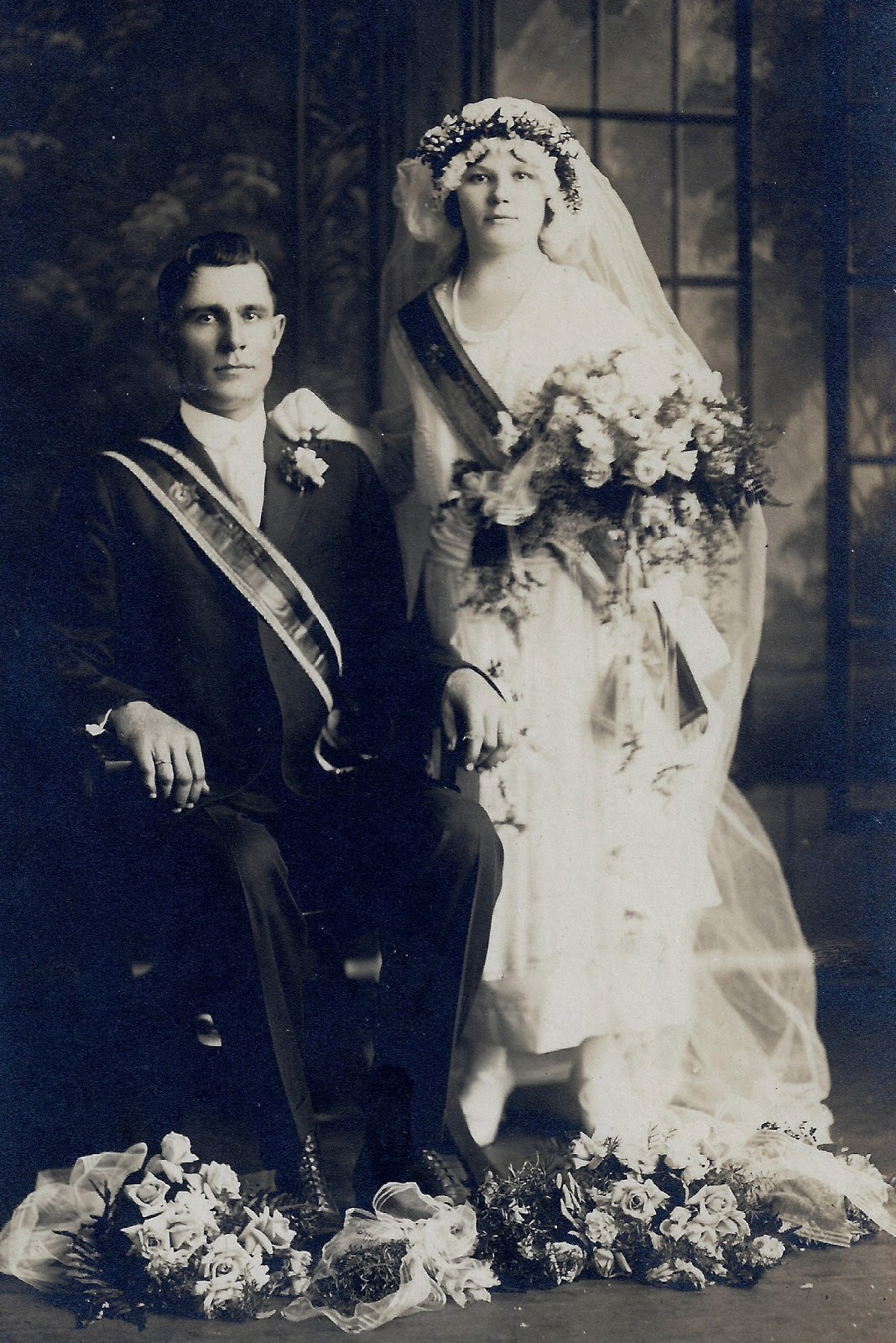
Katherine Rychly and Olexa Pylatuik

The wedding picture of my great aunt Katherine Rychly and Olexa Pylituik contained a mystery.  As you can see in the picture, they were wearing sashes with their wedding attire.  I asked their daughter, if she could tell me about the sashes, and she said that she was wondering about them herself. 
When I was going through boxes of old stuff, I found a picture of my grandfather John Koshuba, and his brother, Joseph Koshuba, both rearing a uniform with the same sash.  The answer came from  a reader of this blog, who send me an link to the University of Minnesota Media Archive--Connecting Our Collections With Yours.  The sashes were worn by members of a Ukrainian Society, The Zaporozs"ka Sich in Minneapolis Minnesota. 

Peter Wons, Joseph Koshuba, John Koshuba


Zaporozs'ka Sich Society 1914


 The Mystery of the Grandmother's Name


This a portrait of my husband's great grandmother.  It came to me in a box of old pictures from my mother-in-law, Lillian Gerstein after she died.  My sister-in-law had it and when she moved, she gave it to me.  My mother-in-law told me that her mother's name was "Bellie", so I wrote it as Bella, or Belle.  I was never sure that it was her correct name.  The light went on in my head when I was looking through old family pictures from the Gerstein family.   My husband's great aunt's first name was Beile.  Perhaps the woman in the portrait was really Beile.  In my research for this blog, I came across a site for the town of Szczuzcyn, Poland, where my husband's ancestors once lived.  I contacted the site administrator and found out that the mysterious woman was Bejla Pienanzek, who married Wolf Berek (Velvil) Monkowski, and was the mother of my husband's grandmother, Rose. 
To connect with the Szczyczyn Site mentioned here:

Friday, July 12, 2013

Prokudin-Gorskii's Photographs of Ukraine and Russia

Ukrainian Woman
Ukrainian Village
The following pictures are from the Library of Congress.  They are an excellent way to see what the countries in which ancestors lived.  Produkin-Gorskii's pictures are unusual because he found a way to take produce photographs in color.  None of the following photographs have been hand colored.  You can see from the photo, the layering of the various negatives, which is how the photographer was able to produce the color pictures. 


About the Prokudin-Gorskii Collection

The Sergei Mikhailovich Prokudin-Gorskii Collection features color photographic surveys of the vast Russian Empire made between ca. 1905 and 1915. Frequent subjects among the 2,607 distinct images include people, religious architecture, historic sites, industry and agriculture, public works construction, scenes along water and railway transportation routes, and views of villages and cities. An active photographer and scientist, Prokudin-Gorskii (1863-1944) undertook most of his ambitious color documentary project from 1909 to 1915. The Library of Congress purchased the collection from the photographer's sons in1948.

Russian Girls outside their house
Ukrainian Village and farm fields


Thatched roof house in Ukraine


Ukrainian Woman


Russian farmers outside their house.

To see more of Prokudin-Gorskii's photographs, click here:
Link to the Library of Congress: The Prokudin-Gorskii Collection.


Friday, July 5, 2013

Sylvester Rychlyj, My Founding Father

Sylvester Rychlyj outside St Michael's Church, 1940

Ninety-nine years ago, on July 4, 1914, my grandmother, Pauline Rychlyj arrived in Minneapolis, MN, the last stop on her journey from Bila, Ternopil', Ukraine.  She was accompanied by her aunt and uncle, Constantine (Stanley) Rychlyj and Maria Bilan Rychlyj and their daughter Jenny. New York Harbor was crowded with steamships the day their ship arrived, so they were processed at Castle Garden instead of Ellis Island.  They left New York on a train for Minnesota and arrived on July 4.  What a day to arrive at their new home!

This story isn't about my grandmother, or her aunt and uncle, it is about  my great-grandfather Sylvester Rychly,j the person I consider my founding ancestor.  Sylvester first came to the United States in 1908 and settled in Tower City, PA.  According to his immigration documents, Sylvester was an agricultural worker, and his contact person in the United States was Wasyl Boyko, listed as his brother-in-law.  Wasyl is a mystery, since I can find no Boykos in the Rychlyj family.  My guess is that he and his wife were friends from the village, perhaps cousins.  Sylvester left Tower City for Ukraine in 1910 because his wife Maria was very ill. When she recovered, he returned to Pennsylvania in November 1910, with his brother Constantine. This time Sylvester was listed as an non-immigrant alien.

Eventually Sylvester moved to Minneapolis, and brought his wife and seven of his 8 children to this country.  The first child to come was Anna, followed by Pauline.  World War I intervened, and the rest of the family came in 1922, 1924 and 1926.  This in itself was an amazing feat, since the average immigrant laborer earned about $1.00 per day, and had to work for about a year to pay the fare of one person to come to the USA. Why did he invest so much time and money  bringing his family to the United States?  My grandmother Pauline said that he didn't want his children to have a life with no opportunities to better themselves.  In the old country, poor people stayed poor, they worked very hard to feed and clothe their children.  Children worked at young ages and schools taught only the basics.  He knew that he could provide a better life for his children in the United States.

Sylvester did more than bring his family to this country.  Although he had an accident at work and lost his hand, he continued working.  He bought two houses in Minneapolis in 1924.  He was a founder of two churches, St Constantine Ukrainian Catholic Church, and later, St Michael's Ukrainian Orthodox Church.  He also served as the first president of St Michael's. 

When he lived in Europe, he played the violin for events in the village, after his accident, he could no longer play, so he sang.  He served as the Choir director for many years at St Michael's, and also as a Diak (cantor). He was a member of the Ukrainian Folk Choir in Minneapolis, which performed all over the Twin Cities area. 

Sylvester helped his children to get settled in this country, providing them a place to live when they arrived and later helping them to purchase homes of their own.  Several of his children and grandchildren lived in the same neighborhood in southeast Minneapolis, around Como Ave. After the death of his wife, Maria, his life was devoted to his family, his church and to the Ukrainian community of Minneapolis.  His descendants live all over the United States.  He died in 1944 of cancer. I was born in 1946, so I never met him, but I am proud to be one of his  descendants, and his great-granddaughter.

Sylvester (seated) with daughters Pauline (bride) and Anna, 1916
Sylvester with daughters Katherine and Ksenia in 1935

Friday, June 28, 2013

The Genealogy of Sarah Schwartz Gerstein

Sarah Schwartz Gerstein

Sarah Schwartz Gerstein was born in Berdychev, Russia, now Ukraine in 1882, the daughter of David Schwartz and Fanny Kessler. She has interested me from the first time I learned about her from my father-in-law, Dave Gerstein. Her daughter, Rose Gerstein Endliss gave me more information about her, and Sherry Berkman Endliss, her grand-daughter sent me the family pictures. Although she died in 1929 at the age of 47, she had a great impact on her family.  All her grandaughters are named for her, Sandra, Sheila and Sherry.  Since I have more images of Sarah as a young person than of all the other older members of the Gerstein family, I am devoting a post to her and her immediate family.

Sarah was born in Berdychev, one of the most important Jewish cities in Russia. The city originally was a part of  the Polish-Lithuanian Kingdom, but became part of the Russian Empire in 1793, in one of partitions of Poland.   Sholom Aleichim, the writer, lived in Berdychev, and Joseph Conrad, author of The Heart of Darkness, was born there to a family of the Polish nobility. When it was the commercial center of Eastern Poland it was owned by the Radziwill family.  In the 1850's, Jews were 70% of the population of  Berdychev and by 1861, it was the second largest Jewish community in Russia. Most of the Jewish population were merchants or artisans.  By 1897, with the building of a railroad link in 1870,  Berdychev became a center of light manufacturing.  Like many of the Jewish families of Berdychev, Sarah's family moved to Odessa, and eventually to the United States.

http://www1.tau.ac.il/humanities/ggcenter/images/stories/Smilovitsky/fcard%2030.jpg
Berdychev in the early 20th century
 Sarah Schwartz was the daughter of David Schwartz and Fagie Kessler.
There were four children, Sarah, 1882-1929, Baile ( Becky) 1887-1963, Avrom(Abe) and Nathan. Sarah and Becky lived in Chicago, I do not know where where Abe or Nathan lived.


Nathan and wife, Simma Schwartz


Sarah and her parents, David and Fagie Schwartz


Baile,  Simma,  grandmother, Fanny Kessler, and Sarah Schwartz

Sarah's children, David, Rose and Philip Gerstein

Sarah and her brother Nathan.


Friday, June 14, 2013

Traveling Again

Rooted in Eastern Europe is taking a short trip-- visiting Springfield, IL, (Lincoln Presidential LIbrary), Fayetteville, (Crystal Bridges Museum of American Art and History) and Little 
Rock, Arkansas. The Blog will be back on Friday, June 21.

Friday, June 7, 2013

The Genealogy of the Holmberg-Koshuba Family

The Joseph Koshuba family continues to fascinate the genealogist in me.  My great uncle, Joseph Koshuba, married Florence Elizabeth Holmberg on Febuary 4, 1913, in St Paul, Minnesota. I have been researching the Holmberg-Koshuba family off and on for the few past years.

Florence Holmberg Koshuba was the daughter of Ida Christine Larson and Erick Carl Holmberg, both born in Sweden; Ida in 1857, Erick's birth date is unknown. I have found no information about Ida and Erick's wedding, neither date nor place. Ida came to the United States sometimes between 1871 and 1885, again, no immigration information about Erick.

Erick and Ida had three children: Julius Herman(1889-1970); William R.(1892-1972), and Florence Elizabeth, born in 1894, death date unknown.

In 1900 US Census, Ida is listed as a widow. Erick Holmberg died  between 1894 and 1900. Ida and her children were living at 257 Williams St, St Paul.

In the 1910 US Census, Ida is listed as married to Gilbert Nelgard,  who was born in Norway.

In 1913, Florence married Joseph Koshuba. They had three children, Fred, (1914-1941), Catherine Florence (1915-unknown) and Marie Olga (1917-1993). They lived at 886 W. Central Ave. in St Paul.  Joseph died in January 1919.

Joseph, Florence and Fred Koshuba, 1916

In the 1920 US Census, Florence Koshuba is listed as a widow. She is still living on Central Ave in St Paul, and continued to live there until 1929-/30. Her mother Ida, is listed as Holmberg, so her second husband, Gilbert Nelgard, may have died, or they divorced.   William Holmberg, Florence's brother, divorced and was now living with the Koshuba family. Ida Holmberg died on Sept 14, 1920.

In the 1930 US Census, Florence Koshuba is living at 177 St Albans Ave,  St Paul, and  worked as a housekeeper in a private home. Fred is a printers helper/apprentice and William Holmberg worked as a pressman at the St Paul Pioneer Press/Dispatch.  The daughters, Marie and Olga attended school but Catherine was also working as a waitress.


According to the St Paul City Directories, Catherine continued to work as a waitress until 1934.  Fred worked in various printing companies.  Catherine attended Central High School in St Paul until 1933. In 1934, Florence and her family moved to Inglehart Ave. in St Paul.  In the 1935 and 1937 St Paul City Directories, Catherine worked at 3M company as a key punch operator.  Marie also worked as a key punch operator at the Minnesota State Employment Office in 1937.

The last entry in the St Paul Directory for Fred Koshuba is 1937.  Fred married Charlotte (surname unknown) between 1937 and 1941.  Marie married John W. Poppler in 1937 in St Paul.  They had two children, Jacklyn Poppler born in 1938, and Richard John Poppler (1941-1976).  
 
In the 1940 Census, only William Holmberg and Marie Koshuba Poppler are listed in St Paul.  I have found no records in the 1940 Census in Minnesota for anybody else in this branch of the Koshuba family.

In December of 1941, Fred was killed in a automobile accident in Dolton, IL.  According to his death certificate, worked in Detroit, MI, as a payroll clerk for the Ford Motor Company. He was buried in St Paul.

Catherine moved to Los Angeles, California, between 1937-1941, and is listed in the Los Angeles Directory as working as a key punch operator at the SFR Company.   In 1946  the Poppler family was living in Compton California, according to the Compton City Directory. Marie and John divorced and she later remarried.  She died in San Diego California, in 1993.

I have found no further information about Florence or Catherine Koshuba.