Saturday, July 25, 2015

Living in Ukraine 100 Years Ago: The Prosvita Society

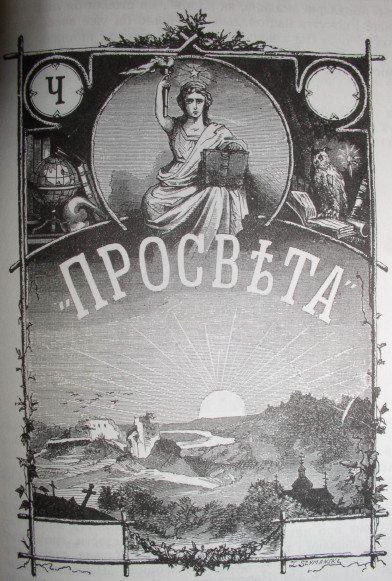
Cover of a Prosvita Publication

There was a house in the village of Biala where nobody lived.  It was owned by Painko Bryniak, my 2Xtigreat uncle.  My great aunt Katherine Rychly Pylatiuk called it the chytalnia, which means reading house in Ukrainian. Monthly meetings were held in the house called Veedchyty (means reading in Ukrainian). These meetings were for the enlightenment of the men, where the more educated shared their knowledge with the less educated.
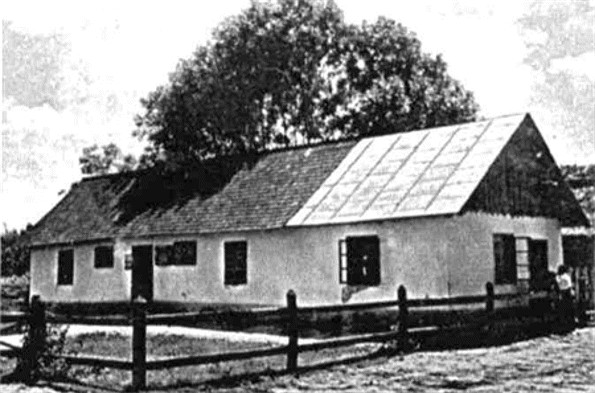

Prosvita reading House in a village. Source: Encyclopedia of Ukraine


Katherine explains in her autobiography how valuable the veedchyty were to the people of the village. Since her grandmother lived next door to the chytalnia, (Painko Bryniak owned that house as well) she could look through the window and see a bust of the Ukrainian poet an artist, Taras Shevchenko. She heard the men recite Shevchenko's poems and sing patriotic Ukrainian songs.  Sometimes one of the men would read an article and then lead a discussion about it.  She also saw shelves of books and magazines and portraits of famous Ukrainian s on the wall of the house.


Statue of Taras Shevchenko on the Mall, Washington D.C.


What was the Prosvita Society?

This reading house in Biala was a part of the Prosvita Society.  Prosvita means enlightenment in Ukrainian,  founded in 1868 in Lviv by Ukrainian students  in order to "know and edify the people." Until 1914, Prosvita was the most important Ukrainian mass organization in Galicia.  Its activities included almost all aspects of Ukrainian life, and it created many cultural, political, economic, farming and sports societies and organizations which eventually became independent organizations.
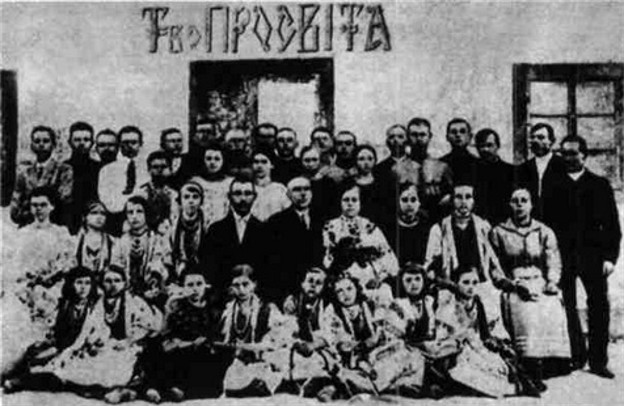
Founders of the Prosvita Society, 1868. Source: Encyclopedia of Ukraine.

Why did this group of young people feel that it was necessary  to edify the people when free public education was available for children in Galicia up to the age of twelve?
This is a question is hard to answer because it involves both politics and history.  Biala, Ternopil' and Eastern Galicia were part of the Austrian-Hungarian Empire which was made up of many countries and many ethnic groups. The Austrians kept control of its various peoples by encouraging discord between ethnic groups.  This policy worked for a time, but in 1861 Austria became a constitutional monarchy when it recognized the Hungary as an equal partner and changed its name to the Austrian-Hungarian Empire. Both Austria and Hungary had their own legislatures and capitals, Vienna for Austria and Budapest for Hungary. The Austrians had their hands full dealing the demands of the various ethnic groups, and left the governing of Galicia to the Poles. In the 1860's, the Poles controlled the both local and provincial government in Eastern Galicia. The Ukrainians wanted instruction in the Ukrainian language in the schools, more Ukrainian high schools,  more representation in government and recognition of their culture. There were many conflicts between the Ukrainians and Poles, but since the Poles held all the positions of power, decisions almost always favored Polish interests.   The founders of Prosvita realized that if the Ukrainian people of were to achieve economic and political power, they would have to do it on their own.


Map of Eastern and Western Galicia.

 Prosvita's Three Goals

Increasing Literacy 

Increasing literacy was Prosvita's  first goal. A network of libraries and reading rooms were established in Eastern Galicia. Most villages had schools with trained teachers, and lessons were in both Ukrainian and Polish. One of the first actions of Prosvita  was to publish basic textbook in the Ukrainian language to be used in schools. The society started a network of chytalnias (reading rooms) in the Lviv area, where books and other reading materials were available. These reading rooms spread quickly and within a few years, reading rooms were established all over Eastern Galicia.

Higher education was a concern, elementary schools, run by the government were available, but secondary education was not. To raise the cultural level of the Ukrainian people, access to higher education was a necessity. In 1897, 30 high schools were Polish, two were Ukrainian. in Galicia.  By 1914, four more Ukrainian high schools were added by the government. Acting on the idea of self  help and knowing that no more high schools would be funded by the government, contributions by the Ukrainian community established eight more private high schools. Private dormitories were built in Lviv so students from rural areas could attend high school and university.  Few Ukrainian students attended Lviv University; about 500 students out of a student body of 1700, which had eight Ukrainian professors in of a faculty of eighty.   Ukrainian professorships gradually increased and the government promised a Ukrainian university, but this did not happen because of the outbreak of World War One.


Cover of "Lions" Ukrainian History Book published by Prosvita


Increasing the Economic Level of the People

Prosvita's second  goal was to raise the economic level of the Ukrainian farmers in Galicia. Ukrainians in the Austrian empire were among the Empire's poorest and under represented people. Self help was the key, since there was no help coming from the government.

Prosvita Vasyl Orynchuk cooperative members, Roztoky,  Lviv Region. Source: wumag.ua

Cooperatives, stores and warehouses were formed to improve the condition of the peasants.  Courses were organized to help the farmers modernize and improve farming methods. Itinerant farming instructors travel the region and taught local farmers how to use modern methods. It started a commercial school in Lviv, a farming school and a women's domestic school. Prosvita gave scholarship for students to study agronomy, dairying and domestic management.  Credit unions were started to enable peasants to save money  and to borrow it when necessary.  Books were published about farming and other subjects such as Ukrainian history and literature. In 1877 Prosvita started to print monthly booklets which were given to members free of charge and established a newspaper was in 1879.
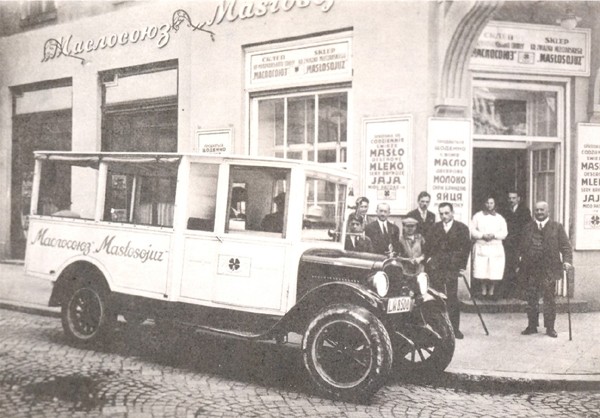
Prosvita Dairy Store/Cooperative in Lviv. Source: Encyclopedia of Ukraine


Building Cultural Awareness and Patriotism
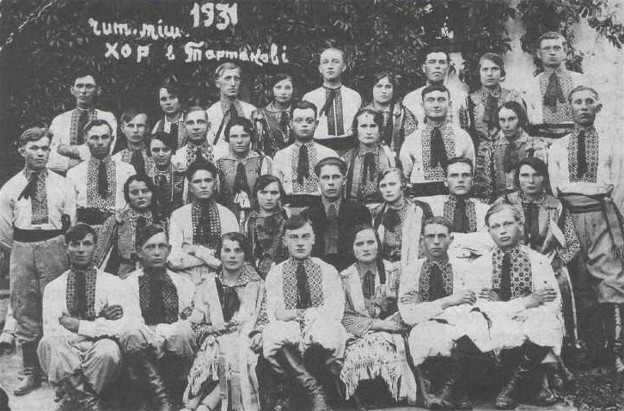
Choir organized by the Prosvita Reading House in Zahiria, 1931. Source: Encyclopedia of Ukraine


The third goal was to raise awareness of the Ukrainian language and culture among the Ukrainian people. To further awareness, Prosvita encouraged the Ukrainians to form choirs, bands and drama groups;  learn about Ukrainian history, read literature in the Ukrainian language and develop Ukrainian patriotism.  Prosvita started Sokil and Sich in 1894 to encourage youth appreciation for discipline, cooperation, patriotism and education. Sokil developed physical training and the goal of Sich was to develop patriotic and cultural activities.

Drama Group, Prosvita Mohyntsa, Ternopil' Source: ebay.


Prosvita's Support

Prosvita's support came from membership dues, individual donations, subsidies  from the provincial and cnetral government.  Government support was small and was often cut off by Polish opposition. Profits from Prosvita's printing and its other operations also funded its activities.  Between 1869 and 1906, Prosvita made a small profit, of 2000 Kronen.iProsvita's Success
By 1900, the Prosvita chytalnia reading houses became the center of village life, displacing the church and tavern. In 1914, Prosvita had  77 regional branches, 3000 reading rooms and over 200,000 members. 75% of the villages cities and towns of Galicia had reading rooms, thelargest number of were in the Ternopil' area.  It published over three million copies of  495 books, supported 45 scholarships for high school and university students.  Prosvita owned its own headquarters building in Lviv and sponsored a large celebration of the 100th anniversary of Taras Shevchenko's birth there in 1914. It spread out  from Eastern Galicia to other parts of the Austrian empire with large numbers of Ukrainians.  It also was established in Eastern Ukraine, which was ruled by Russia.
Prosvita played a critical role in the growth of national consciousness among Ukrainians and in the improvement of their standard of living.

Wilhem Feldman said in 1907, "The 20th century has seen many nations rise from the ashes, but there are very few cases of rebirth so rapid and energetic as that of the Ukrainians of Austria... their unexpected and vigorous growth is mostly the result of self-help and hard fought gains." Subtelny, p. 329.
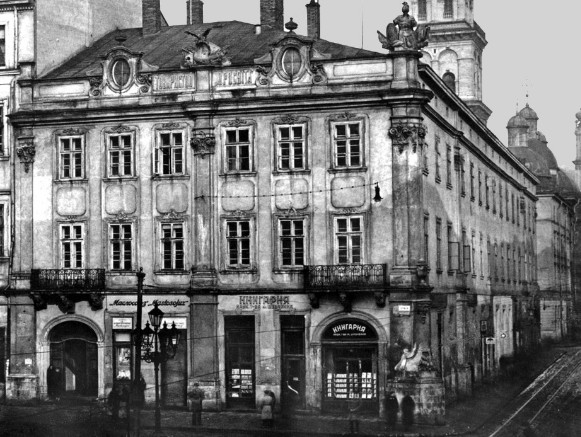


The Prosvita Building in Lviv. Source: Encyclopedia of Ukraine.

Sources: 
Encyclopedia of Ukraine, www.encyclopediaofukraine.com
Lawryk, Julia, Kateryna (Kasha) Autobiography by Katherine Pylatiuk Lymar as told to her Daughter, Julie Lawryk in 1988. copyright 1988
Subtely, Orest, Ukraine, A History,  University of Toronto Press, Toronto, Canada, 1988
Yaremko, Michael, Galicia-Halachyn: From Separation to Unity, Shevchenko Scientific Society,  Toronto, 1967.


Sunday, July 12, 2015

Living in Ukraine 100 Years Ago: Crime and Punishment

The people who lived in the village of Biala,  on the outskirts of Ternopil', Ukraine handled  most conflicts on their own.  My great aunt, Katherine Rychly describes in her Autobiography how the people of the village dealt with issues of morality, petty crime and debt.
 
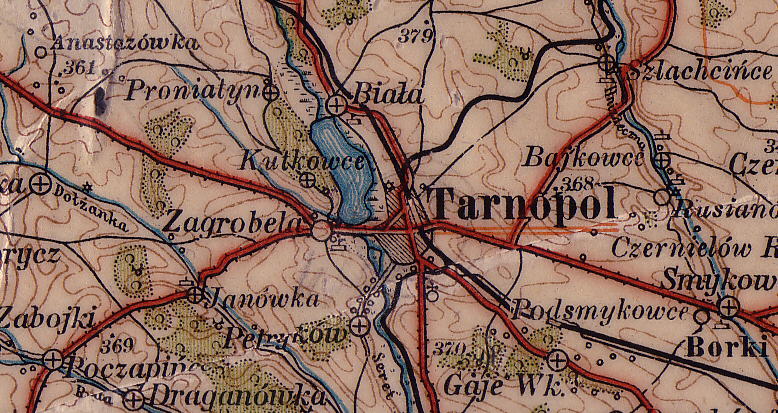
Old Polish map showing Tarnopol(Ternopil') and the village of Biala

Morality

There were 350 houses in the village of Bila.    Katherine explained that most of her family members lived in the village, her grandparents, aunts, uncles and cousins.  Each person was aware of  everything that you did, as a child or as an adult.  If you did wrong, you hurt your entire family--that was the biggest hurt of all--it followed you for the rest of your life.  This encouraged children to behave, and made them aware that their actions represented not only themselves, but their parents and extended family as well.  However, this did not stop crime in the village.  Katherine said "We had to keep an eye on everything because the village had known thieves, and we had no recourse to justice.  If you caught the thief red-handed, you took the matter into your own hands at that moment and beat the living daylights our of him/her.  Stealing was a part of everyday life." So were beatings, which sounds so horrible to us today, but corporal punishment was the way to deal with wrongdoing.

"Our Easter Dinner Vanished!"

The week before Easter was a busy one in Bila, with everyone preparing for the holy day with a family dinner after church services.  On the day before Easter, everything was prepared for the big celebratory dinner the next day. Katherine's mother put all the food in a small storage room, adjacent to the kitchen and locked the door.  Katherine tells the story, "The next morning, we found that during the night, someone had cut a hole in the wall of the storage room from the outside and took all the food.  Why didn't we hear anything?" Katherine wondered, "Someone was always home."  Everybody in the village had a wonderful dinner, but they had nothing. 

The Veet

Every village in Eastern Galicia, where Biala was located, had a Veet.  He was the village headman, somewhat like a mayor.  His duties included collecting taxes and mediating disputes, he served as both judge and jury.

Taxes Not Paid?-We have a Solution for that.

Before World War One, when Bila and Ternopil' were a part of the Austrian-Hungarian  Empire, there was a tax on each house in the village.  The Veet was in charge of tax collection, which was a big job, seeing that there were 350 houses in the village.  If the tax wasn't paid, the Veet came to the house and took something of value as a payment. Most items were acceptable, chickens, lambs or just about anything that had value.  A person was able to buy the article back, plus interest.   The Rychly's were poor, and depended on their farm and on their father,  Sylvester, who was working in the United States for support. The Veet came to their house to collect the back taxes, and since there was no cash, he took Katherine's mother's fur lined coat.  It didn't matter if it was winter time and cold, and that she had nothing warm to wear, the coat was valuable, so he took it.

Don't Mess with Mother's Coat.

The Rychly children did not have many toys, and what they had was home-made.  Katherine had a doll made from corn husks.  One day, she decided to make her doll look nicer, so she cut a leather braided fastener off her mother's coat.  Katherine thought that it would make nice hair for the doll.
When her mother saw what had happened to her coat, Katherine got a beating, and the doll lost her braid.  It was quickly sewn back on the coat.

In the picture of the Koshuba family, the men are wearing fur lined coats with braided leather fasteners, like the one worn by Katherine's mother.  Picture from the collection of Ed Wons.


Katherine is Sued

Stephen Langish lived next door to the Rychly family and recently planted five fruit trees in his yard.  Katherine was seven years old, and wanted them in her yard, so she dug them up and replanted them outside the Rychly's house.  When this was discovered, Langish sued.  Mother went to the Veet with  Katherine's younger sister, Helen, who was just five years old. Mother knew that Katherine was the culprit, but she thought that a younger child would elicit more sympathy from the Veet.  Helen didn't cooperate, and when asked by the Veet if she took the trees, she answered "No, Kasha (Katherine) did!"  The Veet didn't believe her.  He thought that she was afraid to own up to the crime, but that she actually did it.  He took pity on her.  His verdict: return the trees and replant them.  Mother dealt with Katherine in the usual way later.

Just Give Me the Change, Please

 In 1922, Katherine and Helen were ready to immigrate to the United States.  Their father, Sylvester saved enough money to pay for their passage from Bila to Minneapolis, Minnesota. In order to immigrate, they had to get their birth certificates so they could apply for passports. In Poland, vital records were kept by  the religious organizations of the community, the Roman Catholic Church, the Greek Catholic Church or the Jewish Synagogue.  Since Katherine was the older sister, she was responsible for getting the documents for the trip.  She went to the village priest and requested her birth certificate and one for sister Helen.  The charge for both was 500 Markas (the Polish currency at that time).  Mother gave Katherine a 1000 Marka note and expected her to get a 500 Markas in change.
1000 Polish Marka note from 1919
The priest did not have change that day and asked Katherine to come back later and he would give her the 500 Markas.  She came back several times, he did not give her the change.  Mother was annoyed, so she decided to take care of the matter herself.  She went to the priest and asked for the 500 markas that he owed her daughter.  His response was to beat her with his cane.  The villagers working in the priest's garden heard the commotion and ran to get help from Mother's children.  Katherine and the others came quickly, but she couldn't remember what the outcome was.   She and Helen did leave Biala, so the matter must have been resolved.

Source: Kateryna (Kasha) Autobiography by Katherine Pylatiuk Lymar as told to her Daughter, Julie Lawryk in 1988. copyright 1988.

Wednesday, July 8, 2015

John Nyznyk: My Grandfather, an Enigma, The Story Ends

My grandfather, John Nyznyk has been the subject of my blog for the past two weeks. Researching his life has unearthed a lot of information about his life, but not everything that I was trying to find.
This week I will finish the story, but I do not have an satisfactory end to it.

Last week I finished my post with the 1930 United States Census.  John was 52 years old,  living at 533 East 6th Street in New York City, working as an upholsterer in the furniture industry.  He was living alone, and stated that he was a widower. He now was a naturalized citizen of the United States.


Michalina Nyznyk Immigrates to the United States.


Manifest from the SS Kosciuszko.  Michalina Nyznyk is listed on the first line.

Michalina Nyznyk, my father's half sister, arrived at Ellis Island, in New York on April 27, 1931.   She joined her father, John, in Belleville, New Jersey.  He was living at 52 Columbia Ave in Belleville.  Michalina was 20 years old, with brown hair, fair skin and grey eyes.  She was 5'4" tall and in  good health .  She left her brother Paul, her closest relative in Poland, who like Michalina was born  and raised in Pomorainy,  and now lived in Niszczuki, Zborov, Poland.  She obtained her passport in Warsaw on March 23, 1931, and left from Gdynia, Poland, on the SS Kosciuszko on April 15.  She came to the United States as a permanent resident. According to the ship's manifest, her occupation was farmer and she could read and write. From the records that I have, she had never met her father, since he left Pomorainy before she was born.

Second page of the SS Kosciuszko, showing Michalina's home information and her fathers address in New Jersey.

I have found no other information about her at all.  She was not listed in the 1940 Census, or in any existing  Belleville, N.J. directories.  I have found neither marriage nor death records for her.  As far as I know, she came to the United States and vanished.

John Nyznyk: The 1940 United States Census.

John Nyznyk was 58 years old and living alone in New York on April 8, 1940, the day the Census taker came to gather information. He lived at 205 East 4th Street in New York, a few blocks from his residence in 1930 and was paying $13 a month in rent. He was listed as single and was born in Austria and attended school for 5 years.  According the the Census, he lived at the same address in 1935, which is interesting, because four years earlier, in 1931, he was living in Belleville, N. J. with his daughter Michalina.
John had been unemployed for 50 weeks, and had worked only 12 weeks in 1939. However, he said he had a source of income, which was $240 per year or $20 a month.  When he last worked, he was a laborer in construction, unusual for a 58 year old man. He had previously worked as an upholsterer, never as a laborer.  He was still looking for work and did not do any public emergency work.  
This is the last record that I have about John Nyznyk.  I have searched again and again and have consistently found nothing.  I think that he died in the 1950's, but this information came from my parents, and they heard it from other relatives.

1940 United States Census.  John Nyznyk is on line 15.

Conclusions?

I will continue to search for information about John and Michalina.  From the 1920, 1930 and 1940 Censuses, I found a lot of information about my grandfather.  I am also fortunate that his applications for US citizenship were available on line.  I am also glad that my father had a detailed marriage license for his parents.  His birth certificate was also detailed and provided me with a lot of information about his parents.
I would like to find out more about Michalina.  I wonder if she married and stayed in the US?  I wonder if she decided to return to her brother and family in Poland? There are many records of in coming ships to the US, but I have found no sources/manifests about outgoing ships. Perhaps a reader of this blog may remember a grandmother, great-grandmother or aunt by the name of Michalina.  If you do, please let me know.


Friday, June 26, 2015

John Nyznyk: My Grandfather an Enigma, The Story Continues

Last week I wrote about my grandfather John Nyznyk, who has always been a mystery to me.  All I know about him are some family stories, so when I began to research my family history, I was interested in finding more about him.  In last week's blog, I started to tell his story through my research findings.  This week, I will continue his story.

Surprises found in my research

The biggest surprise I found in my research was that my father had a brother and a sister.  My father knew that his father had been married before and that his first wife had died.  He never mentioned that there were any other children.  The second surprise in my  research was that my grandfather did not mention his son, my father, in his Petition for Citizenship.  He listed the children from his first marriage, but not my father.  This is interesting, because states that he was still married to my grandmother Mary Klak.

John Nyznyk's Petition for Citizenship

John declared his intention to become  a United States citizen in 1926.  He filed the Petition for Citizenship on April 8, 1930.  He was living at  533 East 6th Street in New York City and listed his occupation as an upholsterer. He stated that he was born on July 27, 1878 in Pomorainy, Galicia, Austria.

John Nyznyk's Petition for US Citizenship

John said the had been in the United States since 1910 (at least 5 years of residency were required in order to file for citizenship.)  He stated that he was married to Mary Klak, but had no knowledge of her residence since 1915.  He named his two children, Paul, born on August 19, 1904 and Michalina, born August 20, 1910.  He also named his first wife, Anna Kowalsky, who died in Pomorainy (known then as Pomorzany), Poland in 1913. My father Peter was conspicuously absent.  John's citizenship was finalized on November 10, 1930.

John Nyznyk's final Naturalization card

The 1930 United States Census: John Noznick

Searching for information about John Nyznyk in the 1930 US Census was very interesting.  I did not find anything about John Nyznyk, but I did find John Noznick.  The census taker was at 624 East 11th St, New York City on April 12, 1930.  The Noznick family was made up of John Noznick, age 49, Mary Noznick, age 42, and Peter Noznick age 14.  Neither John nor Mary were able to read or write.   They were both born in Galicia, Poland.  John came to the US in 1916,  Mary came in 1911. According to the Census, John worked as a porter in a restaurant and Mary was a housewife.

The 1930 US Census, showing the Noznick family on line 77

When I read this, I thought--what is going on!  First of all, John Nyznyk filed his Petition on April 8, 1930, 5 days before the census taker came to the Noznick home. According to his Petition, he lived at 533 East 6th Street, several blocks away.  John Nyznyk was an upholsterer and  from what I found in his records, never worked in a restaurant.  He was 52 years old, not 49 as listed on  the census.  John Nyznyk could read and write, John Noznick could not.  John Nyznyk stated that he had no knowledge of Mary's residence since 1915, but according to the census record above, he was still living with her.  From what I know for sure, John Nyznyk was never known by the surname Noznick.  So what do we have here?  I have a feeling that my father gave the census taker the information.  His step-father's name was Peter Zackowski and his mother married him before 1920.  I think that my father gave the census taker Peter's  occupation information.  I have no idea why he did not give the actual names of his parents.

The 1930 United States Census: John Nyznyk

Sometimes following a hunch leads to a genealogy jackpot, some times to a wild goose chase.  This time I hit the jackpot.  I decided to search the 1930 Census, using the address John Nyznyk used on his Petition for Citizenship.  After finding the enumeration district for the address, I found the schedule for 533 East 6th St. Looking down the list of names, I found a John Mazwyk, which looked liked it might be my grandfather. There are mistakes on the US Census, often names are miss-spelled or other wise mangled up.  When the person giving the information is not fluent in English, the census taker  would spell the name as best  as he/she could. John's age and birthplace were correct, as was his occupation of upholsterer. The year he immigrated to the US is 1910, which confirms other records. He stated that he was a naturalized citizen and could read and write. His place of origin was listed as Austria.  More surprises, his age at his first marriage was blank.  He stated that he was a widower;  he had "forgotten" not only his son, but his second wife as well.

John Mazwyk aka John Nyznyk is on line 30.
Now I have another record to back up John Nyznyk's basic information, his age, his date of arrival in the US, his US citizenship and his occupation. John's story does not end here.  There are more surprises that I will write about next week.


Sunday, June 21, 2015

John Nyznyk: My Grandfather, an Enigma


My paternal grandfather John Nyznyk, is an enigma, a mysterious or inscrutable person.  I never met him and have see only two pictures of him, both from his wedding to my grandmother Mary(Maria) Klak in 1914.  There are a few family stories about him, but I have no way of verifying any of them.  In this post, I am using material that has a source--no tales, no hearsay, only the facts.  There are only a few sources that I am sure about--the marriage license, the baptismal certificate of my father and his application for United States citizenship.  There are other documents, but I can't be sure that they are his. His story illustrates the problems of finding information for genealogy research. 
If you know anybody with the name of Nyznyk or Niznik or Nisnik, who has ancestors from Galicia, they may be related to John and could shed some light on his story.
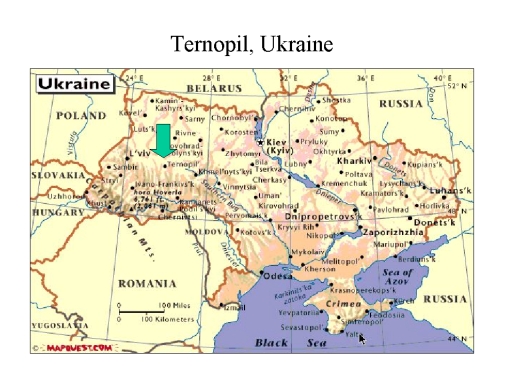
Map of Ukraine, green arrow points to Ternopil'

Pomorjany (Pomorany) is about 15 km SW of Zbirov. and 48 km west of Ternopil"

Arrival in the  United States 1910

John Nyznyk was born on July 27, 1878 in Pomorainy, Galicia, a part of the Austrian-Hungarian.   According to his Declaration of Intent for citizenship, he came to the Port of New York on March 12, 1910 on the Albany.  The Intent (First Papers) was filed on November 19, 1926.  This confirms his date of birth and birthplace. According to the ship's manifest, John arrived in New York on April 1, 1910, on the ship,  S.S. Volturno which sailed from Rotterdam on March 14,1910.  His name is listed as Jan Niznik.  His age is either 22 or 32-- the handwriting is hard to read.  He had $25 with him, he came from the village of Pomorainy in Galicia, his language and ethnicity Ruthenian (Ukrainian) and his occupation was laborer.  He could read and write, and he left his wife Parasia Niznik in Pomorainy.  The ship's manifest also states that he had been in the United States from 1901-1908.  The name and address of the person he was going to in New York is illegible. 

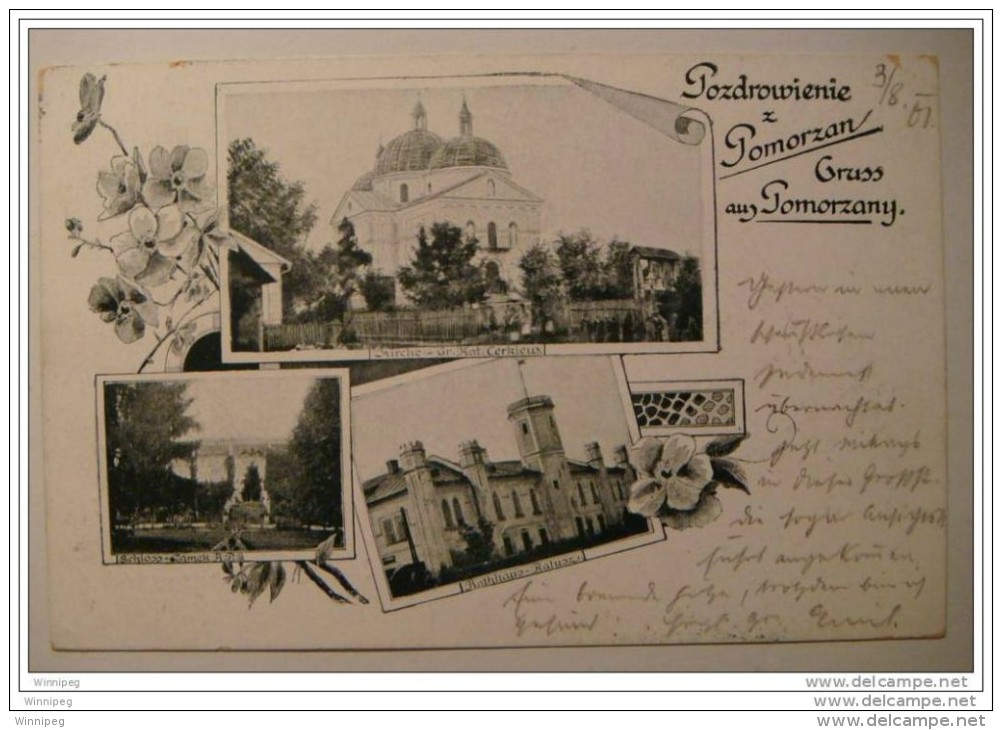
Old postcard sent from Pomorany--Pomorzany in Polish. Source: del campo.net

Marriage to Maria Klak: 1914

John Nyznyk married Mary Klak on November 21, 1914 at St George Greek Catholic Church, 22 East 7th Street, New York, New York.   On the marriage lisence he listed his occupation as a laborer and his residence at 533 East 6th Street, New York, New York.  He also stated that his parents were Paul Nyznyk and Anastasia Romanowicz.  The witnesses to the marriage were Michael Rudnicki (brother-in-law of Mary Klak) and Nicholas Malinowski.  The priest officiating at the wedding was Rev. M. Lysiak.

Birth of son Peter: 1915

Peter Noznick, son of John and Maria Nyznyk was born on August 18, 1915 in New York City at Bellview Hospital. Peter's  surname on the birth certificate was Nausneck, no first name was listed.
According to the Birth Certificate, the family was living at 403 East 92nd St , New York City.  John's occupation was listed as harness maker.  Peter was baptised at St George Church on September 12, 1915. On the Baptismal Certificate his name was listed as Peter Paul Nyzny .  His baptismal sponsors were Michael Rudnicki and Ksenia Malynowska (also a relative of Peter's mother). The officiant was Rev. Pidhorecky.

World War I Draft Registration: 1918

In 1918, all men were required to register for the draft since the United States had just entered World War One. I found a Registration Card for a John Naznak,  with a birth date of July 27, 1876.  I think that this might be my grandfather, but the birth date listed is two years earlier than the birth date on his marriage license.  His residence is 123 Avenue A, Room 12, New York City.  His occupation is listed as upholsterer, his employer is  Liberty Auto Trimming Company.  He is described at tall, slender with grey hair and brown eyes.  He also states that he has filed papers for citizenship, which is different from his Intent papers which he filed eight years later.

United States Census: 1920

According to the 1920 Census, John Noznok was living at 613 East Eleventh St in New York City.  There are several discrepancies in this Census record, so I am not sure that this man is my grandfather.  His age is 42, born in 1878, and he states that he is married and that he has filed first papers.  His occupation is listed as a trimmer in an auto factory.  His year of immigration is listed as 1913, his birthplace is listed as Galicia and his mother tongue is Ruthenian (Ukrainian.) The only information that is consistent with other sources is his age, native language and birthplace and that he is married.

Declaration of Intent to file for United States Citizenship 1926

John filed his Declaration of Intention for US citizen ship in 1926 in the Southern District of New York.  He states that his name is John Nyznyk, he was born on July 27, 1878 in Pomorainy,  Austria.  His physical description lists his complexion as dark, his height as 5 feet, seven inches, his hair gray and his eyes brown.  His occupation is upholsterer.  His says that he is married and his wife Mary, born in Austria, who lives with him at 138 East Third Street, New York City.  He also says that he came to the United States on the ship Albany, on March 12, 1910.  He does not mention that he has any children.  He signed his name "John Nyznyk" and the signature looks similar to his signature on World War I registration document. The date of filing is November 19, 1926.

Petition for United States Citizenship 1930

John Nyznyk's Petition for Citizenship was filed on April 8, 1930.  He lists his address as 533 East 6th Street, New York City, the same address as he had when he married in 1914.  He says that he  married Mary on November 21, 1914, and that her residence was unknown to him since 1915. He also states that she came to the United States in 1916 or 1917. He said that he has two children, Michalina born in 1910 and Paul, born in 1904.  He also states that his wife, Anna Kowalsky died in 1913.  He does not mention my father Peter at all.  He said that he came  to the United States on June 6, 1910 on the ship Niew Amsterdam, which left from Rotterdam, under the name Jan Niznik.  His two witnesses confirming residency were Michael Pochmarsky and Stephen Hysa, both of New York.  On November 10, 1930, he received certification of his citizenship by the US District Court at New York City, New York, petition number 167317. Again, inconsistencies are present in this document.  His date of immigration and name of ship differ from the Declaration of Intent. The information about wife Mary contradicts what he stated in the Declaration of Intent as well.

 My Conclusions--based on the information I have

There are quite a few discrepancies in John's petition. According to his Petition (1930), he arrived on June 6, 1910 on the Niew Amsterdam.  According to the ship's manifest (1910), he arrived in New York on June 1, 1910 on the S.S. Volturno.  The wife listed on the ship's manifest was Parasia, not Anna. If he had been in the United States from 1901-1908(Manifest), he probably wasn't the father of Paul, born in 1904(Petition).   In the Petition, he does not mention that he has a third child, my father, born in  New York in 1915.  He states in the Petition that his second wife's residence was unknown to him since 1915, but in his Declaration (1926) of Intent, he stated that he was living with her.

I do not think that the Jan Niznik on the ship's manifest is my grandfather.  There are three ships mentioned, the Albany, The Niew Amsterdam and the Volturno-- on which ship did he arrive?  It doesn't seem that the  authorities who determined  his citizenship cross checked the sources.
Although John could read and write, I doubt that he had the knowledge to do the research necessary to find the records he needed.  He probably had to hire somebody to find that information.  So after studying the sources, I have concluded that the only information about John that is consistent is his name, birth date and physical description, place of birth and native language.  His story did not end in 1930--I will revisit it next week.

Friday, June 12, 2015

LIving in Ukraine 100 Years Ago: Dealing with Sickness and Injury


Sickness was dangerous in Bila, according to my great aunt Katherine Rychly Pylitiuk. Bila was village bordering Ternopil', a city in eastern Galicia   She was born in Bila in 1904, grew up in there,  and immigrated to the United States, in 1922.  Later in life told her life story to her daughter, Julia Pylatiuk Lawryk.  That story is the information source for this blog post.
Map of Ukraine showing the location of Ternopil. Source: Bowdoin College

Katherine lived in Bila with her mother,  2 sisters and 3 brothers.  Her father, Sylvester Rychly was in the United States,  working to provide a better life for his family in Bila and hoping to bring them to America.  Katherine's older sisters, Anna and Pauline were in the United States, immigrating in 1913 and 1914.  It was difficult to make ends meet in Bila; the family had a farm, but it was too small to support a family of 6.  The younger children attended school, but everybody had to work so there was food on the table.  Since Sylvester was gone, Maria, Katherine's mother, had a heavy load of responsibility.

The family grew hemp and grain on their land, as well as fruits and vegetables.  Hemp was a versatile crop, it grew quickly and could be used for many things.  Its fibers were used for rope,  and could be woven into a fabric.  This fabric was used to make sacks as well as clothing for the family.  The grain was ground into flour that provided the family's bread. Cooking oil was extracted from the seeds. 

Cutting hemp in Ukraine.  Source: Library of Congress
One of Maria's responsibilities was to prepare the grain and hemp.  Before the grain could be sent to the mill, it had to be cut,  and the chaff separated from the seeds. Everybody in the family had to help with the grain harvest.  The hemp was cut, bundled and put into the neighboring lake to rot. After several weeks, it was dredged up and cut.  The fibers inside of the stalk were removed, combed and sent to the tkach (weaver) to be made into cloth.  The women were in charge of cutting the hemp stalks and preparing the fibers.  These jobs took a toll on Maria's health.  She developed allergies to the grain and the dust that came with the threshing.  The mold associated with the hemp also irritated her. She developed asthma.  There was no treatment for asthma except for bed rest, and often Maria was laid up in bed for several weeks.

Maria gave birth to daughter Ksenia in 1908.  In the village, women were expected to go back to work after giving birth.  She had to take care of the baby and her other small children as well as cooking, cleaning and farm work. This time she never recovered her strength.  Her asthma flared up and and she developed pneumonia.  She was sick in bed for weeks and the family thought that she might die.  The family wrote to Sylvester, who was working in Pennsylvania, asking him to return to Bila. By the time he arrived, Maria was feeling better.  He stayed for a several months, then returned to Pennsylvania, but Maria's asthma continued to affect her health.

A typical whitewashed house in Ukraine.

 In 1913, when Katherine's youngest brother Onufrey was two years old, he fell into a bucket of "vapno." Vapno is whitewash,  a type of paint made from calcium hydroxide and chalk.  It is very effective on surfaces made from clay because it absorbs easily and makes the clay harder.   Most of the peasant houses in Galicia, including the Rychly's, had walls made from clay on a wooden frame,  and were painted with whitewash inside and out.  Onufrey was sitting on a bench watching his mother mixing the vapno, and while she looked away for a second, he fell head first into the bucket.  The ingredients in whitewash can cause serious skin irritation, chemical burns, blindness and lung damage. For Onufrey, the results of this accident stayed with him for the rest of his life.  He could not see for the several months after the accident.  One eye was larger than the other, and did not focus properly.  I remember that one his eye bulged , but I never knew why, or that his vision was impaired.  He never saw a doctor for this injury, and was treated with home made remedies.

 In 1916, when Katherine was twelve, she and her younger brother Onufrey, who was four, came down with "prypasnytsia" an illness similar to malaria.  World War I was going on around them since they were living on the Eastern Front.  Malaria is a disease that comes with war.  Today, it exists in tropical areas, but 100 years ago, it was prevalent in many parts of Europe.  Since there were soldiers in the village, and they were staying in village homes, it is possible that the disease came with them.  It is caused by mosquito bites, and in those days, there was no cure. Its symptoms are a high fever, chills, shivering and fatigue.  After six months, Onufrey recovered.  However Katherine was sick for two years.  I wondered how this disease could last so long,  I found that an affected person can suffer relapses.  Since the family was so poor, they were reluctant to see a doctor.  But her mother was worried that the Katherine wasn't getting better, so she went to a pharmacy in Ternopil'.  It was recommended that she treat Katherine with "keenova voda," which means horse's water.  It was prepared by soaking rusty nails in water.  Katherine took this "medicine", which had a bad taste.  She recovered eventually.  I could find no evidence that iron oxide mixed with water has any effect on malaria.

Illness and injury were often ignored because of the cost of treatment and because the family could not get by without everybody working.  Katherine cut her finger harvesting oats.  She had to continue cutting the oats because the crop needed to be harvested immediately.  Her finger had a serious cut,  so it was bandaged and she went back to work.  A few days later, the family cow became sick.  In those days, sick cows were treated by blood letting.  They took the cow to have her blood let, but couldn't pay the bill.  Katherine had to work in the doctor's field in order to play the bill even though her finger was not healed.  Debts had to be paid right away.

Painting of women harvesting grain in Ukraine.
When Maria came to the United States in 1923, she was still suffering from the effects of a asthma.  Now it was possible for her to see a doctor who could treat her illness, but it was too late.  The doctor told her that there was nothing that could be done for her condition.  She died on April 12, 1925 at the age of 52.  According to her death certificate, the cause of her death was bronchial pneumonia.

Friday, May 29, 2015

Ozerna/Jezeirna: Ancestral Home of the Koshuba Family


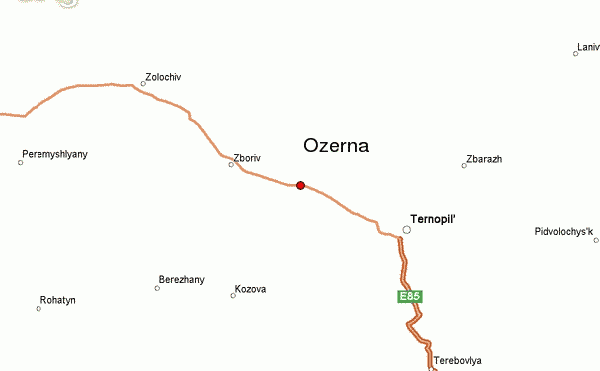
Ozerna is located 13 miles west of Ternopil" and 9 miles west of Zbirov
Ternopil' in relation to Ukraine and surrounding countries


The Kociuba family emigrated from the town of Ozerna, Ukraine, to the United States in the beginning of the 20th century.  They Americanized their surname, Kociuba to Koshuba when they settled in the United States. When they lived in Ozerna, it was part of the Austrian-Hungarian Empire and was known as Jezierna.
Ozerna is on the Vysuska River and Lake Vysuska.  The Vysuska is a tributary of the Strypa River, which flows into the Dniester, and eventually into the Black Sea. The population is about 3,000 today, but when the Koshubas lived there, around 1900 it was almost 5,000 people. Although I know quite a bit about the Koshuba family in Minnesota, I know very little about their life in Europe.  Feodor and Maria Koshuba had five children, three boys and two girls. Of the boys, the oldest was Joseph, born in 1885, John, born in 1891 and Stephen, born in 1899.  The girls included Tecla, the oldest child, born in 1883 and Anna, born in 1897.  Tecla married Peter Wons in 1903 in Ozerna. My grandmother told me that that there was another son, Michaylo, but I have found no information about him.
The Koshuba Family. Tecla, Maria, Anna, Joseph, Feodor, and John. This was probably taken around 1898, since Stephen, born in 1899 is not in the picture. Photo: collection of Ed Wons.

The town's strategic location, on a river and surrounded by mountains made it an attractive place for Polish lords to settle.  In 1545, Jan Tarnowski,  founder of Ternopil' took over the village located where Ozerna is today.  In 1615, it was purchased by Yakob Sobieski, father  of the future king of Poland, Jan Sobieski.  He built a castle on a mountain overlooking the town and in 1636, built a Roman Catholic Church.  In 1667, the Tartars destroyed the town, but it was rebuilt and thrived. Many members of the Sobieski family continued to lived there.

 I n 1772, Ozerna became part of the Austrian Empire in the first partition of Poland. It remained part of the Empire until 1918, when the Austrian Empire collapsed in 1919 after World War One.  The Western Ukrainian Republic ruled for a short time, and Ozerna became part of the new Republic of Poland in 1920, after the Polish-Ukrainian War, and the Polish-Soviet War.

During the 19th century, Ozerna was a transfer point.  Not only was it located on a river, it also was on the Ternopil'-Lviv railroad line and the Ternopil'-Lviv highway, near the intersection of the Kaiser-Strasse, a main highway.  There was a toll-gate at the entrance of the town, on the Ternopil (east) side of the  Vysuska River bridge, and all who crossed had to pay a toll before entering town.  This practice ended when World War One began.

The people living outside the town were farmers, growing grain potatoes, beets, flax, honey;  raising chickens and eggs, cattle, horses and pigs.  There were several grain mills and oil presses in town.  Most of the businesses in the town including the mills, were owned by Jews. The mills were located on tributaries of the River Vysuska.  In earlier times, the mills used a system called "own strength." The farmers brought in their grain, ground it themselves, and paid the miller for the use of his equipment. Later, hand work was replaced by machinery.  The oil presses extracted oil from hemp and flax seeds, both grown by local farmers.
Business men in town bought farm products from the peasants, resold them to major dealers, who consolidated the products and shipped them by train to the grain exchange in Lviv.  The streets around the train station were lined with warehouses. Ozerna had several markets; a general market, as well as horse, cattle and pig markets.

The town square was lined with retail businesses, small shops that sold everything, and larger ones that specialized in clothing, hats or shoes, dry and household goods. There were two bakeries with modern equipment to provide bread and baked goods to the population.  There was a Roman Catholic Church, a Greek(Ukrainian) Catholic Church and a synagogue. Since the Austrian government encouraged education,  there were two public elementary schools; one for the Jewish children, the Baron Hirsch School, and the other for the rest of the children in the community.  If students wanted to continue their education and attend high school, they traveled to Ternopil' by train, stayed there for the week and returned for the weekend.   In addition to public schools there were private and religious schools.  Four inns  provided food, drink and a place to stay the night.   The Brandy Inn was the place for the wealthy to meet.

According to my mother, the Koshuba family lived in the town, not outside on a farm. I do not know how the Koshuba family made their living in Ozerna.   They were comfortable enough to be able to afford family photographs.  Of all my Ukrainian ancestors, only the Koshubas could afford to have family portraits made in Europe. They also could afford to have their children attend school.  All the Koshuba children attended the public school, and were able to read and write when they came to the United States, according to immigration and census records. Tecla, Joseph and John completed the eighth grade of elementary school, Anna and Stephen completed 6th grade.

The Koshuba family, probably in 1903.  Standing from left: John, Anna, Joseph, Tecla, Stephen.  Seated from left: Maria, unknown girl, Feodor, Peter Wons.  Photo: collection of Ed. Wons. The boys are wearing embroidered Ukrainian shirts.
During the last years of the 19th century and the first years of the 20th, the population of Ozerna began to decline.  This was because many of the residents were immigrating to the United States or Canada.  The Koshuba  family was one of the families that decided to send their children to the United States.  Joseph left in 1904 at the age of 19. Tecla and Peter Wons left in 1906 with their two sons and settled in Massachussets. In 1908, John, 17,  joined them  in Massachusetts.   Anna and Stephen came together in 1914 and joined the family, now living in St Paul, Minnesota.  Moving to the United States worked out well for the Koshuba family.  The sons started their own businesses, their children were educated and several graduated university and became professionals. The daughters were successful, both married and their children were educated and successful as well.

A note on my sources:  I had a difficult time finding information about Ozerna.  Finally, on Jewish-Gen, a genealogy website, I found a Yizkor book from Ozerna,  This book was a compilation of memoirs from the Jewish people who lived in Ozerna who survived the Holocaust.  The book is called The Memorial Book of Jezierna, published in 1971. I found detailed descriptions of the town,  and how the people lived.