Thursday, July 3, 2014

The 100th Anniversary of Pauline Rychly’s Arrival in the United States.


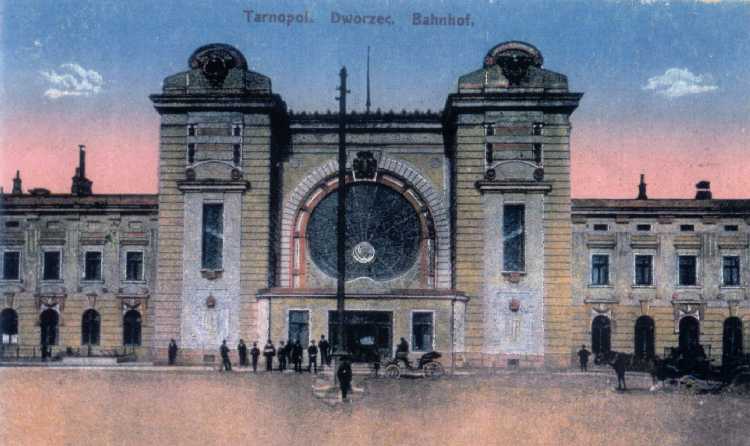
The Train Station in Ternopil', the beginning of my Grandmother's journey to the United States.


Tomorrow, the 4th of July, 2014 is the 100th anniversary of my grandmother, Pauline Rychly Koshuba Haykak’s arrival in Minneapolis, Minnesota.  She left her home in the village of Bila, just outside of the city of Ternopil’ (aka Tarnopol), in June 1914.  I am not sure of the exact date, but I do know that she left on the ship, The Kronprinz Wilhem, from Bremen Germany, on June 23, 1914, bound for New York City.   
 
The Kronprinz Wilhem, built in 1901, shortly after my Grandmother arrived in the US in 1914 it became a German warship.

According to the ship’s manifest, she was 14 years old.  She traveled with her Uncle and Aunt, Constantine and Maria Bilan Rychly and their young daughter, Anna.  All of her belongings were in a trunk, which for some reason, she kept for her entire life.  One of her grandsons has the trunk now.
The voyage was difficult for Pauline, since she was seasick for most of the time.  She was traveling on 3rd class tickets, commonly known as steerage, and was processed at Castle Garden, the old immigrant processing center, reopened because Ellis Island could not handle of the large number of ships arriving in New York.  Castle Garden is located near Battery Park and the terminal for the Staten Island Ferry in lower Manhattan. 
 
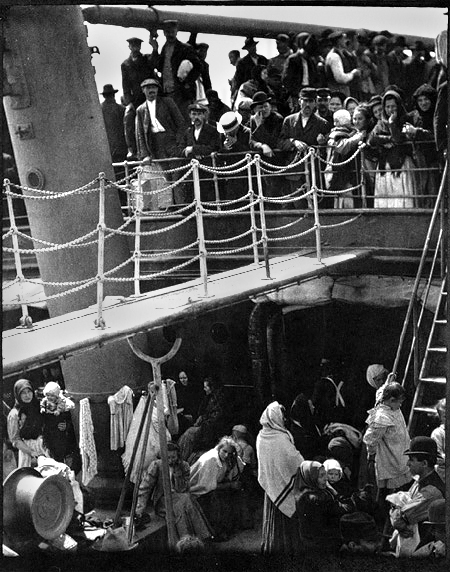
Photo by Alfred Stieglitz, Steerage class on a ship bound for Bremen, Germany is 1907

Castle Garden, where my Grandmother first stepped on American soil.


Passengers who had first or second class tickets were processed on board, and left from a dock near where the Verrazano Narrows Bridge is today.  Third class passengers were taken by ferry to Ellis Island, or Castle Garden for immigration processing.  If there were no problems, the immigrants took another ferry to the railroad station in New Jersey, where they continued the journey to their final destination.  Third class tickets for the trip from Europe to the United States big money makers for the shipping lines and railroads, and were often offered as package deals, costing about $25.  I have to mention that although the price of a trans-Atlantic ticket appears to be low, it took an average immigrant working in the United States at that time, about a year to save the money to buy a ticket for a relative in Europe. The shipping lines made no money on first or second class tickets, the profit was made on the third class tickets. 
 
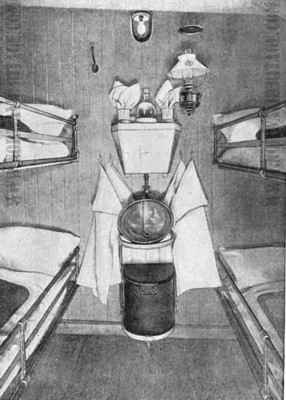
Four bunks in a steerage class cabin.

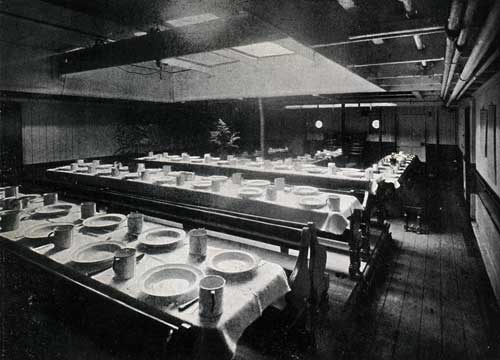
Third Class Dining Room on a Trans-Atlantic passenger ship

Accommodations on the voyage in third class were Spartan. The steerage section was in the front of the ship, which felt all the pitching and rolling.  Meals were included in the fare, but the food served was unfamiliar to many of the immigrants, so they didn’t eat it.  My great-aunt, Katherine remembers that she was served liverwurst sandwiches and ripe bananas, which she had never seen before.   The accommodations were basic, on the lower decks, travelers slept in bunk beds, which were sometimes in large rooms, sometimes in cabins. There were portholes in some of the cabins, but they didn’t open. Passengers spent the day walking on the deck.   There were no lounges or entertainment offered to immigrants. 

Ellis Island Train Station--after being processed, many immigrants boarded a train here for the trip to the West.
 
Inside a car on an immigrant train
Pauline’s sea voyage from Germany to New York took about nine days. My grandmother must have been on a slow train, because it took four days to go from New Jersey to Minneapolis. Often all the passengers on a train were immigrants, so the facilities on the trains were meager, especially if the train and ship were a package deal.

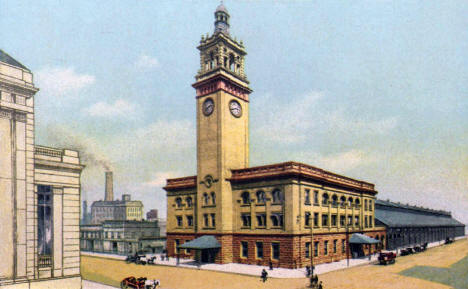
Milwaukee Station, Minneapolis MN.

On July 4th, Pauline, Constantine, Maria and Anna arrived in Minneapolis, and were met their family members.  Pauline’s father, Sylvester had been in the United States since 1908, and her sister Anna, since 1913.  Fourth of July fireworks made a big impression on Pauline, since she had never seen such a display.  Within a few days, she was working in the laundry at the Nicollet Hotel in downtown Minneapolis.


Gateway Park and the Nicollet Hotel where my Grandmother worked when she first came to Minneapolis


Pauline and Anna Rychly in 1915.  This is the oldest picture I have of my Grandmother.

Friday, June 27, 2014

June 28, 1914: “The Archduke is Assassinated!”

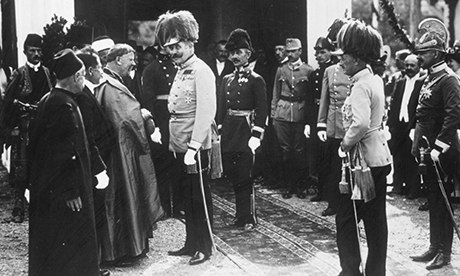
Archduke Franz Ferdinand of Austria-Hungary, being greeted by dignitaries in Sarajevo, June 28, 1914


June 28, 1914 was an ordinary Sunday in the village of Bila, just outside the eastern wall of the city of Ternopil.  The villagers attended church and ate dinner at home. They spent spring and summer afternoons outdoors, visiting with friends and enjoying the summer weather. Nobody had any idea how everyone’s lives would change because of what happened that Sunday morning in Sarajevo, Bosnia-Herzegovina. 

My great-aunt, Katherine Rychly was 10 years old in 1914. Her father, Sylvester, was in Minneapolis, Minnesota, working at a sugar company in order to save enough money to bring his family to the United States.  Katherine’s older sister Anna was newly married and living in Minneapolis. Katherine's other older sister, my grandmother, Paranka (Pauline), had left Bila a few days earlier,  and sailed from Bremen, Germany, on June 23, arriving in New York on July 1, 1914.  Katherine, Anna and Paranka wouldn’t see each other again until 1922.

Map of the Austria-Hungary Empire, showing Bosnia - Herzegovina and the city of Sarajevo


Sarajevo, Bosnia, was located in a province of the Austria-Hungary Empire, added in 1908, after being occupied by the Austrians since 1878.  The province had a mixed population of Serbs, Croats, Muslims and other ethnic groups.  The annexation of Bosnia-Herzegovina by Austria-Hungary was unpopular with its people. I have heard from family stories that my paternal grandfather, John Nyznyk, was a soldier in the Austrian army, stationed in Bosnia-Herzegovina, and he said that there were a lot of problems there.  After the Balkan war of 1912-1913, the neighboring country of Serbia gained territory and power, and growing Serbian nationalism encouraged the Serbs to do something about the status of Bosnia and Herzegovina. 


June 28 is an important day to the Serbians, St Vitus’s Day, the day when, in 1389, the Ottoman Turks destroyed the Serbian Army on the Field of Blackbirds—today known as Kosovo, and ended the Serbian Empire.  The Serbian lands and people became part of the Ottoman Empire.  The visit of the Archduke, Franz Ferdinand to Sarajevo on June 28 was considered an insult to the Serbs.   Austrian authorities were warned that the Archduke’s visit wasn’t a good idea, but nobody took these threats seriously.  Seven young Serbian men volunteered to assassinate the Archduke and his wife. They were members of a secret Serbian nationalist society, The Black Hand. 
Archduke Franz Ferdinand arriving in Sarajevo on the morning of June 28, 1914

 
The Archduke and the Duchess Sophie leaving the train station for the ride to City Hall


On Sunday morning, June 28, the Archduke and his wife, the Duchess Sophie, arrived at the Sarajevo train station. There was a six car motorcade waiting, full of Austrian and local dignitaries.  Their first destination was the Sarajevo City Hall, with other stops scheduled later.

The Archduke and the Duchess were in the second car, open so the crowds could see them, along with the Governor of Bosnia and another person. There was no security along the route, normally soldiers line the streets when important dignitaries such as the Archduke visited. The chosen route, Appel Quay runs along the Miljacka River.  Two cells of Serbian terrorists were stationed along the Quay. To insure its success, seven men were assigned to the plot.  Each one had small bomb strapped to his waist, a revolver and a packet of cyanide in his pocket.


The first assassin lost his nerve and did not throw his bomb.  As the second assassin detonated his bomb, it made a noise similar to a blown tire, which alerted people in the motorcade.  The bomb was thrown just as the driver stepped on the gas.  The Archduke batted the bomb away, and it exploded under the third car, injuring several people. The second assassin swallowed the cyanide and jumped over the wall and into the river.  His suicide attempt was unsuccessful, and he was easily captured. 

The motorcade was stopped so the wounded could be attended to, and the proceeded to the Town Hall. 
The third, fourth and fifth assassins lost their confidence and did nothing.

The Archduke and Duchess minutes before the assassination


The Motorcade arrived at the Town Hall, the planned speeches continued after the Archduke expressed his unhappiness with the “welcome” he received.  It was decided to cancel the rest of the day’s activities, however, the Archduke wanted to visit the wounded at the hospital.  Nobody thought to tell the drivers of the changed plans, so when the parties arrived at the cars, the procession went ahead with the original route.  Someone in the Archduke’s party shouted that they were driving in the wrong direction, so the cars stopped.  Since the Archduke’s car did not have a reverse gear, the car had to be pushed backwards to Franz Joseph Street.  

Map of the Archdukes's route.  The green arrows show the trip from the train station to the City Hall.  The yellow star is the first bomb.  The  broken red arrows show the new route from the City Hall to the Hospital.  The red star is the place of the Assassination


The sixth assassin, Gavrilo Princip, saw that the car stopped and ran toward it.  He untied the bomb, but decided to use his revolver.  The first bullet hit the Duchess in the stomach.  The second shot hit the Archduke in the neck.  Both died quickly, by the time the car arrived at the hospital, both were dead.  It was 11 o’clock in the morning.

 
Newspaper depiction of the assassination.  Duchess Sophie was shot in the stomach, the Archduke  was shot in the neck.


The next day, newspaper headlines around the world told the story, but nobody as any idea  how far reaching the consequences of the assassination would be.  Many people remembered for years, exactly what they were doing when they heard the news of the assassination, the effect was similar to how people felt when they heard about the Attack on Pearl Harbor, the Assassination of President Kennedy or 9/11.


The arrest of the assassin, Gavrilo Princip.

Friday, June 20, 2014

Genealogy Mysteries: Finding Fred Koshuba

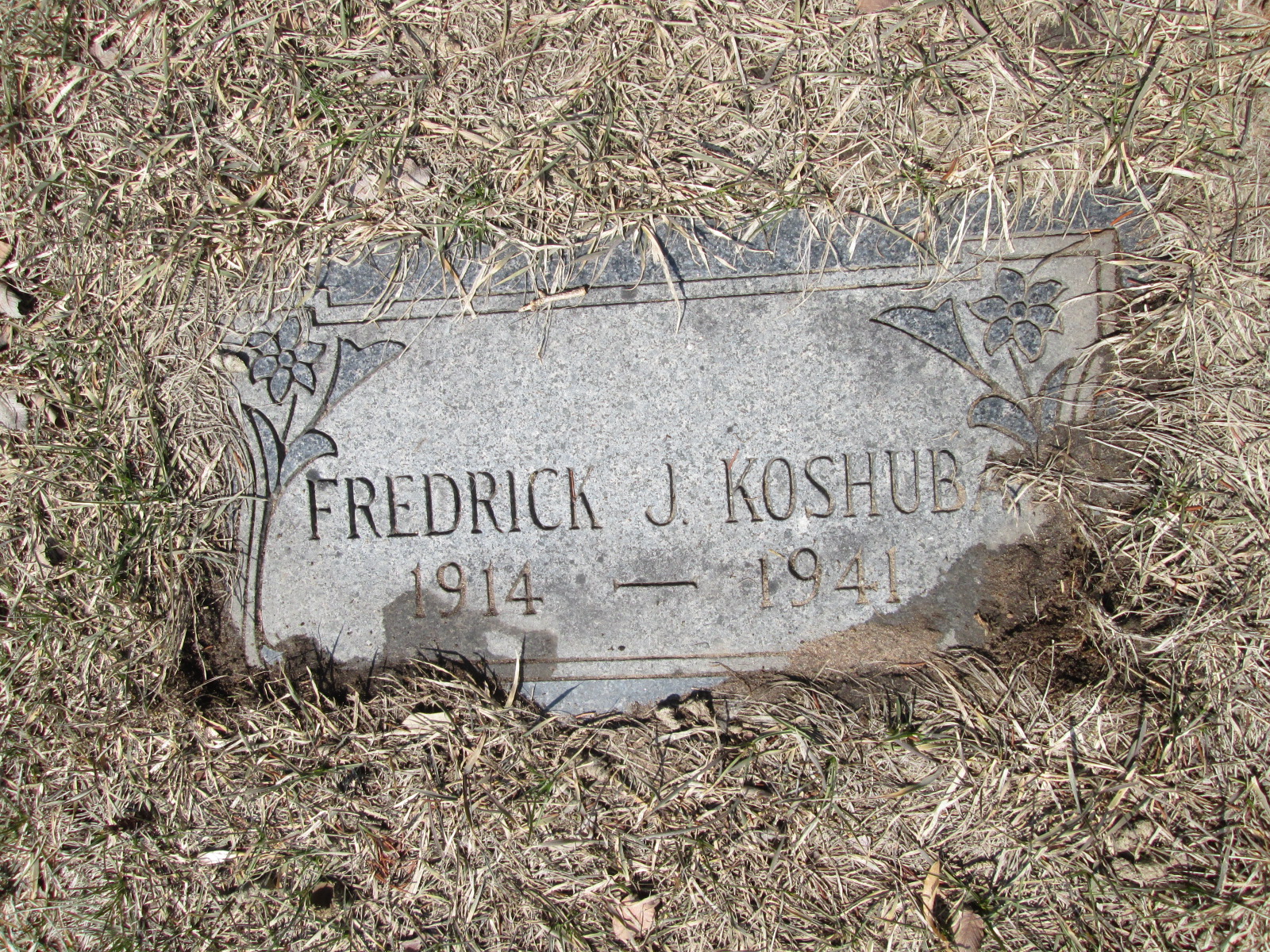
Fred Koshuba's Grave in Forest Lawn Cemetery, Maplewood, MN


One of the first genealogy projects I worked on is a family tree for the Koshuba Family  I have been interested in  putting together Fred Koshuba’s story, since my mother and uncle told me that he was a favorite cousin.   Since my mother’s family was estranged from Joseph Koshuba’s (Fred's father) family, finding information about them has not been easy. 


When doing genealogy research, you have to consider what do you know, what  you think may be correct and what may or may not be correct.  These are big questions when studying a person’s history. Remember, your information is only as good as your sources.


First of all, the facts in the list below are backed up by the 1920, 1930 and 1940 US Census and Fred’s Death Certificate.

·       Fredrick Koshuba was the son of Joseph Koshuba and Florence Florence Holmberg

·       He had two sisters, Katherine Florence and Marie Olga.

·       He was born on January 18, 1914 in St Paul Minnesota

·       He was living in Detroit, Michigan in 1941.

·       He died on December 8, 1941 in Dolton, Illinois, at the age of 27, and was buried in St Paul, Minnesota


Fred Koshuba, about 10 years old.

Fred Koshuba , 1934-5

The 1920 and 1930 US Census

The first place that I found solid information about Joseph Koshuba’s family was in the 1920 and 1930 United States Census.  Since Joseph died on January 1919, on the 1920 US Census, Florence is the head of the house, living at 886 Central, in St Paul, and is listed as the owner of the house. Her mother, Ida Holmberg and her brother, Julian lived with the family.  Fred was attending school.


In the 1930 US Census, The family had moved an apartment at 177 St Albans St, Saint Paul. Fred is working as a helper in a print shop, as well as going to school.  According to family information, Fred always worked, and the Census corroborates this. 

St Paul City Directories


From the years 1930-1940, the information about Fred  comes from St Paul City Directories, which list addresses and occupation information for residents of the city.  They are good sources, but not great ones, since I haven’t found a directory for every year, and sometimes the information doesn’t agree with what I already found.

Fred graduated high school in 1932. I assume that it was Central High School in St Paul, since Fred's sister graduated in 1934.  In the 1940 Census, his education is listed as 4 years of high school.  In the years following high school, Fred worked at various jobs including apprentice at the St Paul Dispatch-Pioneer Press newspaper.  In 1935, he worked as an assembler at the Ford Motor Company in St Paul.  In 1937, he is listed as working as a printer, but I’m not sure that this is accurate, since on the 1940 US Census, he is listed as living in Detroit in 1935.


The 1940 US Census


In the 1940 Census, Fred is living in Detroit, Michigan at 6436 Jonathan St.  All the information appears to be correct about Fred, his age, state of birth, but his name is spelled Kashuba.  However, the Koshuba name is spelled incorrectly more often than it is spelled correctly. Fred was boarding with a family, and had been living there for five years. His occupation is listed as line hand in an auto factory, which is consistent with his last occupation in St Paul.  The dates fit what is already known about Fred, except for two dates in the St Paul Directory for 1935 and 1937, so it is possible that the Census record may be for a different Fred Koshuba.  Both my mother and my Uncle Walter told me that Fred was working as a reporter for the Detroit Free Press, but I can find no sources to back this up.  This may just be one of those "facts" that were muddled by time.

The Report in the Dolton Pointer


The next information I have about Fred is his death.  My mother told me that Fred died in a car accident and that a Koshuba uncle was driving.  Family members from the Holmberg side of Fred’s family said that a Holmberg relative was driving.  This is when I searched for some additional sources.  I found a copy of his death certificate and an article about the accident in an Illinois newspaper. 

According to the Dolton, Illinois newspaper, The Pointer, Fred was killed and another man was seriously injured on Monday, December 8, 1941, the day after Pearl Harbor was attacked by the Japanese.

The accident occurred at Stoney Island Ave and Main Street in Dolton, IL, when a car, driven by C. Akerman (or Ankerman), was traveling west at a high speed on Main Street when he struck a culvert and his car overturned.  There is no mention of how Fred’s car was hit, but from the description, I am guessing that Fred was driving south on Stoney Island, and was hit at the intersection of Stoney Island and Main St.  When I checked Google Maps and Google Earth, I  found this intersection no longer exists; today, Main Street ends at the Bishop Ford Expressway. Fred suffered internal injuries and a crushed chest and was pronounced dead at Ingalls Memorial Hospital in Harvey, Illinois.  The other driver, Akerman, survived with serious injuries; several broken ribs, an injured spine and a possible skull fracture.  In my search, I contacted the Dolton Police and was told that accident reports are destroyed after 10 years.

Unanswered Question: Why was Fred in Dolton?


Why was Fred in Dolton, Illinois, when he lived in Detroit?  One of his nieces suggested that he may have been visiting her mother who was living at the time in Evanston, Illinois. He would have to travel south in order to get around the southern tip of Lake Michigan.  Stoney Island Ave, still a main thoroughfare on Chicago’s south side, now runs next to The Bishop Ford Expressway (Interstate 94).  Route 41, runs near the shore of Lake Michigan, and I94 follows the route of old Route 41.  It is possible that Fred was driving south on highway 41 on his way back to Michigan when he was hit.   

Unanswered Question: Was Fred Driving Alone? 

Since this was a serious accident, it is hard to imagine that a second person in Fred’s car could survive it with no injuries.  The article in The Pointer does not mention any other person in either car. I can find no sources to back up the family story that there was another person with Fred in his car. However, since it was mentioned by both the Holmberg and Koshuba families, there is a possibility that someone was with him and was not seriously injured in the accident.

Unanswered Question: Fred's Marriage


When and where did Fred get married?.  My mother never mentioned that Fred was married, and his nieces did not know this either. According to the death certificate, Fred was living at 1761 Seward Ave in Detroit, working at the Ford Motor Company as a payroll clerk. He was married to Charlotte. The address differs that the address shown on the 1940 US Census.  At the time of the Census, usually taken in the month of April, Fred was single.  He must have married sometime between April 1940 and December 1941.  However, I have found no other source for Fred’s marriage besides the Death Certificate.  I have found no evidence of Charlotte’s maiden name or of the date and place of the marriage.

So, I do not have all of Fred's story.  I will continue to work on it, because solving mysteries is one of the pleasures of genealogy.


Friday, June 13, 2014

Beautiful Brides! 106 Years of Family Weddings.

June is the traditional month for wedding, so to celebrate this beautiful month, I am sharing wedding pictures from my extended family.  The pictures are arranged by decade, the bride and groom (if he is in the picture) are identified.


1900-1919

 Morris Gerstein,  Sarah Schwartz, Chicago IL, 1907-08

 John Nyznyk, Marya Klak, New York NY, 1914.
 John Koshuba,  Pauline Rychley, Minneapolis MN, 1916


Joseph Graskow, Anna Koshuba, Minneapolis, 1918

1920-1929

Oleksa Pylatiuk, Katherine Rychley, Minneapolis, 1923


Stephen Koshuba, Helen Rychley, Minneapolis, MN 1924


1930-1939

Stephen Koshuba, Sally Popko , Minneapolis MN, 1930's


William Krause, Muriel Friedman, Buffalo NY, 1930's


Helen Tkacyk Rychley, Minneapolis MN, 1930's


1940-1949

Dave Gerstein and Lillian Krause, Chicago IL 1941


Julia Pylatiuk Lawryk, Minneapolis MN 1943


Jack Krause  and Evelyn Schwartz, Chicago IL, 1946


Julia Koshuba Noznick, Minneapolis MN, 1944


Sam Nemtzow and Charlotte Lieser, Chicago IL 1944


Mykola Haydak, Pauline Koshuba,  Minneapolis MN, 1943


Stephen and Eugenia Koshuba, 1940's

Walter Koshuba and Renella Waalund, Minneapolis MN, 1945


1950's

William Palaniuk and Evelyn Koshuba, Minneapolis MN, 1951


Friday, May 23, 2014

SHAVUOT: Spring Holidays in Eastern Europe


"Moses on Mount Sinai". Painting by Jean-Leon Jerome, 1895-1900.


Shavuot is the commemoration of Moses receiving the Ten Commandments from God on Mount Sinai, and the acceptance of the Law by the Jewish people. It occurrs  seven weeks after Passover, counting from the second day.
Shavuot is also one of the three ancient Jewish pilgrimage holidays, Passover, Shavuot and Sukkot, when Jews in Israel were required to travel to Jerusalem and to offerings to the Temple.  The offerings brought on were the first fruits of the land, which in ancient Israel was barley, which was ready to harvest in the spring.


"Shavuot" Painting by Moritz David Oppenheim 1880.


Since Shavuot has a strong agricultural base, The Jews of Eastern Europe decorated their homes and the Synagogue with garlands, flowers and greenery. The greenery was a reminder of the grass that the Jews stood on when Moses came down from Mount Sinai with the Ten Commandments. The holiday was celebrated in the Synagogue and in the home. Since the Jews were promised a “Land of milk and honey” by God, dairy products are served on Shavuot.  Orthodox Jews in Eastern Europe observed Shavuot for two days.  On the first day, only dairy foods were eaten, which included many dishes made with cheese. Cheese filled kreplach, (dumplings) made in triangle shapes were served on the first night of Shavuot.

Triangle shaped Kreplach for Shavuot
A dinner which included meat was served on the second day.  Two loaves of challah were baked, one long one with a braided dough ladder on the top, and one round.

 
A "Seven Heavens" Challah for Shavuot


Ladder Challah for Shavuot

In Eastern Europe, young children between the ages of three and five, began their study of the Torah during Shavuot.  They were given honey, cake and candy so they would associate Torah study with sweetness and joy.

Paper cut  for  Shavuot showing the Ten Commandments and the Torah by Stephen Funk


Another interesting custom that developed around Shavuot was the making of paper cuts called Shavuoslekh (little Shavuot) or roiselekh (little roses).  These were elaborate designs made from paper cut in intricate designs.  This custom was practiced primarily in Ukraine and Lithuania: in Galicia and Bukovina in Ukraine, and in neighboring areas of Poland and Russia.  The designs were floral, or traditional Jewish motifs.

Modern Paper Cut by Israeli artist Yehudit Shadur

Shavuot begins on June 3, 2014.


Sources:
     Jewish Life: Shavuot in the Community.  The Jewish Federation of North America. MyJewishLearning.com: Shavuot in the Community.
     Jewish Life: Shavuot at Home. The Jewish Federation of North American, MyJewishLearning.com: Shavuot at Home.
     Ross, Lesli Koppleman. Shavuot Decorations. MyJewishLearning.com, The Jewish Federation of North America.


Friday, May 16, 2014

Greetings! from the 1940's.

No email? No Twitter, no Facebook?  Communicating  with people outside your own community wasn't as easy in the 1940's as it is today.  Of course, there was the telephone, but long distance was very expensive and people used it only for very important calls.  Western Union Telegrams were fast, but also expensive--and the arrival of a telegram usually meant some serious news was being delivered.  What people used was the US mail and the letter and its "little brother" the picture postcard. It only cost a penny to send a postcard and 3 cents to mail a letter.  It was a reliable and fairly quick way to get news to you family and friends who lived far away. 


Put the postcard into an envelope, and you had a short letter and a nice picture too.The pictures appear to be originally black and and white, with color applied later in the printing process.
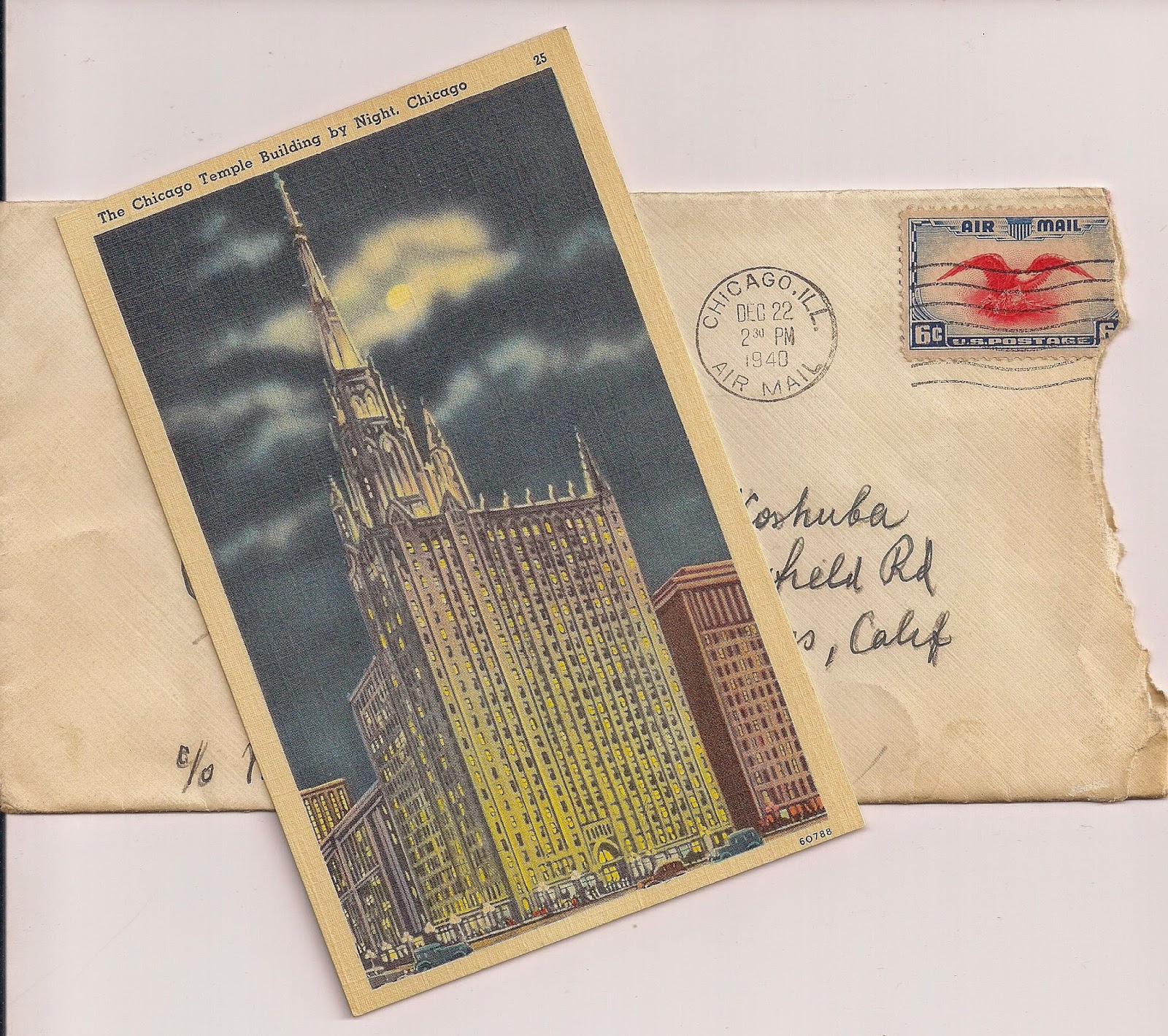
This is The Chicago Temple, a church on the top of a skyscraper.


Independence Hall in Philadelphia, Pennsylvania, where the Declaration of Independence was signed in 1776 and the United States Constitution was written and signed in 1787. 


The Rand Tower in Minneapolis, Minnesota.


The Trojan, mascot of the University of Southern California in Los Angeles.

San Juan Capistrano Mission in California


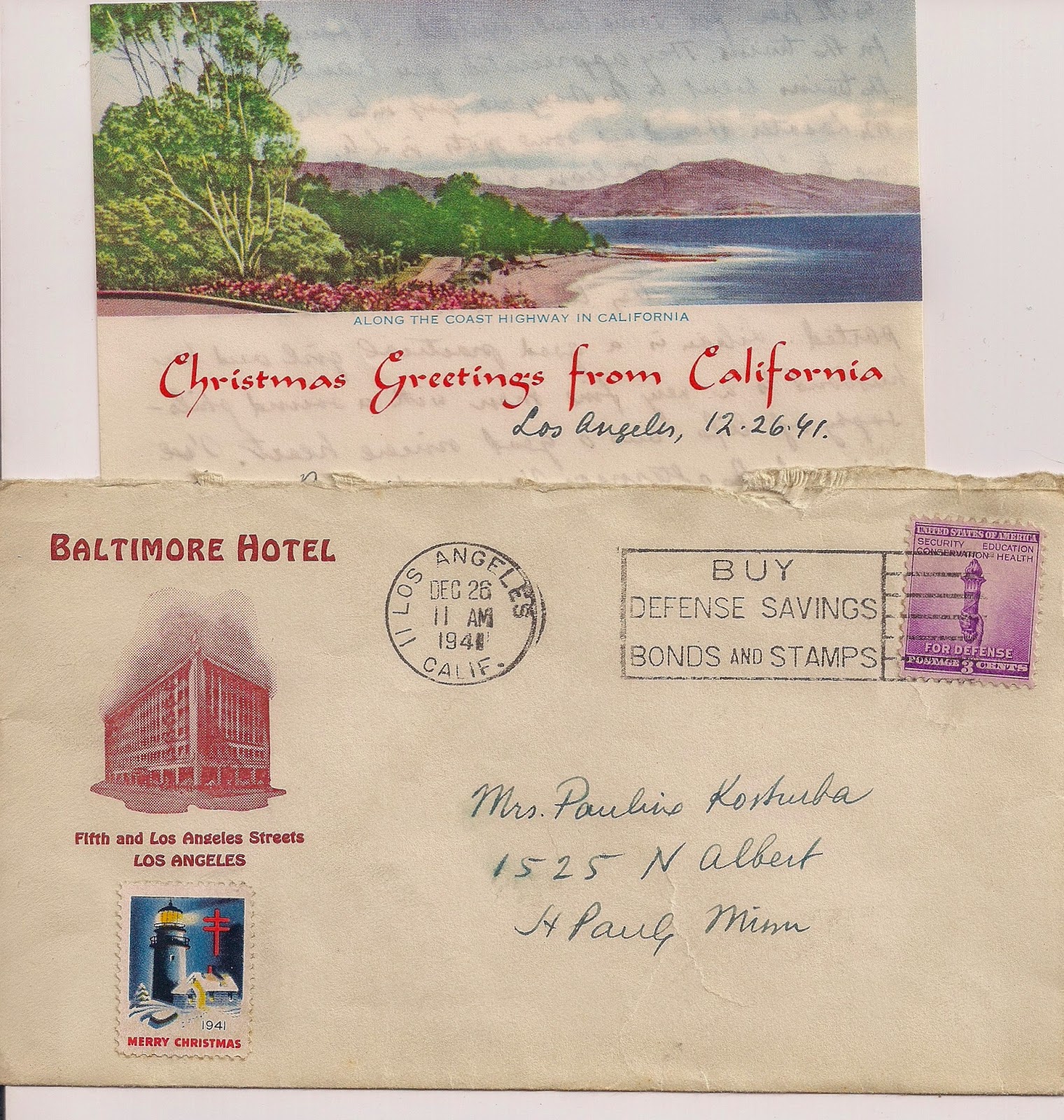
A letter from California--with a Christmas Seal from the March of Dimes on the envelope.
Golden Gate Park and Lombard Street in San Francisco


A birthday telegram delivered to my grandmother  by Western Union.