 |
| Pysanky from the collection of the Ukrainian Museum of New York |
How do pysanky link the past with the present? Each pysanka is a work of art, created by a person for a reason. For many, it is to connect with their Ukrainian heritage, for others, it is to create a gift for family or friends, others make pysanky for fun and profit, or to sell for church fundraisers.
Every pysanka tells a story, and the symbols commemorate an ancient heritage that existed before Christianity was brought to Ukraine by Volodymyr, ruler of Kiev in the tenth century. The eggs above, from the Ukrainian Museum of New York, illustrate the many symbols used in Ukrainian pysanky.
The pysanky below are from my own collection, unless noted. Most were made by either my mother, my grandmother and my aunts, and members of St Michael's Ukrainian Orthodox church in Minneapolis. They were made between the 1930's and 1970's. Almost all of them are unsigned, and only a few are dated.
Scevemorphic Symbols
Scevemorphic symbols are items used in daily life in Ukraine. The most common are the sieve, which is a triangle or square filled with cross-hatching. It stands for plowed fields, something that was done in the spring. Other symbols are rakes and combs which signify the hope for a good harvest. The ladder represents prayers sent by the people to heaven.
 |
| The pysanka uses the rake cross and flower symbols. |
 |
| Triangles filled with crosshatching are sieves, representing plowed fields. |
Zoomorphic symbols
Zoomorphic symbols are animals, and each animal stands for a characteristic or idea. The animals are not realistic, they usually are stylized or simplified. Fish are a symbol of Jesus and Christianity. Birds, and bird eggs are symbols of spring and the rebirth of nature, they are also messengers from heaven. The deer is a sign of prosperity and long life. Two deer with a tree between them symbolizes the tree of life. Horses stand for strength, endurance, wealth and prosperity. They are also associated with the sun, pagan Ukraine, it was believed that horses pulled the carriage of the sun across the sky.
 |
| The ram, a common animal on pysanky,
indicates strength, leadership, dignity
and perseveranc. |
 |
| Deer on each side of a pine tree symbolizes the Tree of Life. It also has an eternity band symbolizing water, squares and diamonds. |
 |
| Deer combined with a cross, pagan and Christian symbols on the same pysanka. |
 | ||
| This pysanka may be the oldest in my collection. |
Plant and Flower Symbols
Plants are frequently used on pysanky, but are stylized. Plants symbolized spring and return of nature and the hope for a good harvest. The most common flowers painted are the daisy, sunflower, and carnation. The periwinkle flower is not used, only the leaves, which are shown as three or four leaves on a stem. The pussy willow, which are used in Ukraine instead of palms on Palm Sunday, is a very popular motif. Wheat and poppies are often used outside of Ukraine, but were not used on traditional pysanky. Many of the flowers are just generic flowers, no specific plant is depicted.
 |
| This pysanka shows a flower that resembles a poppy. |
 |
| Stylized flowers are used on this modern pysanka. |
 |
| Wheat is the main motif on the pysanka that also uses crosshatched squares. |
 | |
| This pysanka, painted by my mother in the 1940's, a band of stylized flowers which are connected to an eternity band. |
Eternity Bands
The eternity band is a line that never ends. It can also be shown as a wave, ribbon or meander. All three eggs below use a either the wave or the meander. Eternity bands symbolize that God/Jesus has no beginning or end. Before Christianity, eternity bands meant waves of water and immortality.
 | |
| A pysanka in the Trypillian style. The ancient Trypillians may have painted pysanky, but no examples have been found. These designs come from Trypillian pottery. |
 | ||||||
| This pysanka uses the meander pattern eternity band. |
 |
| A Trypillian style pysanka, with an eternity band. |
Geometric Symbols
Geometric symbols are used on most pysanky. They include triangles, diamonds, lines, dots and squares.
Triangles meant trinities like the air, water and fire, or the circle of life in prehistoric times. Diamonds signified knowledge, dots stood for seeds or bird's eggs, which were signs of spring and of nature coming alive after winter. In Christian Ukraine, triangles symbolized the Holy Trinity.
 |
| Squares and diamonds. |
 |
| Triangles are the main motif on this modern pysanka. |
 |
| Triangles and stars.The dots inside the triangles stand for seeds, a sign of spring and the rebirth of nature. |
 |
| Diamonds and stylized flowers, The eight pointed star represents the sun. |
Christian Symbols
Symbols on used on pysanka today carry Christian meanings, but most of them have pagan origins. Only the cross and the church are actual Christian symbols. The Greek cross is used most often, but some pysanka use the Ukrainian Orthodox Cross. The Greek Cross has two bars, which intersect, making all parts equal in length The eight sided star is often combined with the Greek cross.
 | ||||||
| The star and cross combination | . |
 |
| Fish, sieves and flowers are used as well as a wave eternity band. |
 |
| This eggs, painted, signed and dated by my grandmother, shows the Orthodox cross and the Easter greeting, Christ had Risen, written in Ukrainian. She was 76 years old when she painted this egg. |
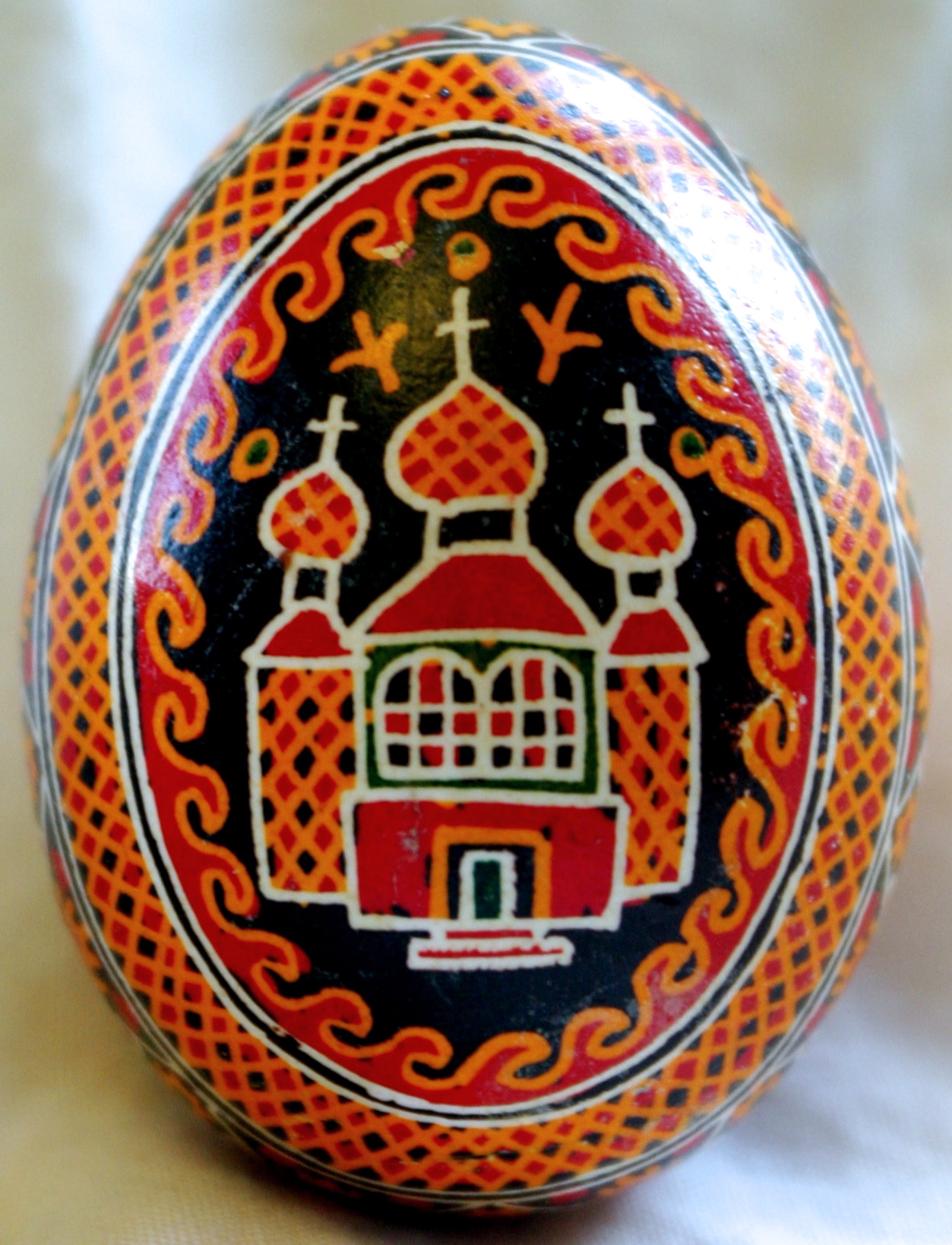 |
| A church in the Ukrainian style. Source: Wikipedia. |
Cosmological Symbols
The sun is ubiquitous on both traditional and modern pysanky. The sun is shown as a closed circle without rays. The eight sided star is also a symbol of the sun. It represented life and warmth in pagan times. To Christians is represents the love of God. The windmill or broken cross is also a sun symbol, showing the sun's progress across the sky.
 |
| Windmill pattern combined with plant motifs. |
 | ||
| Eight pointed star with small circles which | indicate seeds. |
 |
| Windmill pattern on the bottom of the pysanka. |
 |
| The eight pointed star is shown several ways on this pysanka. The small circles next to the points of the star may also be sun symbols. Plant motifs are also used. |

The pysanky in this picture illustrated the types of eggs commonly used.From left to right: a brown egg, a chicken egg, goose egg, pullet (young chicken) egg.
For more information click on the links below:


